

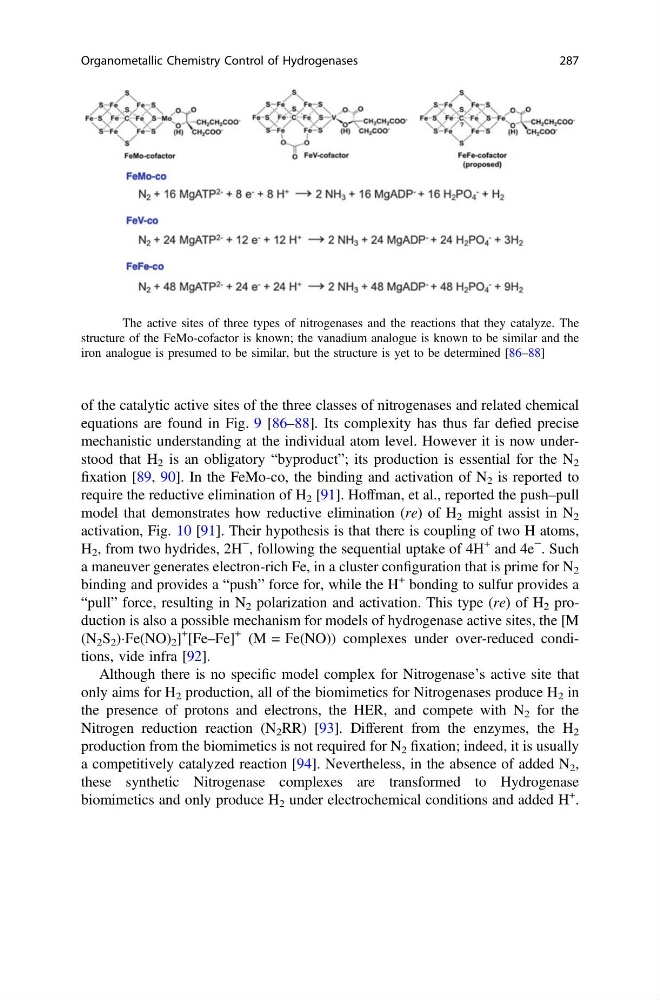
of the catalytic active sites of the three classes of nitrogenases and related chemical
equations are found in Fig. 9 [86–88]. Its complexity has thus far defied precise
mechanistic understanding at the individual atom level. However it is now understood that H 2 is an obligatory “byproduct”; its production is essential for the N 2
fixation [89, 90]. In the FeMo-co, the binding and activation of N 2 is reported to
require the reductive elimination of H 2 [91]. Hoffman, et al., reported the push–pull
model that demonstrates how reductive elimination (re) of H 2 might assist in N 2
activation, Fig. 10 [91]. Their hypothesis is that there is coupling of two H atoms,
H 2 , from two hydrides, 2H
− , following the sequential uptake of 4H
+ and 4e
− . Such
a maneuver generates electron-rich Fe, in a cluster configuration that is prime for N 2
binding and provides a “push” force for, while the H
+ bonding to sulfur provides a
“pull” force, resulting in N 2 polarization and activation. This type (re) of H 2 production is also a possible mechanism for models of hydrogenase active sites, the [M
(N 2 S 2 )ÁFe(NO) 2 ]
+
[Fe–Fe]
+ (M = Fe(NO)) complexes under over-reduced conditions, vide infra [92].
Although there is no specific model complex for Nitrogenase’s active site that
only aims for H 2 production, all of the biomimetics for Nitrogenases produce H 2 in
the presence of protons and electrons, the HER, and compete with N 2 for the
Nitrogen reduction reaction (N 2 RR) [93]. Different from the enzymes, the H 2
production from the biomimetics is not required for N 2 fixation; indeed, it is usually
a competitively catalyzed reaction [94]. Nevertheless, in the absence of added N 2 ,
these synthetic Nitrogenase complexes are transformed to Hydrogenase
biomimetics and only produce H 2 under electrochemical conditions and added H
+
.
Fig. 9 The active sites of three types of nitrogenases and the reactions that they catalyze. The
structure of the FeMo-cofactor is known; the vanadium analogue is known to be similar and the
iron analogue is presumed to be similar, but the structure is yet to be determined [86–88]
Organometallic Chemistry Control of Hydrogenases
287
equations are found in Fig. 9 [86–88]. Its complexity has thus far defied precise
mechanistic understanding at the individual atom level. However it is now understood that H 2 is an obligatory “byproduct”; its production is essential for the N 2
fixation [89, 90]. In the FeMo-co, the binding and activation of N 2 is reported to
require the reductive elimination of H 2 [91]. Hoffman, et al., reported the push–pull
model that demonstrates how reductive elimination (re) of H 2 might assist in N 2
activation, Fig. 10 [91]. Their hypothesis is that there is coupling of two H atoms,
H 2 , from two hydrides, 2H
− , following the sequential uptake of 4H
+ and 4e
− . Such
a maneuver generates electron-rich Fe, in a cluster configuration that is prime for N 2
binding and provides a “push” force for, while the H
+ bonding to sulfur provides a
“pull” force, resulting in N 2 polarization and activation. This type (re) of H 2 production is also a possible mechanism for models of hydrogenase active sites, the [M
(N 2 S 2 )ÁFe(NO) 2 ]
+
[Fe–Fe]
+ (M = Fe(NO)) complexes under over-reduced conditions, vide infra [92].
Although there is no specific model complex for Nitrogenase’s active site that
only aims for H 2 production, all of the biomimetics for Nitrogenases produce H 2 in
the presence of protons and electrons, the HER, and compete with N 2 for the
Nitrogen reduction reaction (N 2 RR) [93]. Different from the enzymes, the H 2
production from the biomimetics is not required for N 2 fixation; indeed, it is usually
a competitively catalyzed reaction [94]. Nevertheless, in the absence of added N 2 ,
these synthetic Nitrogenase complexes are transformed to Hydrogenase
biomimetics and only produce H 2 under electrochemical conditions and added H
+
.
Fig. 9 The active sites of three types of nitrogenases and the reactions that they catalyze. The
structure of the FeMo-cofactor is known; the vanadium analogue is known to be similar and the
iron analogue is presumed to be similar, but the structure is yet to be determined [86–88]
Organometallic Chemistry Control of Hydrogenases
287