

characteristics have inspired scientists from that time forward, most recently for the
possibility that their enzyme active sites might serve as potential templates for
sustainable molecular catalysts in electrolyzers (the water splitting reaction making
use of renewable energy sources of electrons and storing them in chemical bonds of
H 2 ) and fuel cells (hydrogen oxidation for on-demand electrons). This work has
continued for nearly a century and continues at ever more fundamental levels.
An occasional pause in efforts focused on discovery for reflection on the history
of a scientific pursuit that has occupied the attention of a broad range of experimentalists and theoreticians is a worthwhile exercise. Such efforts are particularly
engaging, and useful, for metalloenzymes where characterization of the relationship
of biological function to structure requires a small army of microbiologists, enzymologists, spectroscopists, crystallographers, and both synthetic and computational
chemists. In this particular case, a new cadre of chemists was called upon to account
for the decidedly organometallic-like components and function of the hydrogenase
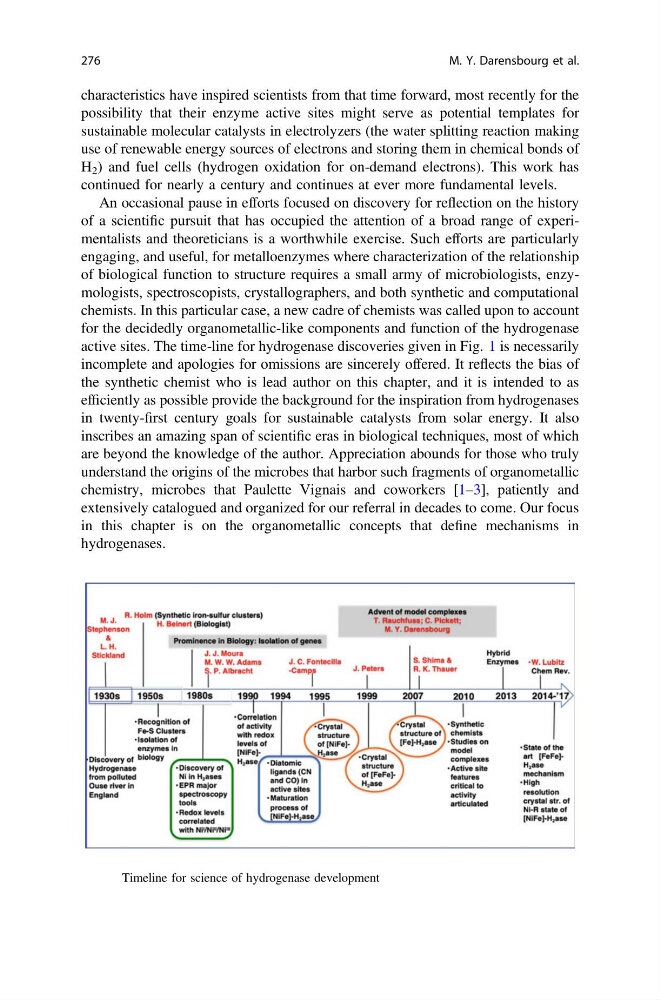
active sites. The time-line for hydrogenase discoveries given in Fig. 1 is necessarily
incomplete and apologies for omissions are sincerely offered. It reflects the bias of
the synthetic chemist who is lead author on this chapter, and it is intended to as
efficiently as possible provide the background for the inspiration from hydrogenases
in twenty-first century goals for sustainable catalysts from solar energy. It also
inscribes an amazing span of scientific eras in biological techniques, most of which
are beyond the knowledge of the author. Appreciation abounds for those who truly
understand the origins of the microbes that harbor such fragments of organometallic
chemistry, microbes that Paulette Vignais and coworkers [1–3], patiently and
extensively catalogued and organized for our referral in decades to come. Our focus
in this chapter is on the organometallic concepts that define mechanisms in
hydrogenases.
Fig. 1 Timeline for science of hydrogenase development
276
M. Y. Darensbourg et al.
possibility that their enzyme active sites might serve as potential templates for
sustainable molecular catalysts in electrolyzers (the water splitting reaction making
use of renewable energy sources of electrons and storing them in chemical bonds of
H 2 ) and fuel cells (hydrogen oxidation for on-demand electrons). This work has
continued for nearly a century and continues at ever more fundamental levels.
An occasional pause in efforts focused on discovery for reflection on the history
of a scientific pursuit that has occupied the attention of a broad range of experimentalists and theoreticians is a worthwhile exercise. Such efforts are particularly
engaging, and useful, for metalloenzymes where characterization of the relationship
of biological function to structure requires a small army of microbiologists, enzymologists, spectroscopists, crystallographers, and both synthetic and computational
chemists. In this particular case, a new cadre of chemists was called upon to account
for the decidedly organometallic-like components and function of the hydrogenase
active sites. The time-line for hydrogenase discoveries given in Fig. 1 is necessarily
incomplete and apologies for omissions are sincerely offered. It reflects the bias of
the synthetic chemist who is lead author on this chapter, and it is intended to as
efficiently as possible provide the background for the inspiration from hydrogenases
in twenty-first century goals for sustainable catalysts from solar energy. It also
inscribes an amazing span of scientific eras in biological techniques, most of which
are beyond the knowledge of the author. Appreciation abounds for those who truly
understand the origins of the microbes that harbor such fragments of organometallic
chemistry, microbes that Paulette Vignais and coworkers [1–3], patiently and
extensively catalogued and organized for our referral in decades to come. Our focus
in this chapter is on the organometallic concepts that define mechanisms in
hydrogenases.
Fig. 1 Timeline for science of hydrogenase development
276
M. Y. Darensbourg et al.