

4 Extracellular Electron Transfer (EET) Pathway
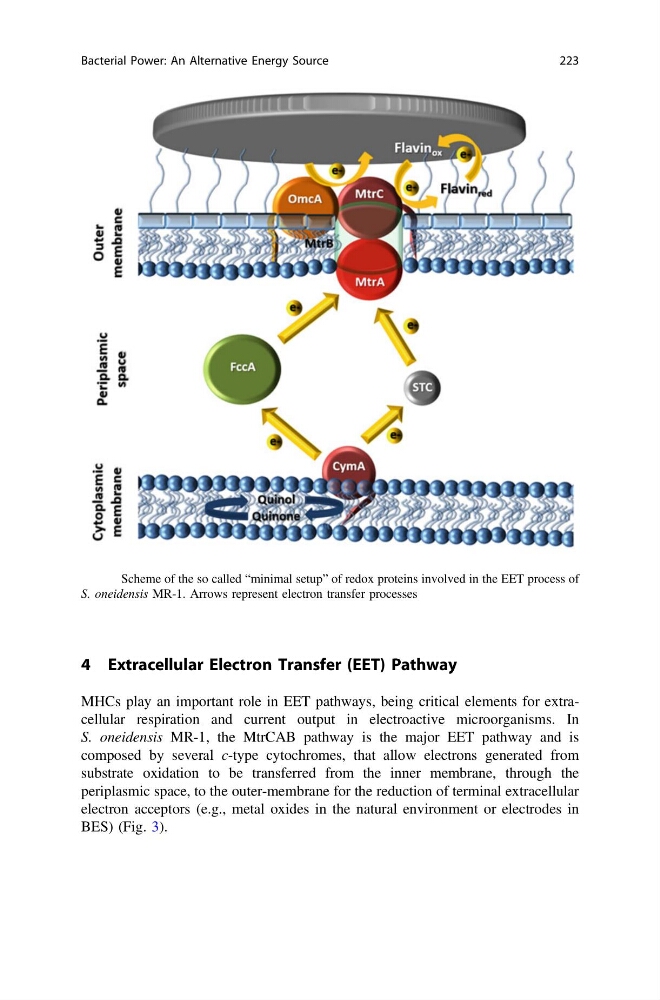
MHCs play an important role in EET pathways, being critical elements for extracellular respiration and current output in electroactive microorganisms. In
S. oneidensis MR-1, the MtrCAB pathway is the major EET pathway and is
composed by several c-type cytochromes, that allow electrons generated from
substrate oxidation to be transferred from the inner membrane, through the
periplasmic space, to the outer-membrane for the reduction of terminal extracellular
electron acceptors (e.g., metal oxides in the natural environment or electrodes in
BES) (Fig. 3).
Fig. 3 Scheme of the so called “minimal setup” of redox proteins involved in the EET process of
S. oneidensis MR-1. Arrows represent electron transfer processes
Bacterial Power: An Alternative Energy Source
223
MHCs play an important role in EET pathways, being critical elements for extracellular respiration and current output in electroactive microorganisms. In
S. oneidensis MR-1, the MtrCAB pathway is the major EET pathway and is
composed by several c-type cytochromes, that allow electrons generated from
substrate oxidation to be transferred from the inner membrane, through the
periplasmic space, to the outer-membrane for the reduction of terminal extracellular
electron acceptors (e.g., metal oxides in the natural environment or electrodes in
BES) (Fig. 3).
Fig. 3 Scheme of the so called “minimal setup” of redox proteins involved in the EET process of
S. oneidensis MR-1. Arrows represent electron transfer processes
Bacterial Power: An Alternative Energy Source
223