

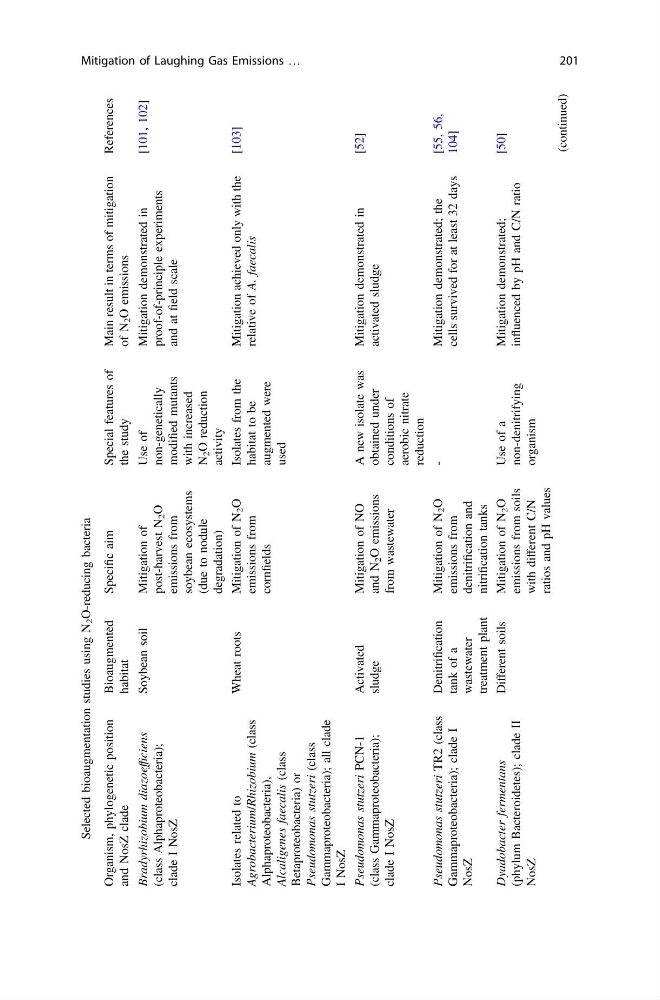
Table 3
Selected bioaugmentation studies using N
2 O-reducing bacteria
Organism, phylogenetic position
and NosZ clade
Bioaugmented
habitat
Specific aim
Special features of
the study
Main result in terms of mitigation
of N
2 O emissions
References
Bradyrhizobium diazoefficiens
(class Alphaproteobacteria);
clade I NosZ
Soybean soil
Mitigation of
post-harvest N
2 O
emissions from
soybean ecosystems
(due to nodule
degradation)
Use of
non-genetically
modified mutants
with increased
N
2 O reduction
activity
Mitigation demonstrated in
proof-of-principle experiments
and at
field scale
[101, 102]
Isolates related to
Agrobacterium/Rhizobium
(class
Alphaproteobacteria),
Alcaligenes faecalis
(class
Betaproteobacteria) or
Pseudomonas stutzeri
(class
Gammaproteobacteria); all clade
I NosZ
Wheat roots
Mitigation of N
2 O
emissions from
cornfields
Isolates from the
habitat to be
augmented were
used
Mitigation achieved only with the
relative of A. faecalis
[103]
Pseudomonas stutzeri
PCN-1
(class Gammaproteobacteria);
clade I NosZ
Activated
sludge
Mitigation of NO
and N
2 O emissions
from wastewater
A new isolate was
obtained under
conditions of
aerobic nitrate
reduction
Mitigation demonstrated in
activated sludge
[52]
Pseudomonas stutzeri
TR2 (class
Gammaproteobacteria); clade I
NosZ
Denitrification
tank of a
wastewater
treatment plant
Mitigation of N
2 O
emissions from
denitrification and
nitrification tanks
-
Mitigation demonstrated; the
cells survived for at least 32 days
[55, 56,
104]
Dyadobacter fermentans
(phylum Bacteroidetes); clade II
NosZ
Different soils
Mitigation of N
2 O
emissions from soils
with different C/N
ratios and pH values
Use of a
non-denitrifying
organism
Mitigation demonstrated;
influenced by pH and C/N ratio
[50]
(continued)
Mitigation of Laughing Gas Emissions …
201
Selected bioaugmentation studies using N
2 O-reducing bacteria
Organism, phylogenetic position
and NosZ clade
Bioaugmented
habitat
Specific aim
Special features of
the study
Main result in terms of mitigation
of N
2 O emissions
References
Bradyrhizobium diazoefficiens
(class Alphaproteobacteria);
clade I NosZ
Soybean soil
Mitigation of
post-harvest N
2 O
emissions from
soybean ecosystems
(due to nodule
degradation)
Use of
non-genetically
modified mutants
with increased
N
2 O reduction
activity
Mitigation demonstrated in
proof-of-principle experiments
and at
field scale
[101, 102]
Isolates related to
Agrobacterium/Rhizobium
(class
Alphaproteobacteria),
Alcaligenes faecalis
(class
Betaproteobacteria) or
Pseudomonas stutzeri
(class
Gammaproteobacteria); all clade
I NosZ
Wheat roots
Mitigation of N
2 O
emissions from
cornfields
Isolates from the
habitat to be
augmented were
used
Mitigation achieved only with the
relative of A. faecalis
[103]
Pseudomonas stutzeri
PCN-1
(class Gammaproteobacteria);
clade I NosZ
Activated
sludge
Mitigation of NO
and N
2 O emissions
from wastewater
A new isolate was
obtained under
conditions of
aerobic nitrate
reduction
Mitigation demonstrated in
activated sludge
[52]
Pseudomonas stutzeri
TR2 (class
Gammaproteobacteria); clade I
NosZ
Denitrification
tank of a
wastewater
treatment plant
Mitigation of N
2 O
emissions from
denitrification and
nitrification tanks
-
Mitigation demonstrated; the
cells survived for at least 32 days
[55, 56,
104]
Dyadobacter fermentans
(phylum Bacteroidetes); clade II
NosZ
Different soils
Mitigation of N
2 O
emissions from soils
with different C/N
ratios and pH values
Use of a
non-denitrifying
organism
Mitigation demonstrated;
influenced by pH and C/N ratio
[50]
(continued)
Mitigation of Laughing Gas Emissions …
201