

Genes encoding NosD, -Y, -F and -L are commonly found in clade I and clade II
NGCs (Fig. 2). NosD, -Y and -F possibly constitute a membrane-bound
ATP-binding cassette (ABC) transporter complex [69, 70, 76]. NosY is a
hydrophobic protein that is predicted to form six transmembrane segments and to
interact with the putative ATP-binding and -hydrolysing subunit NosF at the
cytoplasmic side of the membrane. NosD is a periplasmic protein thought to be
transported by the Sec system and to interact with NosY. It is unclear whether the
NosDYF complex acts as a transporter although an exporter function, presumably
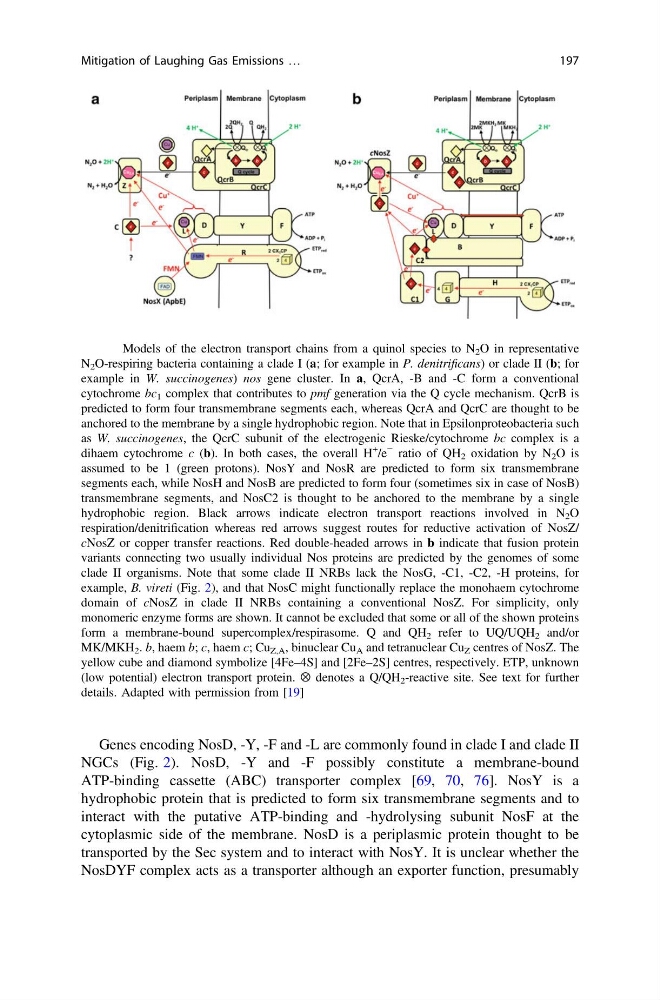
Fig. 3 Models of the electron transport chains from a quinol species to N 2 O in representative
N 2 O-respiring bacteria containing a clade I (a; for example in P. denitrificans) or clade II (b; for
example in W. succinogenes) nos gene cluster. In a, QcrA, -B and -C form a conventional
cytochrome bc 1 complex that contributes to pmf generation via the Q cycle mechanism. QcrB is
predicted to form four transmembrane segments each, whereas QcrA and QcrC are thought to be
anchored to the membrane by a single hydrophobic region. Note that in Epsilonproteobacteria such
as W. succinogenes, the QcrC subunit of the electrogenic Rieske/cytochrome bc complex is a
dihaem cytochrome c (b). In both cases, the overall H
+ /e
− ratio of QH 2 oxidation by N 2 O is
assumed to be 1 (green protons). NosY and NosR are predicted to form six transmembrane
segments each, while NosH and NosB are predicted to form four (sometimes six in case of NosB)
transmembrane segments, and NosC2 is thought to be anchored to the membrane by a single
hydrophobic region. Black arrows indicate electron transport reactions involved in N 2 O
respiration/denitrification whereas red arrows suggest routes for reductive activation of NosZ/
cNosZ or copper transfer reactions. Red double-headed arrows in b indicate that fusion protein
variants connecting two usually individual Nos proteins are predicted by the genomes of some
clade II organisms. Note that some clade II NRBs lack the NosG, -C1, -C2, -H proteins, for
example, B. vireti (Fig. 2), and that NosC might functionally replace the monohaem cytochrome
domain of cNosZ in clade II NRBs containing a conventional NosZ. For simplicity, only
monomeric enzyme forms are shown. It cannot be excluded that some or all of the shown proteins
form a membrane-bound supercomplex/respirasome. Q and QH 2 refer to UQ/UQH 2 and/or
MK/MKH 2 . b, haem b; c, haem c; Cu Z,A , binuclear Cu A and tetranuclear Cu Z centres of NosZ. The
yellow cube and diamond symbolize [4Fe–4S] and [2Fe–2S] centres, respectively. ETP, unknown
(low potential) electron transport protein. ⊗ denotes a Q/QH 2 -reactive site. See text for further
details. Adapted with permission from [19]
Mitigation of Laughing Gas Emissions …
197
NGCs (Fig. 2). NosD, -Y and -F possibly constitute a membrane-bound
ATP-binding cassette (ABC) transporter complex [69, 70, 76]. NosY is a
hydrophobic protein that is predicted to form six transmembrane segments and to
interact with the putative ATP-binding and -hydrolysing subunit NosF at the
cytoplasmic side of the membrane. NosD is a periplasmic protein thought to be
transported by the Sec system and to interact with NosY. It is unclear whether the
NosDYF complex acts as a transporter although an exporter function, presumably
Fig. 3 Models of the electron transport chains from a quinol species to N 2 O in representative
N 2 O-respiring bacteria containing a clade I (a; for example in P. denitrificans) or clade II (b; for
example in W. succinogenes) nos gene cluster. In a, QcrA, -B and -C form a conventional
cytochrome bc 1 complex that contributes to pmf generation via the Q cycle mechanism. QcrB is
predicted to form four transmembrane segments each, whereas QcrA and QcrC are thought to be
anchored to the membrane by a single hydrophobic region. Note that in Epsilonproteobacteria such
as W. succinogenes, the QcrC subunit of the electrogenic Rieske/cytochrome bc complex is a
dihaem cytochrome c (b). In both cases, the overall H
+ /e
− ratio of QH 2 oxidation by N 2 O is
assumed to be 1 (green protons). NosY and NosR are predicted to form six transmembrane
segments each, while NosH and NosB are predicted to form four (sometimes six in case of NosB)
transmembrane segments, and NosC2 is thought to be anchored to the membrane by a single
hydrophobic region. Black arrows indicate electron transport reactions involved in N 2 O
respiration/denitrification whereas red arrows suggest routes for reductive activation of NosZ/
cNosZ or copper transfer reactions. Red double-headed arrows in b indicate that fusion protein
variants connecting two usually individual Nos proteins are predicted by the genomes of some
clade II organisms. Note that some clade II NRBs lack the NosG, -C1, -C2, -H proteins, for
example, B. vireti (Fig. 2), and that NosC might functionally replace the monohaem cytochrome
domain of cNosZ in clade II NRBs containing a conventional NosZ. For simplicity, only
monomeric enzyme forms are shown. It cannot be excluded that some or all of the shown proteins
form a membrane-bound supercomplex/respirasome. Q and QH 2 refer to UQ/UQH 2 and/or
MK/MKH 2 . b, haem b; c, haem c; Cu Z,A , binuclear Cu A and tetranuclear Cu Z centres of NosZ. The
yellow cube and diamond symbolize [4Fe–4S] and [2Fe–2S] centres, respectively. ETP, unknown
(low potential) electron transport protein. ⊗ denotes a Q/QH 2 -reactive site. See text for further
details. Adapted with permission from [19]
Mitigation of Laughing Gas Emissions …
197