

4 The Enzymatic Level, Part I: Members of the Nitrous
Oxide Reductase (NosZ) Family and Their Biogenesis
Nitrous oxide reductase catalyses the two-electron reduction of N 2 O to N 2 (Eq. 4)
and is located at the outer side of the cytoplasmic membrane (corresponding to the
periplasm in case of gram-negative bacteria) where it receives electrons from a
dedicated electron transport chain (see Sect. 5).
N 2 O þ 2e
À
þ 2H
þ
! N 2 þ H 2 O
ð4Þ
Some DNRA-performing bacteria (predominantly Epsilonproteobacteria) produce
a NosZ variant called cytochrome c N 2 O reductase (cNosZ), which harbours an
additional C-terminal monohaem cytochrome c domain that was proposed to function
as an electron entry point to the copper active site [16, 58, 59]. Genes encoding cNosZ
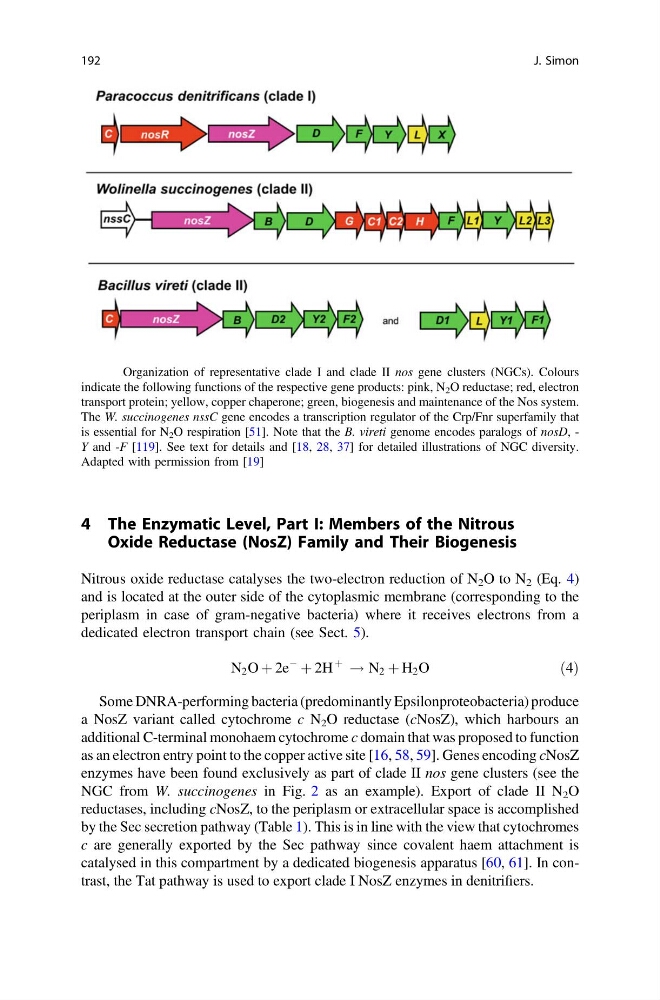
enzymes have been found exclusively as part of clade II nos gene clusters (see the
NGC from W. succinogenes in Fig. 2 as an example). Export of clade II N 2 O
reductases, including cNosZ, to the periplasm or extracellular space is accomplished
by the Sec secretion pathway (Table 1). This is in line with the view that cytochromes
c are generally exported by the Sec pathway since covalent haem attachment is
catalysed in this compartment by a dedicated biogenesis apparatus [60, 61]. In contrast, the Tat pathway is used to export clade I NosZ enzymes in denitrifiers.
Fig. 2 Organization of representative clade I and clade II nos gene clusters (NGCs). Colours
indicate the following functions of the respective gene products: pink, N 2 O reductase; red, electron
transport protein; yellow, copper chaperone; green, biogenesis and maintenance of the Nos system.
The W. succinogenes nssC gene encodes a transcription regulator of the Crp/Fnr superfamily that
is essential for N 2 O respiration [51]. Note that the B. vireti genome encodes paralogs of nosD, -
Y and -F [119]. See text for details and [18, 28, 37] for detailed illustrations of NGC diversity.
Adapted with permission from [19]
192
J. Simon
Oxide Reductase (NosZ) Family and Their Biogenesis
Nitrous oxide reductase catalyses the two-electron reduction of N 2 O to N 2 (Eq. 4)
and is located at the outer side of the cytoplasmic membrane (corresponding to the
periplasm in case of gram-negative bacteria) where it receives electrons from a
dedicated electron transport chain (see Sect. 5).
N 2 O þ 2e
À
þ 2H
þ
! N 2 þ H 2 O
ð4Þ
Some DNRA-performing bacteria (predominantly Epsilonproteobacteria) produce
a NosZ variant called cytochrome c N 2 O reductase (cNosZ), which harbours an
additional C-terminal monohaem cytochrome c domain that was proposed to function
as an electron entry point to the copper active site [16, 58, 59]. Genes encoding cNosZ
enzymes have been found exclusively as part of clade II nos gene clusters (see the
NGC from W. succinogenes in Fig. 2 as an example). Export of clade II N 2 O
reductases, including cNosZ, to the periplasm or extracellular space is accomplished
by the Sec secretion pathway (Table 1). This is in line with the view that cytochromes
c are generally exported by the Sec pathway since covalent haem attachment is
catalysed in this compartment by a dedicated biogenesis apparatus [60, 61]. In contrast, the Tat pathway is used to export clade I NosZ enzymes in denitrifiers.
Fig. 2 Organization of representative clade I and clade II nos gene clusters (NGCs). Colours
indicate the following functions of the respective gene products: pink, N 2 O reductase; red, electron
transport protein; yellow, copper chaperone; green, biogenesis and maintenance of the Nos system.
The W. succinogenes nssC gene encodes a transcription regulator of the Crp/Fnr superfamily that
is essential for N 2 O respiration [51]. Note that the B. vireti genome encodes paralogs of nosD, -
Y and -F [119]. See text for details and [18, 28, 37] for detailed illustrations of NGC diversity.
Adapted with permission from [19]
192
J. Simon