

performing either denitrification or DNRA are capable to convert nitrate to N 2 O
[18]. However, the contribution of each of these pathways (let alone of individual
species) to the release of N 2 O from natural microbial communities has not been
elucidated and is thought to depend on several abiotic factors such as carbon and
oxygenation status, carbon-to-nitrogen ratio, pH and supply of nitrate, nitrite or
bioavailable copper ions [20, 27–29]. The denitrification pathway releases intermediate N 2 O when these environmental constraints or the absence of an intact N 2 O
reductase prevent N 2 O reduction to N 2 . On the other hand, the DNRA pathway is
thought to produce minor amounts of N 2 O as a by-product of the nitrate/nitrite
ammonification process, in which nitrite is reduced directly to ammonium by a
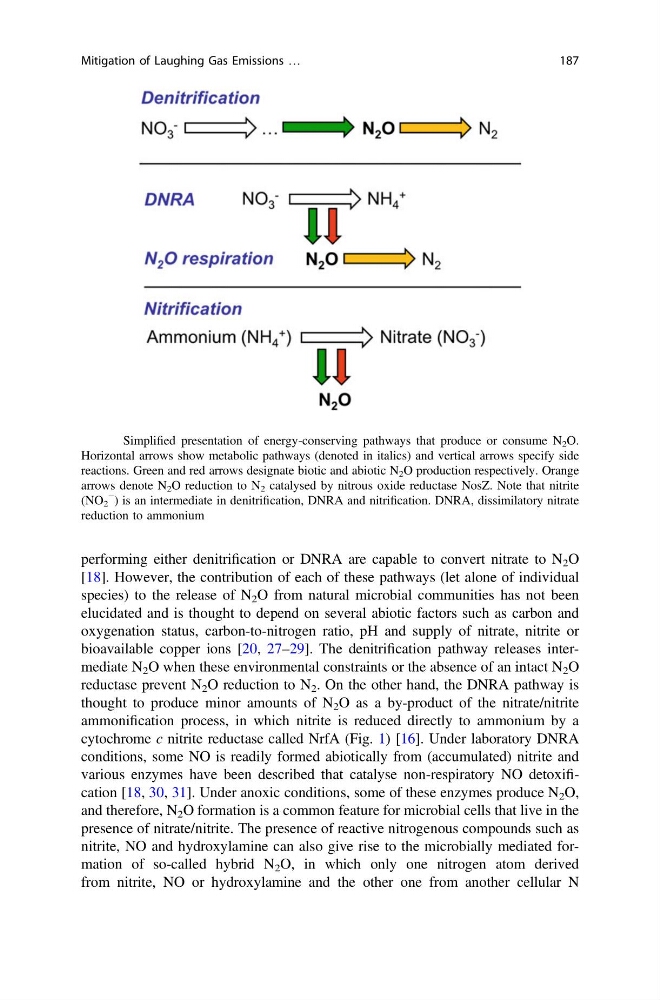
cytochrome c nitrite reductase called NrfA (Fig. 1) [16]. Under laboratory DNRA
conditions, some NO is readily formed abiotically from (accumulated) nitrite and
various enzymes have been described that catalyse non-respiratory NO detoxification [18, 30, 31]. Under anoxic conditions, some of these enzymes produce N 2 O,
and therefore, N 2 O formation is a common feature for microbial cells that live in the
presence of nitrate/nitrite. The presence of reactive nitrogenous compounds such as
nitrite, NO and hydroxylamine can also give rise to the microbially mediated formation of so-called hybrid N 2 O, in which only one nitrogen atom derived
from nitrite, NO or hydroxylamine and the other one from another cellular N
Fig. 1 Simplified presentation of energy-conserving pathways that produce or consume N 2 O.
Horizontal arrows show metabolic pathways (denoted in italics) and vertical arrows specify side
reactions. Green and red arrows designate biotic and abiotic N 2 O production respectively. Orange
arrows denote N 2 O reduction to N 2 catalysed by nitrous oxide reductase NosZ. Note that nitrite
(NO 2
−
) is an intermediate in denitrification, DNRA and nitrification. DNRA, dissimilatory nitrate
reduction to ammonium
Mitigation of Laughing Gas Emissions …
187
[18]. However, the contribution of each of these pathways (let alone of individual
species) to the release of N 2 O from natural microbial communities has not been
elucidated and is thought to depend on several abiotic factors such as carbon and
oxygenation status, carbon-to-nitrogen ratio, pH and supply of nitrate, nitrite or
bioavailable copper ions [20, 27–29]. The denitrification pathway releases intermediate N 2 O when these environmental constraints or the absence of an intact N 2 O
reductase prevent N 2 O reduction to N 2 . On the other hand, the DNRA pathway is
thought to produce minor amounts of N 2 O as a by-product of the nitrate/nitrite
ammonification process, in which nitrite is reduced directly to ammonium by a
cytochrome c nitrite reductase called NrfA (Fig. 1) [16]. Under laboratory DNRA
conditions, some NO is readily formed abiotically from (accumulated) nitrite and
various enzymes have been described that catalyse non-respiratory NO detoxification [18, 30, 31]. Under anoxic conditions, some of these enzymes produce N 2 O,
and therefore, N 2 O formation is a common feature for microbial cells that live in the
presence of nitrate/nitrite. The presence of reactive nitrogenous compounds such as
nitrite, NO and hydroxylamine can also give rise to the microbially mediated formation of so-called hybrid N 2 O, in which only one nitrogen atom derived
from nitrite, NO or hydroxylamine and the other one from another cellular N
Fig. 1 Simplified presentation of energy-conserving pathways that produce or consume N 2 O.
Horizontal arrows show metabolic pathways (denoted in italics) and vertical arrows specify side
reactions. Green and red arrows designate biotic and abiotic N 2 O production respectively. Orange
arrows denote N 2 O reduction to N 2 catalysed by nitrous oxide reductase NosZ. Note that nitrite
(NO 2
−
) is an intermediate in denitrification, DNRA and nitrification. DNRA, dissimilatory nitrate
reduction to ammonium
Mitigation of Laughing Gas Emissions …
187