

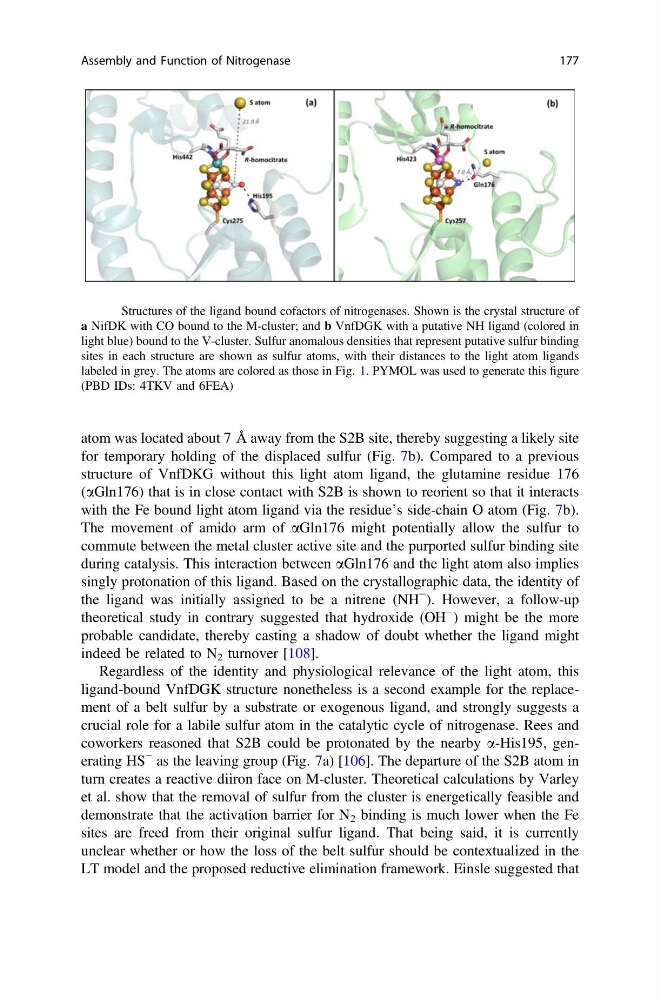
atom was located about 7 Å away from the S2B site, thereby suggesting a likely site
for temporary holding of the displaced sulfur (Fig. 7b). Compared to a previous
structure of VnfDKG without this light atom ligand, the glutamine residue 176
(aGln176) that is in close contact with S2B is shown to reorient so that it interacts
with the Fe bound light atom ligand via the residue’s side-chain O atom (Fig. 7b).
The movement of amido arm of aGln176 might potentially allow the sulfur to
commute between the metal cluster active site and the purported sulfur binding site
during catalysis. This interaction between aGln176 and the light atom also implies
singly protonation of this ligand. Based on the crystallographic data, the identity of
the ligand was initially assigned to be a nitrene (NH
− ). However, a follow-up
theoretical study in contrary suggested that hydroxide (OH
−
) might be the more
probable candidate, thereby casting a shadow of doubt whether the ligand might
indeed be related to N 2 turnover [108].
Regardless of the identity and physiological relevance of the light atom, this
ligand-bound VnfDGK structure nonetheless is a second example for the replacement of a belt sulfur by a substrate or exogenous ligand, and strongly suggests a
crucial role for a labile sulfur atom in the catalytic cycle of nitrogenase. Rees and
coworkers reasoned that S2B could be protonated by the nearby a-His195, generating HS
− as the leaving group (Fig. 7a) [106]. The departure of the S2B atom in
turn creates a reactive diiron face on M-cluster. Theoretical calculations by Varley
et al. show that the removal of sulfur from the cluster is energetically feasible and
demonstrate that the activation barrier for N 2 binding is much lower when the Fe
sites are freed from their original sulfur ligand. That being said, it is currently
unclear whether or how the loss of the belt sulfur should be contextualized in the
LT model and the proposed reductive elimination framework. Einsle suggested that
Fig. 7 Structures of the ligand bound cofactors of nitrogenases. Shown is the crystal structure of
a NifDK with CO bound to the M-cluster; and b VnfDGK with a putative NH ligand (colored in
light blue) bound to the V-cluster. Sulfur anomalous densities that represent putative sulfur binding
sites in each structure are shown as sulfur atoms, with their distances to the light atom ligands
labeled in grey. The atoms are colored as those in Fig. 1. PYMOL was used to generate this figure
(PBD IDs: 4TKV and 6FEA)
Assembly and Function of Nitrogenase
177
for temporary holding of the displaced sulfur (Fig. 7b). Compared to a previous
structure of VnfDKG without this light atom ligand, the glutamine residue 176
(aGln176) that is in close contact with S2B is shown to reorient so that it interacts
with the Fe bound light atom ligand via the residue’s side-chain O atom (Fig. 7b).
The movement of amido arm of aGln176 might potentially allow the sulfur to
commute between the metal cluster active site and the purported sulfur binding site
during catalysis. This interaction between aGln176 and the light atom also implies
singly protonation of this ligand. Based on the crystallographic data, the identity of
the ligand was initially assigned to be a nitrene (NH
− ). However, a follow-up
theoretical study in contrary suggested that hydroxide (OH
−
) might be the more
probable candidate, thereby casting a shadow of doubt whether the ligand might
indeed be related to N 2 turnover [108].
Regardless of the identity and physiological relevance of the light atom, this
ligand-bound VnfDGK structure nonetheless is a second example for the replacement of a belt sulfur by a substrate or exogenous ligand, and strongly suggests a
crucial role for a labile sulfur atom in the catalytic cycle of nitrogenase. Rees and
coworkers reasoned that S2B could be protonated by the nearby a-His195, generating HS
− as the leaving group (Fig. 7a) [106]. The departure of the S2B atom in
turn creates a reactive diiron face on M-cluster. Theoretical calculations by Varley
et al. show that the removal of sulfur from the cluster is energetically feasible and
demonstrate that the activation barrier for N 2 binding is much lower when the Fe
sites are freed from their original sulfur ligand. That being said, it is currently
unclear whether or how the loss of the belt sulfur should be contextualized in the
LT model and the proposed reductive elimination framework. Einsle suggested that
Fig. 7 Structures of the ligand bound cofactors of nitrogenases. Shown is the crystal structure of
a NifDK with CO bound to the M-cluster; and b VnfDGK with a putative NH ligand (colored in
light blue) bound to the V-cluster. Sulfur anomalous densities that represent putative sulfur binding
sites in each structure are shown as sulfur atoms, with their distances to the light atom ligands
labeled in grey. The atoms are colored as those in Fig. 1. PYMOL was used to generate this figure
(PBD IDs: 4TKV and 6FEA)
Assembly and Function of Nitrogenase
177