

electrons more reduced than the E 0 ground state. Therefore, taken together it was
recognized that the intermediate represents E 4 [89]. This interpretation was further
supported by an annealing experiment, in which the warming of the freeze-trapped
intermediate led to the release of two equivalents of H 2 , thereby demonstrating the
accumulation of four electrons/protons on M-cluster [85–87, 89].
1,2 H,
57 Fe, and
95 Mo ENDOR experiments suggested that the spectroscopic features of this intermediate can be interpreted as an Fe-bound hydride fragment, plausibly in a l 2 -
bridging conformation (Fe–H–Fe) [85–87, 89, 90]. This finding led to the proposal
that the E 4 state of NifDK, which is represented by the freeze-trapped intermediate
mentioned above, is an M-cluster having two l 2 -hydride ligands bridged between
two different pairs of Fe atoms with two protons bound elsewhere on the cluster.
This proposed E 4 state, also termed E 4 (4H), then formed the basis for the reductive
elimination mechanism of N 2 binding. Its structure was further explored in recent
theoretical study, which suggests that the cleavage of an Fe-S bond, if not the entire
removal of the belt sulfur atom, is an energetically feasible reaction for the
M-cluster in the E 4 state [91, 92].
The binding of N 2 plausibly occurs via a reductive elimination mechanism. Insight
into N 2 binding was provided by Hoffman and co-workers who used freeze-quench
trapping to accumulate an intermediate species. Its presence was first noticed in an
aVal70 to aIle70 point mutant of NifDK (designated NifDK
Ile70 ) with impaired
ability to reduce all known substrates except protons, but which could later also be
identified in wild-type NifDK [88, 89]. For this intermediate, the presence of a
paramagnetic S = 1/2 EPR signal indicated that NifDK is in an even-numbered
state while kinetic analysis suggested that this intermediate is either three or four
electrons more reduced than the E 0 ground state. Therefore, taken together it was
recognized that the intermediate represents E 4 [89]. This interpretation was further
supported by an annealing experiment, in which the warming of the freeze-trapped
b
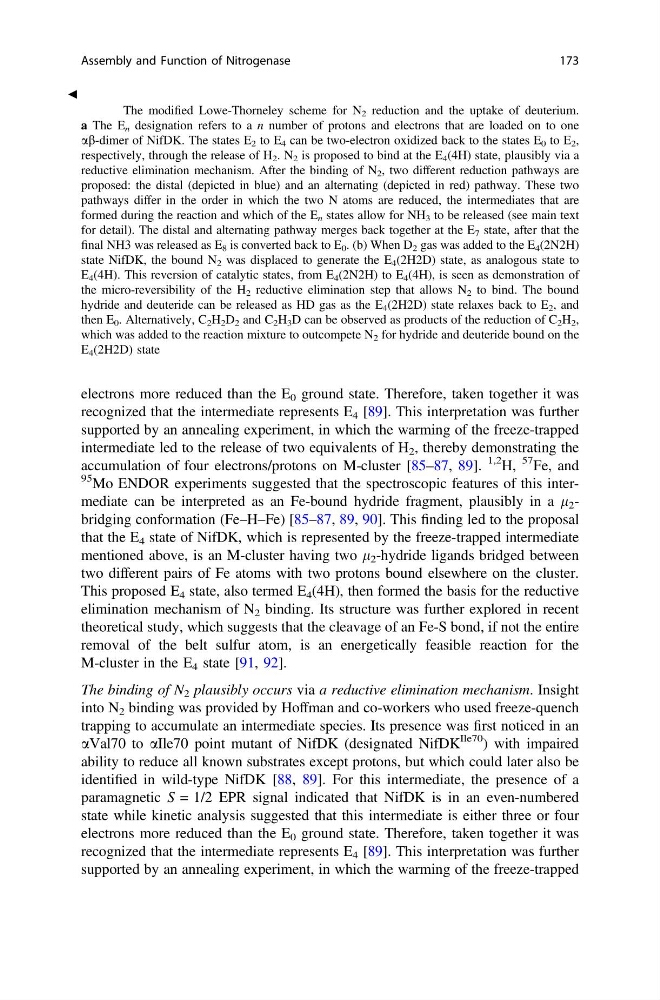
Fig. 6 The modified Lowe-Thorneley scheme for N 2 reduction and the uptake of deuterium.
a The E n designation refers to a n number of protons and electrons that are loaded on to one
ab-dimer of NifDK. The states E 2 to E 4 can be two-electron oxidized back to the states E 0 to E 2 ,
respectively, through the release of H 2 . N 2 is proposed to bind at the E 4 (4H) state, plausibly via a
reductive elimination mechanism. After the binding of N 2 , two different reduction pathways are
proposed: the distal (depicted in blue) and an alternating (depicted in red) pathway. These two
pathways differ in the order in which the two N atoms are reduced, the intermediates that are
formed during the reaction and which of the E n states allow for NH 3 to be released (see main text
for detail). The distal and alternating pathway merges back together at the E 7 state, after that the
final NH3 was released as E 8 is converted back to E 0 . (b) When D 2 gas was added to the E 4 (2N2H)
state NifDK, the bound N 2 was displaced to generate the E 4 (2H2D) state, as analogous state to
E 4 (4H). This reversion of catalytic states, from E 4 (2N2H) to E 4 (4H), is seen as demonstration of
the micro-reversibility of the H 2 reductive elimination step that allows N 2 to bind. The bound
hydride and deuteride can be released as HD gas as the E 4 (2H2D) state relaxes back to E 2 , and
then E 0 . Alternatively, C 2 H 2 D 2 and C 2 H 3 D can be observed as products of the reduction of C 2 H 2 ,
which was added to the reaction mixture to outcompete N 2 for hydride and deuteride bound on the
E 4 (2H2D) state
Assembly and Function of Nitrogenase
173
recognized that the intermediate represents E 4 [89]. This interpretation was further
supported by an annealing experiment, in which the warming of the freeze-trapped
intermediate led to the release of two equivalents of H 2 , thereby demonstrating the
accumulation of four electrons/protons on M-cluster [85–87, 89].
1,2 H,
57 Fe, and
95 Mo ENDOR experiments suggested that the spectroscopic features of this intermediate can be interpreted as an Fe-bound hydride fragment, plausibly in a l 2 -
bridging conformation (Fe–H–Fe) [85–87, 89, 90]. This finding led to the proposal
that the E 4 state of NifDK, which is represented by the freeze-trapped intermediate
mentioned above, is an M-cluster having two l 2 -hydride ligands bridged between
two different pairs of Fe atoms with two protons bound elsewhere on the cluster.
This proposed E 4 state, also termed E 4 (4H), then formed the basis for the reductive
elimination mechanism of N 2 binding. Its structure was further explored in recent
theoretical study, which suggests that the cleavage of an Fe-S bond, if not the entire
removal of the belt sulfur atom, is an energetically feasible reaction for the
M-cluster in the E 4 state [91, 92].
The binding of N 2 plausibly occurs via a reductive elimination mechanism. Insight
into N 2 binding was provided by Hoffman and co-workers who used freeze-quench
trapping to accumulate an intermediate species. Its presence was first noticed in an
aVal70 to aIle70 point mutant of NifDK (designated NifDK
Ile70 ) with impaired
ability to reduce all known substrates except protons, but which could later also be
identified in wild-type NifDK [88, 89]. For this intermediate, the presence of a
paramagnetic S = 1/2 EPR signal indicated that NifDK is in an even-numbered
state while kinetic analysis suggested that this intermediate is either three or four
electrons more reduced than the E 0 ground state. Therefore, taken together it was
recognized that the intermediate represents E 4 [89]. This interpretation was further
supported by an annealing experiment, in which the warming of the freeze-trapped
b
Fig. 6 The modified Lowe-Thorneley scheme for N 2 reduction and the uptake of deuterium.
a The E n designation refers to a n number of protons and electrons that are loaded on to one
ab-dimer of NifDK. The states E 2 to E 4 can be two-electron oxidized back to the states E 0 to E 2 ,
respectively, through the release of H 2 . N 2 is proposed to bind at the E 4 (4H) state, plausibly via a
reductive elimination mechanism. After the binding of N 2 , two different reduction pathways are
proposed: the distal (depicted in blue) and an alternating (depicted in red) pathway. These two
pathways differ in the order in which the two N atoms are reduced, the intermediates that are
formed during the reaction and which of the E n states allow for NH 3 to be released (see main text
for detail). The distal and alternating pathway merges back together at the E 7 state, after that the
final NH3 was released as E 8 is converted back to E 0 . (b) When D 2 gas was added to the E 4 (2N2H)
state NifDK, the bound N 2 was displaced to generate the E 4 (2H2D) state, as analogous state to
E 4 (4H). This reversion of catalytic states, from E 4 (2N2H) to E 4 (4H), is seen as demonstration of
the micro-reversibility of the H 2 reductive elimination step that allows N 2 to bind. The bound
hydride and deuteride can be released as HD gas as the E 4 (2H2D) state relaxes back to E 2 , and
then E 0 . Alternatively, C 2 H 2 D 2 and C 2 H 3 D can be observed as products of the reduction of C 2 H 2 ,
which was added to the reaction mixture to outcompete N 2 for hydride and deuteride bound on the
E 4 (2H2D) state
Assembly and Function of Nitrogenase
173