

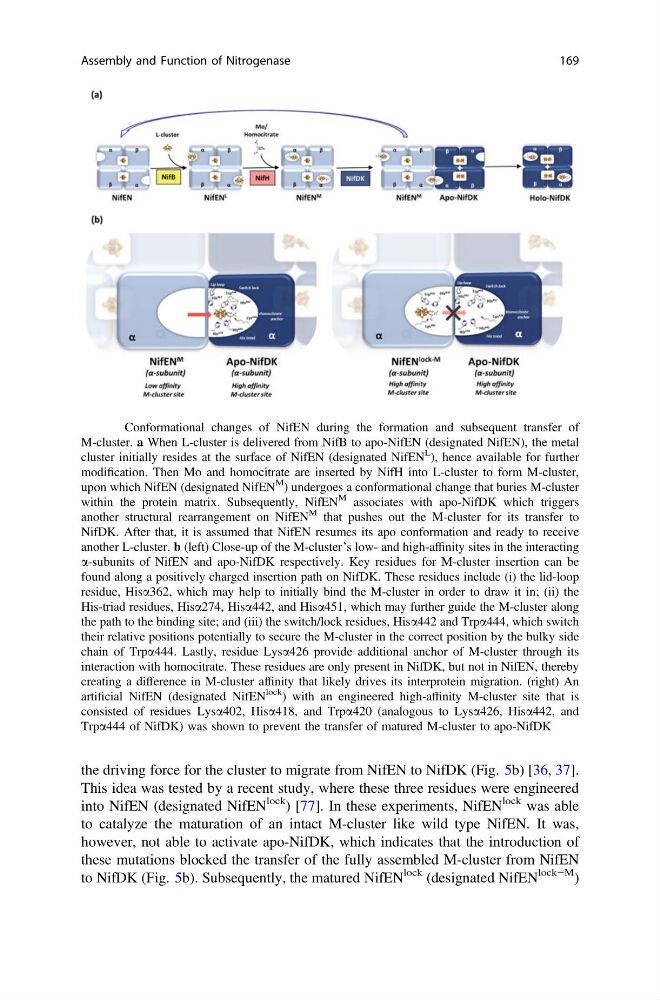
the driving force for the cluster to migrate from NifEN to NifDK (Fig. 5b) [36, 37].
This idea was tested by a recent study, where these three residues were engineered
into NifEN (designated NifEN
lock ) [77]. In these experiments, NifEN
lock was able
to catalyze the maturation of an intact M-cluster like wild type NifEN. It was,
however, not able to activate apo-NifDK, which indicates that the introduction of
these mutations blocked the transfer of the fully assembled M-cluster from NifEN
to NifDK (Fig. 5b). Subsequently, the matured NifEN
lock (designated NifEN
lock−M )
Fig. 5 Conformational changes of NifEN during the formation and subsequent transfer of
M-cluster. a When L-cluster is delivered from NifB to apo-NifEN (designated NifEN), the metal
cluster initially resides at the surface of NifEN (designated NifEN
L ), hence available for further
modification. Then Mo and homocitrate are inserted by NifH into L-cluster to form M-cluster,
upon which NifEN (designated NifEN
M
) undergoes a conformational change that buries M-cluster
within the protein matrix. Subsequently, NifEN
M associates with apo-NifDK which triggers
another structural rearrangement on NifEN
M that pushes out the M-cluster for its transfer to
NifDK. After that, it is assumed that NifEN resumes its apo conformation and ready to receive
another L-cluster. b (left) Close-up of the M-cluster’s low- and high-affinity sites in the interacting
a-subunits of NifEN and apo-NifDK respectively. Key residues for M-cluster insertion can be
found along a positively charged insertion path on NifDK. These residues include (i) the lid-loop
residue, Hisa362, which may help to initially bind the M-cluster in order to draw it in; (ii) the
His-triad residues, Hisa274, Hisa442, and Hisa451, which may further guide the M-cluster along
the path to the binding site; and (iii) the switch/lock residues, Hisa442 and Trpa444, which switch
their relative positions potentially to secure the M-cluster in the correct position by the bulky side
chain of Trpa444. Lastly, residue Lysa426 provide additional anchor of M-cluster through its
interaction with homocitrate. These residues are only present in NifDK, but not in NifEN, thereby
creating a difference in M-cluster affinity that likely drives its interprotein migration. (right) An
artificial NifEN (designated NifEN
lock ) with an engineered high-affinity M-cluster site that is
consisted of residues Lysa402, Hisa418, and Trpa420 (analogous to Lysa426, Hisa442, and
Trpa444 of NifDK) was shown to prevent the transfer of matured M-cluster to apo-NifDK
Assembly and Function of Nitrogenase
169
This idea was tested by a recent study, where these three residues were engineered
into NifEN (designated NifEN
lock ) [77]. In these experiments, NifEN
lock was able
to catalyze the maturation of an intact M-cluster like wild type NifEN. It was,
however, not able to activate apo-NifDK, which indicates that the introduction of
these mutations blocked the transfer of the fully assembled M-cluster from NifEN
to NifDK (Fig. 5b). Subsequently, the matured NifEN
lock (designated NifEN
lock−M )
Fig. 5 Conformational changes of NifEN during the formation and subsequent transfer of
M-cluster. a When L-cluster is delivered from NifB to apo-NifEN (designated NifEN), the metal
cluster initially resides at the surface of NifEN (designated NifEN
L ), hence available for further
modification. Then Mo and homocitrate are inserted by NifH into L-cluster to form M-cluster,
upon which NifEN (designated NifEN
M
) undergoes a conformational change that buries M-cluster
within the protein matrix. Subsequently, NifEN
M associates with apo-NifDK which triggers
another structural rearrangement on NifEN
M that pushes out the M-cluster for its transfer to
NifDK. After that, it is assumed that NifEN resumes its apo conformation and ready to receive
another L-cluster. b (left) Close-up of the M-cluster’s low- and high-affinity sites in the interacting
a-subunits of NifEN and apo-NifDK respectively. Key residues for M-cluster insertion can be
found along a positively charged insertion path on NifDK. These residues include (i) the lid-loop
residue, Hisa362, which may help to initially bind the M-cluster in order to draw it in; (ii) the
His-triad residues, Hisa274, Hisa442, and Hisa451, which may further guide the M-cluster along
the path to the binding site; and (iii) the switch/lock residues, Hisa442 and Trpa444, which switch
their relative positions potentially to secure the M-cluster in the correct position by the bulky side
chain of Trpa444. Lastly, residue Lysa426 provide additional anchor of M-cluster through its
interaction with homocitrate. These residues are only present in NifDK, but not in NifEN, thereby
creating a difference in M-cluster affinity that likely drives its interprotein migration. (right) An
artificial NifEN (designated NifEN
lock ) with an engineered high-affinity M-cluster site that is
consisted of residues Lysa402, Hisa418, and Trpa420 (analogous to Lysa426, Hisa442, and
Trpa444 of NifDK) was shown to prevent the transfer of matured M-cluster to apo-NifDK
Assembly and Function of Nitrogenase
169