

based on this resemblance an analogous mechanism of methyl insertion was proposed for NifB [57, 58]. It involves an initial S N 2-type methyl transfer from one
molecule of SAM (thereby generating SAH as product), followed by hydrogen
abstraction from the methyl moiety by the 5′-dAÁ (thereby generating 5 ‘-dAH and
5′-dAD with regular and [methyl-d 3 ] SAM, respectively as products) which is
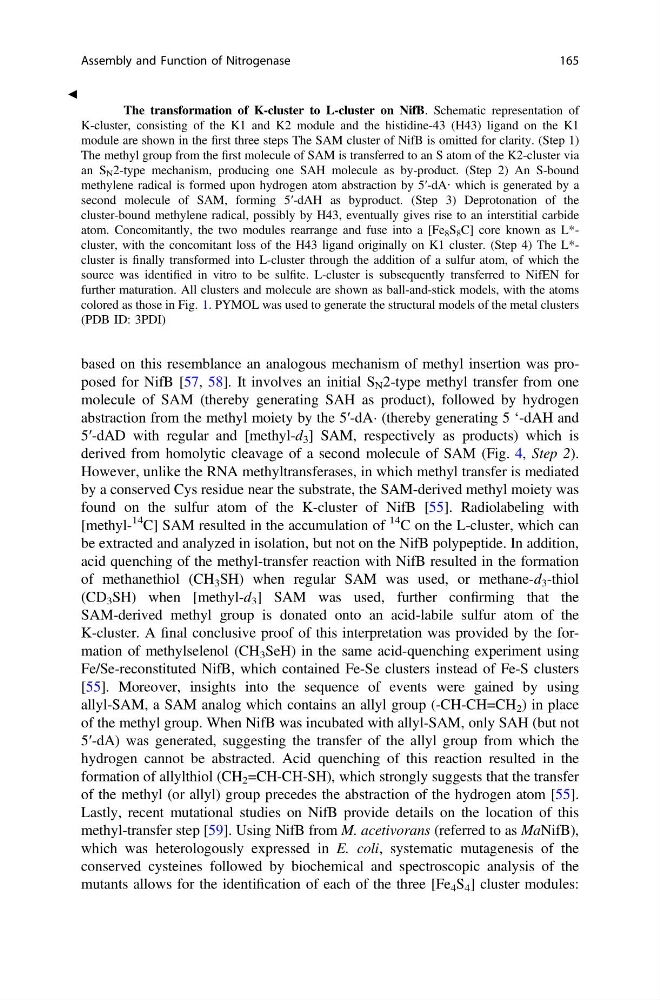
derived from homolytic cleavage of a second molecule of SAM (Fig. 4, Step 2).
However, unlike the RNA methyltransferases, in which methyl transfer is mediated
by a conserved Cys residue near the substrate, the SAM-derived methyl moiety was
found on the sulfur atom of the K-cluster of NifB [55]. Radiolabeling with
[methyl14 C] SAM resulted in the accumulation of
14 C on the L-cluster, which can
be extracted and analyzed in isolation, but not on the NifB polypeptide. In addition,
acid quenching of the methyl-transfer reaction with NifB resulted in the formation
of methanethiol (CH 3 SH) when regular SAM was used, or methane-d 3 -thiol
(CD 3 SH) when [methyl-d 3 ] SAM was used, further confirming that the
SAM-derived methyl group is donated onto an acid-labile sulfur atom of the
K-cluster. A final conclusive proof of this interpretation was provided by the formation of methylselenol (CH 3 SeH) in the same acid-quenching experiment using
Fe/Se-reconstituted NifB, which contained Fe-Se clusters instead of Fe-S clusters
[55]. Moreover, insights into the sequence of events were gained by using
allyl-SAM, a SAM analog which contains an allyl group (-CH-CH=CH 2 ) in place
of the methyl group. When NifB was incubated with allyl-SAM, only SAH (but not
5′-dA) was generated, suggesting the transfer of the allyl group from which the
hydrogen cannot be abstracted. Acid quenching of this reaction resulted in the
formation of allylthiol (CH 2 =CH-CH-SH), which strongly suggests that the transfer
of the methyl (or allyl) group precedes the abstraction of the hydrogen atom [55].
Lastly, recent mutational studies on NifB provide details on the location of this
methyl-transfer step [59]. Using NifB from M. acetivorans (referred to as MaNifB),
which was heterologously expressed in E. coli, systematic mutagenesis of the
conserved cysteines followed by biochemical and spectroscopic analysis of the
mutants allows for the identification of each of the three [Fe 4 S 4 ] cluster modules:
b
Fig. 4 The transformation of K-cluster to L-cluster on NifB. Schematic representation of
K-cluster, consisting of the K1 and K2 module and the histidine-43 (H43) ligand on the K1
module are shown in the first three steps The SAM cluster of NifB is omitted for clarity. (Step 1)
The methyl group from the first molecule of SAM is transferred to an S atom of the K2-cluster via
an S N 2-type mechanism, producing one SAH molecule as by-product. (Step 2) An S-bound
methylene radical is formed upon hydrogen atom abstraction by 5′-dA⋅ which is generated by a
second molecule of SAM, forming 5′-dAH as byproduct. (Step 3) Deprotonation of the
cluster-bound methylene radical, possibly by H43, eventually gives rise to an interstitial carbide
atom. Concomitantly, the two modules rearrange and fuse into a [Fe 8 S 8 C] core known as L*cluster, with the concomitant loss of the H43 ligand originally on K1 cluster. (Step 4) The L*cluster is finally transformed into L-cluster through the addition of a sulfur atom, of which the
source was identified in vitro to be sulfite. L-cluster is subsequently transferred to NifEN for
further maturation. All clusters and molecule are shown as ball-and-stick models, with the atoms
colored as those in Fig. 1. PYMOL was used to generate the structural models of the metal clusters
(PDB ID: 3PDI)
Assembly and Function of Nitrogenase
165
molecule of SAM (thereby generating SAH as product), followed by hydrogen
abstraction from the methyl moiety by the 5′-dAÁ (thereby generating 5 ‘-dAH and
5′-dAD with regular and [methyl-d 3 ] SAM, respectively as products) which is
derived from homolytic cleavage of a second molecule of SAM (Fig. 4, Step 2).
However, unlike the RNA methyltransferases, in which methyl transfer is mediated
by a conserved Cys residue near the substrate, the SAM-derived methyl moiety was
found on the sulfur atom of the K-cluster of NifB [55]. Radiolabeling with
[methyl14 C] SAM resulted in the accumulation of
14 C on the L-cluster, which can
be extracted and analyzed in isolation, but not on the NifB polypeptide. In addition,
acid quenching of the methyl-transfer reaction with NifB resulted in the formation
of methanethiol (CH 3 SH) when regular SAM was used, or methane-d 3 -thiol
(CD 3 SH) when [methyl-d 3 ] SAM was used, further confirming that the
SAM-derived methyl group is donated onto an acid-labile sulfur atom of the
K-cluster. A final conclusive proof of this interpretation was provided by the formation of methylselenol (CH 3 SeH) in the same acid-quenching experiment using
Fe/Se-reconstituted NifB, which contained Fe-Se clusters instead of Fe-S clusters
[55]. Moreover, insights into the sequence of events were gained by using
allyl-SAM, a SAM analog which contains an allyl group (-CH-CH=CH 2 ) in place
of the methyl group. When NifB was incubated with allyl-SAM, only SAH (but not
5′-dA) was generated, suggesting the transfer of the allyl group from which the
hydrogen cannot be abstracted. Acid quenching of this reaction resulted in the
formation of allylthiol (CH 2 =CH-CH-SH), which strongly suggests that the transfer
of the methyl (or allyl) group precedes the abstraction of the hydrogen atom [55].
Lastly, recent mutational studies on NifB provide details on the location of this
methyl-transfer step [59]. Using NifB from M. acetivorans (referred to as MaNifB),
which was heterologously expressed in E. coli, systematic mutagenesis of the
conserved cysteines followed by biochemical and spectroscopic analysis of the
mutants allows for the identification of each of the three [Fe 4 S 4 ] cluster modules:
b
Fig. 4 The transformation of K-cluster to L-cluster on NifB. Schematic representation of
K-cluster, consisting of the K1 and K2 module and the histidine-43 (H43) ligand on the K1
module are shown in the first three steps The SAM cluster of NifB is omitted for clarity. (Step 1)
The methyl group from the first molecule of SAM is transferred to an S atom of the K2-cluster via
an S N 2-type mechanism, producing one SAH molecule as by-product. (Step 2) An S-bound
methylene radical is formed upon hydrogen atom abstraction by 5′-dA⋅ which is generated by a
second molecule of SAM, forming 5′-dAH as byproduct. (Step 3) Deprotonation of the
cluster-bound methylene radical, possibly by H43, eventually gives rise to an interstitial carbide
atom. Concomitantly, the two modules rearrange and fuse into a [Fe 8 S 8 C] core known as L*cluster, with the concomitant loss of the H43 ligand originally on K1 cluster. (Step 4) The L*cluster is finally transformed into L-cluster through the addition of a sulfur atom, of which the
source was identified in vitro to be sulfite. L-cluster is subsequently transferred to NifEN for
further maturation. All clusters and molecule are shown as ball-and-stick models, with the atoms
colored as those in Fig. 1. PYMOL was used to generate the structural models of the metal clusters
(PDB ID: 3PDI)
Assembly and Function of Nitrogenase
165