

monitoring their activity is a helpful tool to assess soil quality. This is particularly
true in soils subjected to mixed organic and/or mineral fertilization included in
different crop rotations [20].
Nitrogenase also plays an important role in the N cycle as it is a metalloenzyme
responsible for catalyzing atmospheric nitrogen fixation, by ensuring the reduction
of di-nitrogen (N 2 ) to ammonia (NH 3 ) which is a vital process for all forms of life
on Earth.
Soil fertility is based on intense enzymatic and microbial activity and on metabolic
diversity of microorganisms. SOM mineralization and transformation of nutrients
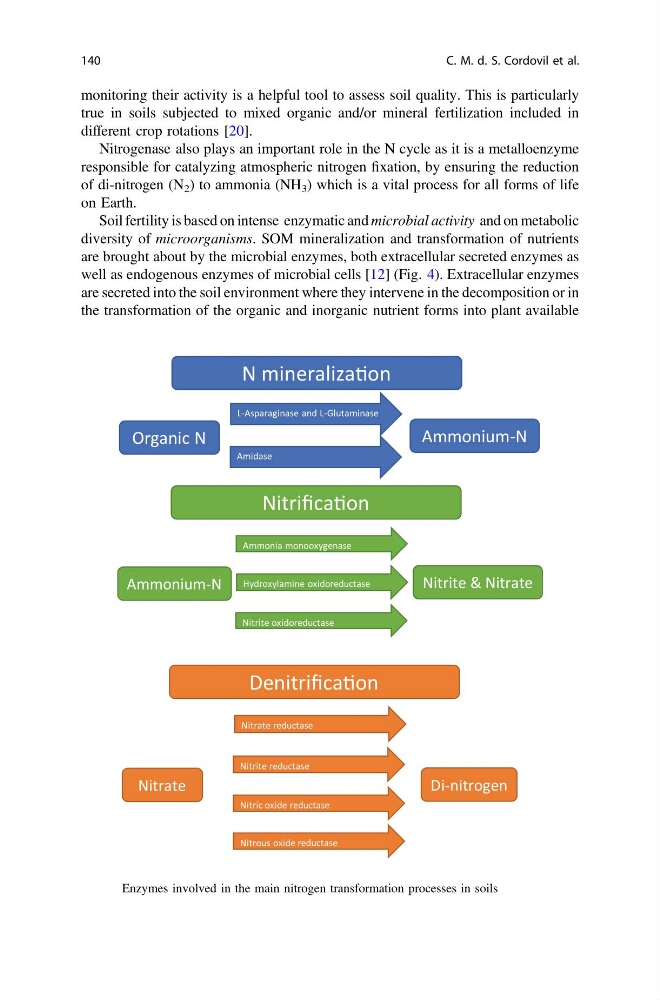
are brought about by the microbial enzymes, both extracellular secreted enzymes as
well as endogenous enzymes of microbial cells [12] (Fig. 4). Extracellular enzymes
are secreted into the soil environment where they intervene in the decomposition or in
the transformation of the organic and inorganic nutrient forms into plant available
N mineralizaƟon
Organic N
Ammonium-N
L-Asparaginase and L-Glutaminase
Amidase
NitrificaƟon
Ammonium-N
Nitrite & Nitrate
Ammonia monooxygenase
Hydroxylamine oxidoreductase
Nitrite oxidoreductase
Nitrate
DenitrificaƟon
Nitrate reductase
Nitric oxide reductase
Nitrite reductase
Nitrous oxide reductase
Di-nitrogen
Fig. 4 Enzymes involved in the main nitrogen transformation processes in soils
140
C. M. d. S. Cordovil et al.
true in soils subjected to mixed organic and/or mineral fertilization included in
different crop rotations [20].
Nitrogenase also plays an important role in the N cycle as it is a metalloenzyme
responsible for catalyzing atmospheric nitrogen fixation, by ensuring the reduction
of di-nitrogen (N 2 ) to ammonia (NH 3 ) which is a vital process for all forms of life
on Earth.
Soil fertility is based on intense enzymatic and microbial activity and on metabolic
diversity of microorganisms. SOM mineralization and transformation of nutrients
are brought about by the microbial enzymes, both extracellular secreted enzymes as
well as endogenous enzymes of microbial cells [12] (Fig. 4). Extracellular enzymes
are secreted into the soil environment where they intervene in the decomposition or in
the transformation of the organic and inorganic nutrient forms into plant available
N mineralizaƟon
Organic N
Ammonium-N
L-Asparaginase and L-Glutaminase
Amidase
NitrificaƟon
Ammonium-N
Nitrite & Nitrate
Ammonia monooxygenase
Hydroxylamine oxidoreductase
Nitrite oxidoreductase
Nitrate
DenitrificaƟon
Nitrate reductase
Nitric oxide reductase
Nitrite reductase
Nitrous oxide reductase
Di-nitrogen
Fig. 4 Enzymes involved in the main nitrogen transformation processes in soils
140
C. M. d. S. Cordovil et al.