

C. acetobutylicum with the one from C. kluyveri [108]. Successfully, acetone
production was also shown for a recombinant A. woodii strain containing plasmids
with the genes of the acetone pathway from C. acetobutylicum [107]. In a continuous fermentation, the production of acetone could be increased to
26.4 mg/lÁh
−1 . So far, acetone production is rather low in engineered strains and
further optimizations need to be done with respect to an industrial application.
Another biosynthetic compound that has come into focus lately is
poly-3-hydroxybutyrate (PHB). This biopolymer is considered as a sustainable,
biodegradable replacement for non-degradable, fuel-based plastics [109]. Naturally,
acetogenic bacteria are not able to produce PHB. By metabolic engineering, they
could become a promising candidate for the biotechnological production of PHB.
Strategies for the heterologous production of PHB are based on the implementation
of codon-optimized genes from the PHB pathway in Cupriavidus necator (phaA,
phaB, phaC) [110–112]. The natural PHB pathway comprises three reactions: In a
first reaction, two molecules of acetyl-CoA are condensed to acetoacetyl-CoA by a
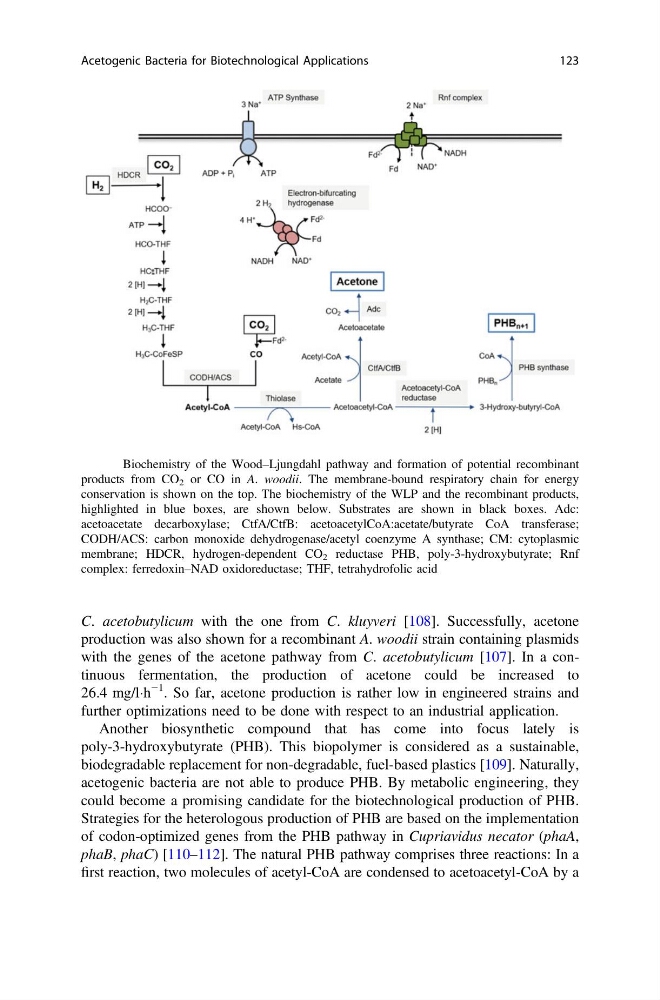
Fig. 4 Biochemistry of the Wood–Ljungdahl pathway and formation of potential recombinant
products from CO 2 or CO in A. woodii. The membrane-bound respiratory chain for energy
conservation is shown on the top. The biochemistry of the WLP and the recombinant products,
highlighted in blue boxes, are shown below. Substrates are shown in black boxes. Adc:
acetoacetate decarboxylase; CtfA/CtfB: acetoacetylCoA:acetate/butyrate CoA transferase;
CODH/ACS: carbon monoxide dehydrogenase/acetyl coenzyme A synthase; CM: cytoplasmic
membrane; HDCR, hydrogen-dependent CO 2 reductase PHB, poly-3-hydroxybutyrate; Rnf
complex: ferredoxin–NAD oxidoreductase; THF, tetrahydrofolic acid
Acetogenic Bacteria for Biotechnological Applications
123
production was also shown for a recombinant A. woodii strain containing plasmids
with the genes of the acetone pathway from C. acetobutylicum [107]. In a continuous fermentation, the production of acetone could be increased to
26.4 mg/lÁh
−1 . So far, acetone production is rather low in engineered strains and
further optimizations need to be done with respect to an industrial application.
Another biosynthetic compound that has come into focus lately is
poly-3-hydroxybutyrate (PHB). This biopolymer is considered as a sustainable,
biodegradable replacement for non-degradable, fuel-based plastics [109]. Naturally,
acetogenic bacteria are not able to produce PHB. By metabolic engineering, they
could become a promising candidate for the biotechnological production of PHB.
Strategies for the heterologous production of PHB are based on the implementation
of codon-optimized genes from the PHB pathway in Cupriavidus necator (phaA,
phaB, phaC) [110–112]. The natural PHB pathway comprises three reactions: In a
first reaction, two molecules of acetyl-CoA are condensed to acetoacetyl-CoA by a
Fig. 4 Biochemistry of the Wood–Ljungdahl pathway and formation of potential recombinant
products from CO 2 or CO in A. woodii. The membrane-bound respiratory chain for energy
conservation is shown on the top. The biochemistry of the WLP and the recombinant products,
highlighted in blue boxes, are shown below. Substrates are shown in black boxes. Adc:
acetoacetate decarboxylase; CtfA/CtfB: acetoacetylCoA:acetate/butyrate CoA transferase;
CODH/ACS: carbon monoxide dehydrogenase/acetyl coenzyme A synthase; CM: cytoplasmic
membrane; HDCR, hydrogen-dependent CO 2 reductase PHB, poly-3-hydroxybutyrate; Rnf
complex: ferredoxin–NAD oxidoreductase; THF, tetrahydrofolic acid
Acetogenic Bacteria for Biotechnological Applications
123