

isolated from an agricultural settling lagoon in Oklahoma (USA) [90]. Along with
Butyribacterium methylotrophicum [91], Clostridium drakei [90], C. ragsdalei [92]
and Eubacterium limosum [93], it is one of few acetogens that is known to produce
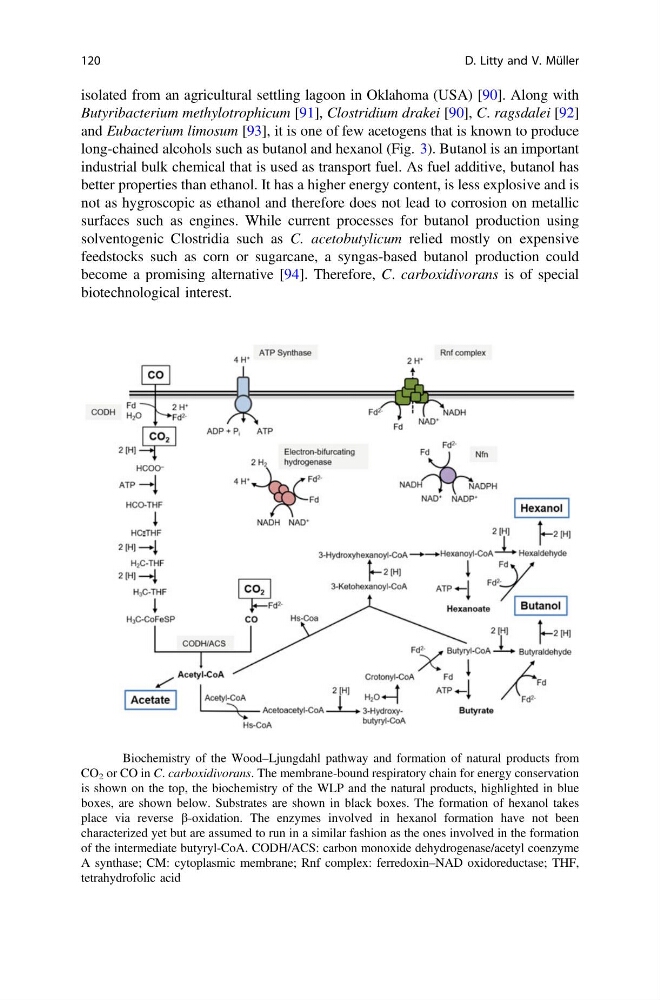
long-chained alcohols such as butanol and hexanol (Fig. 3). Butanol is an important
industrial bulk chemical that is used as transport fuel. As fuel additive, butanol has
better properties than ethanol. It has a higher energy content, is less explosive and is
not as hygroscopic as ethanol and therefore does not lead to corrosion on metallic
surfaces such as engines. While current processes for butanol production using
solventogenic Clostridia such as C. acetobutylicum relied mostly on expensive
feedstocks such as corn or sugarcane, a syngas-based butanol production could
become a promising alternative [94]. Therefore, C. carboxidivorans is of special
biotechnological interest.
Fig. 3 Biochemistry of the Wood–Ljungdahl pathway and formation of natural products from
CO 2 or CO in C. carboxidivorans. The membrane-bound respiratory chain for energy conservation
is shown on the top, the biochemistry of the WLP and the natural products, highlighted in blue
boxes, are shown below. Substrates are shown in black boxes. The formation of hexanol takes
place via reverse b-oxidation. The enzymes involved in hexanol formation have not been
characterized yet but are assumed to run in a similar fashion as the ones involved in the formation
of the intermediate butyryl-CoA. CODH/ACS: carbon monoxide dehydrogenase/acetyl coenzyme
A synthase; CM: cytoplasmic membrane; Rnf complex: ferredoxin–NAD oxidoreductase; THF,
tetrahydrofolic acid
120
D. Litty and V. Müller
Butyribacterium methylotrophicum [91], Clostridium drakei [90], C. ragsdalei [92]
and Eubacterium limosum [93], it is one of few acetogens that is known to produce
long-chained alcohols such as butanol and hexanol (Fig. 3). Butanol is an important
industrial bulk chemical that is used as transport fuel. As fuel additive, butanol has
better properties than ethanol. It has a higher energy content, is less explosive and is
not as hygroscopic as ethanol and therefore does not lead to corrosion on metallic
surfaces such as engines. While current processes for butanol production using
solventogenic Clostridia such as C. acetobutylicum relied mostly on expensive
feedstocks such as corn or sugarcane, a syngas-based butanol production could
become a promising alternative [94]. Therefore, C. carboxidivorans is of special
biotechnological interest.
Fig. 3 Biochemistry of the Wood–Ljungdahl pathway and formation of natural products from
CO 2 or CO in C. carboxidivorans. The membrane-bound respiratory chain for energy conservation
is shown on the top, the biochemistry of the WLP and the natural products, highlighted in blue
boxes, are shown below. Substrates are shown in black boxes. The formation of hexanol takes
place via reverse b-oxidation. The enzymes involved in hexanol formation have not been
characterized yet but are assumed to run in a similar fashion as the ones involved in the formation
of the intermediate butyryl-CoA. CODH/ACS: carbon monoxide dehydrogenase/acetyl coenzyme
A synthase; CM: cytoplasmic membrane; Rnf complex: ferredoxin–NAD oxidoreductase; THF,
tetrahydrofolic acid
120
D. Litty and V. Müller