

crystals are shown in Figure 4.6. Some shape control has also been demonstrated
in the case of CdS and CdTe nanocrystals [81, 82].
4.2.4
Tailoring the Ligand Shell
Nanocrystals in their native form are dominated by the surface species, the capping agents employed play a role in determining the property of the nanocrystals
[83]. Hence, in addition to controlling the size and the shape of the nanocrystals it
is also necessary to tailor its surface with the right capping agent. In addition to
traditional capping agents that include ions, surfactants and polymers, a new breed
of ligands: dendrimers, hydrogen bonding fragments of protein, DNA and dyes,
with pendent thiol groups, as well as silica layers have been used as capping agents
[84–86].
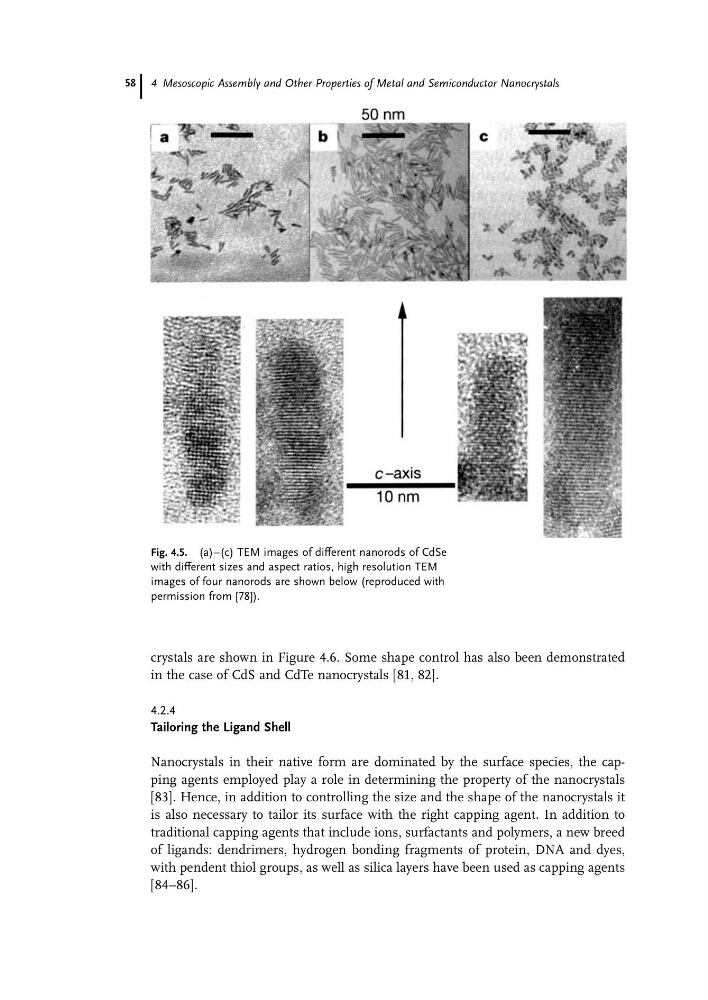
Fig. 4.5. (a)–(c) TEM images of different nanorods of CdSe
with different sizes and aspect ratios, high resolution TEM
images of four nanorods are shown below (reproduced with
permission from [78]).
4 Mesoscopic Assembly and Other Properties of Metal and Semiconductor Nanocrystals
58
in the case of CdS and CdTe nanocrystals [81, 82].
4.2.4
Tailoring the Ligand Shell
Nanocrystals in their native form are dominated by the surface species, the capping agents employed play a role in determining the property of the nanocrystals
[83]. Hence, in addition to controlling the size and the shape of the nanocrystals it
is also necessary to tailor its surface with the right capping agent. In addition to
traditional capping agents that include ions, surfactants and polymers, a new breed
of ligands: dendrimers, hydrogen bonding fragments of protein, DNA and dyes,
with pendent thiol groups, as well as silica layers have been used as capping agents
[84–86].
Fig. 4.5. (a)–(c) TEM images of different nanorods of CdSe
with different sizes and aspect ratios, high resolution TEM
images of four nanorods are shown below (reproduced with
permission from [78]).
4 Mesoscopic Assembly and Other Properties of Metal and Semiconductor Nanocrystals
58