

observed that in conditions of low humidity (R H A 10%–20%) when the tip is in
contact with the substrate (and resting on it) the water is transported from the tip
to the substrate forming a meniscus. This changes the lateral force during scanning. When the humidity is high (R H A 90%) for a hydrophilic substrate, there is
transport of water from the substrate to the tip around the region of contact, leading to depletion of the water meniscus in the region around the contact. For a hydrophobic substrate, for the same high humidity there is transport of water from
tip to substrate leading to growth of the water meniscus.
The scan speed of the AFM tip will determine the amount of water that is carried with the tip. At high scan rates the tip carries less water and the meniscus has
less time to grow. The transport being essentially diffusion controlled the scale of
growth is z t
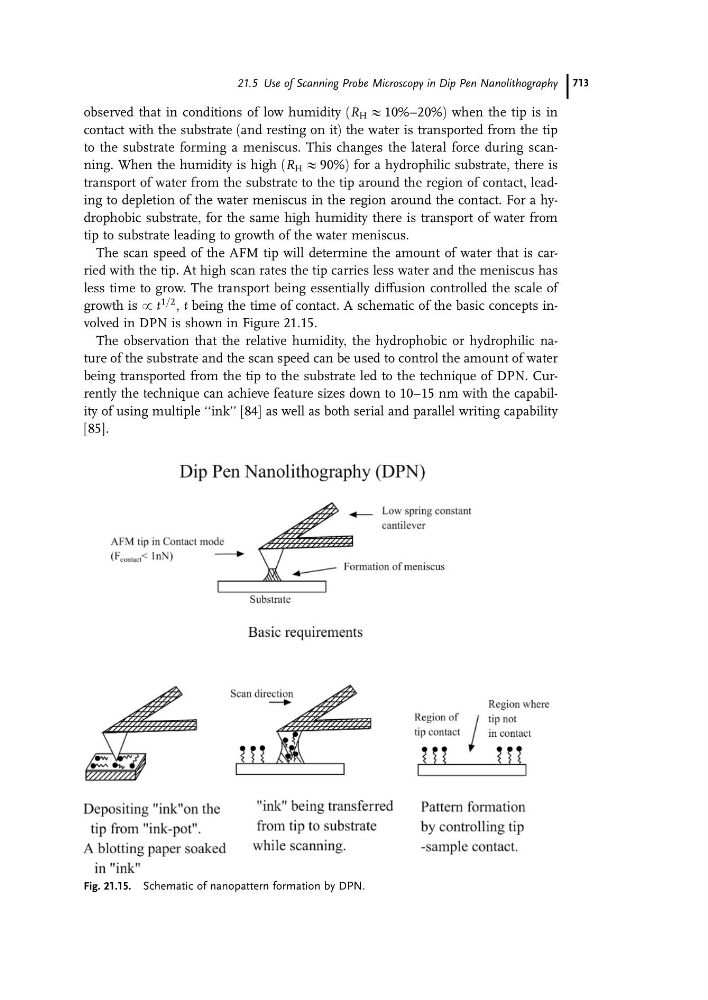
1=2 , t being the time of contact. A schematic of the basic concepts involved in DPN is shown in Figure 21.15.
The observation that the relative humidity, the hydrophobic or hydrophilic nature of the substrate and the scan speed can be used to control the amount of water
being transported from the tip to the substrate led to the technique of DPN. Currently the technique can achieve feature sizes down to 10–15 nm with the capability of using multiple ‘‘ink’’ [84] as well as both serial and parallel writing capability
[85].
Fig. 21.15. Schematic of nanopattern formation by DPN.
21.5 Use of Scanning Probe Microscopy in Dip Pen Nanolithography 713