

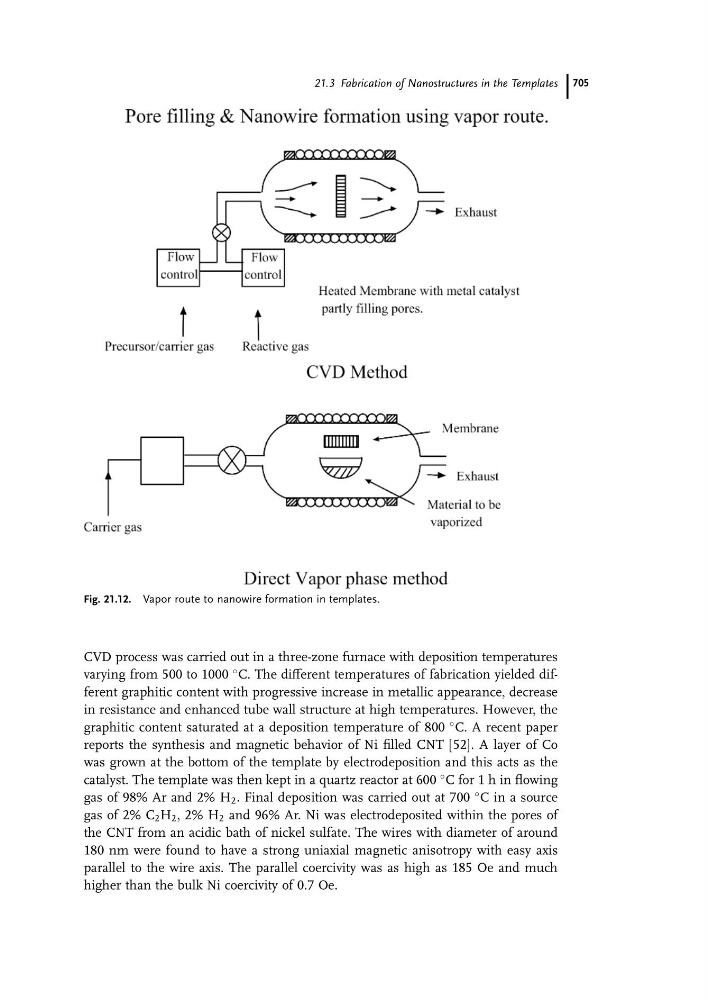
CVD process was carried out in a three-zone furnace with deposition temperatures
varying from 500 to 1000
C. The different temperatures of fabrication yielded different graphitic content with progressive increase in metallic appearance, decrease
in resistance and enhanced tube wall structure at high temperatures. However, the
graphitic content saturated at a deposition temperature of 800
C. A recent paper
reports the synthesis and magnetic behavior of Ni filled CNT [52]. A layer of Co
was grown at the bottom of the template by electrodeposition and this acts as the
catalyst. The template was then kept in a quartz reactor at 600
C for 1 h in flowing
gas of 98% Ar and 2% H 2 . Final deposition was carried out at 700
C in a source
gas of 2% C 2 H 2 , 2% H 2 and 96% Ar. Ni was electrodeposited within the pores of
the CNT from an acidic bath of nickel sulfate. The wires with diameter of around
180 nm were found to have a strong uniaxial magnetic anisotropy with easy axis
parallel to the wire axis. The parallel coercivity was as high as 185 Oe and much
higher than the bulk Ni coercivity of 0.7 Oe.
Fig. 21.12. Vapor route to nanowire formation in templates.
21.3 Fabrication of Nanostructures in the Templates 705