

large perpendicular MR of 22% at 4.2 K and 11% at room temperature, in a field
of 0.5 T. An interesting class of magnetic tunnel junction nanowires based on
Ni/NiO/Co multilayers was made by a combination of electrodeposition and oxidation (to make NiO) [32]. There are very recent studies on magnetic shape anisotropy on nanowires of Co/Ag multilayer grown in 20 mm, 120 nm pore polycarbonate membranes using a nearly neutral bath (pH A 7). The bath had 0.15 M
CoSO 4 , 0.36 M K 4 P 2 O 7 and 0.6 mM AgCN. 0.5 mm sputtered Ag with a 20 nm Ti
adhesion layer was used as the cathode [33].
There are a number of reports of the growth of good quality elemental nanowires in templates using ED techniques. They include Bi wires [21, 34] for positive
GMR properties, an array of membrane-synthesized Ni [35] and Co [36] for magnetic recording applications and single crystalline Pb nanowires [37] for studying
superconductivity in constrained systems. Bi wires are generally grown from an
acidic bath (pH A 3) consisting of 0.15 M BiCl 3 , 0.3 M tartaric acid and glycerol.
Bi wire shows giant positive MR which for the perpendicular geometry can be as
high as 600–800% at 4.2 K (field perpendicular to wire) and 200% for the parallel
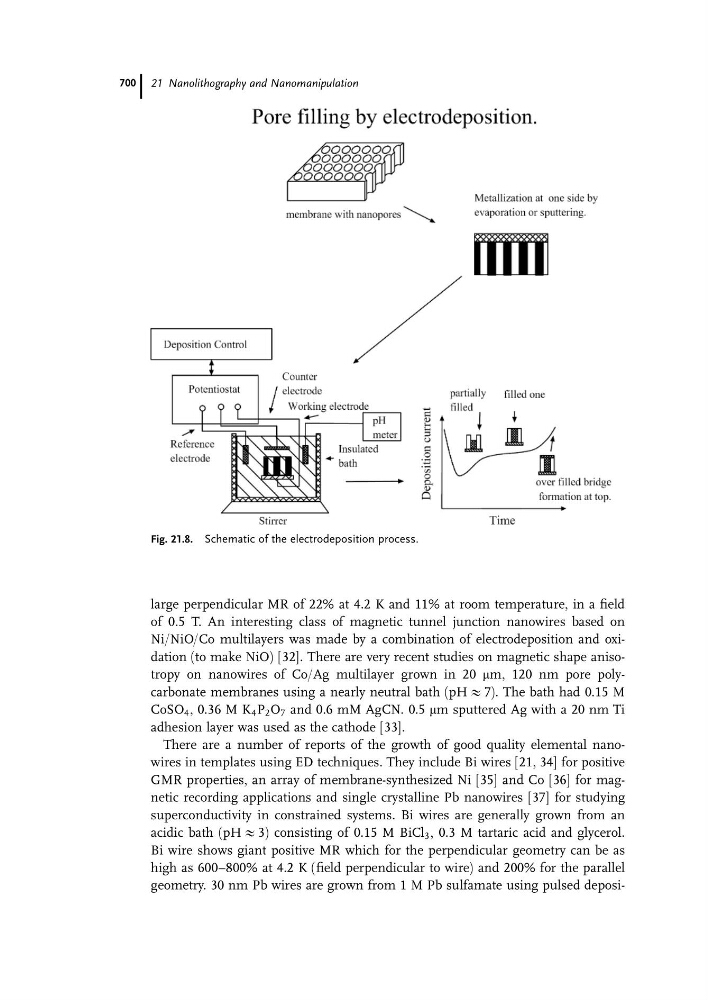
geometry. 30 nm Pb wires are grown from 1 M Pb sulfamate using pulsed deposiFig. 21.8. Schematic of the electrodeposition process.
21 Nanolithography and Nanomanipulation
700