

than the lining of the pore which is more amorphous. There are reports of photoluminescence (PL) from these grown templates in the frequency range 400–500
nm [14]. These seem to appear from the oxygen defects (charged) in the Al 2 O 3 and
thus can be used as a probe to measure the defects in the grown layer. This becomes important when such templates are used for making PL or similar devices.
The two-stage anodization process for making the AM is necessary to produce a
hexagonal pattern on the alumina for the oxidation in the second stage. In fact any
patterning of the aluminum can act as a template for the oxidation and can produce the template. This has been shown by making a hexagonal array structure on
aluminum film by nano-indentation [15]. It was shown that the anodization process leads to growth of hexagonal oxide tubes.
A recent application of the AM is to grow secondary templates of a polymer such
as polyaniline. The nanopores have been filled with polyaniline nanowires [16]
and even with carbon nanotubes (CNT) grown inside the pores [17]. The polyaniline was deposited by simply immersing the membrane in a solution of aniline
and HCl. The aniline was then polymerized at room temperature following usual
methods. The secondary templates, such as aligned CNTs, were generated in the
alumina nanotubes by the catalytic pyrolysis of acetylene. These secondary templates, which have pores of much smaller diameter, are then used to grow new
materials. The desired material, such as metal nanowires can be introduced into
the aligned carbon nanotubes by methods such as electrodeposition. This leads to
nanowires with a core structure, such as a Ni wire in a carbon nanotube.
21.2.3
Anodized Alumina Membrane as a Mask for Physical Vapor Deposition
A very important recent application is to use aluminized membranes as a mask for
physical vapor deposition. In these cases the membrane is either attached to the
substrate or a film of aluminum (typically a few microns thick) is grown on a substrate such as Si. This is followed by the anodic oxidation process to convert the
aluminum film to an anodized template. The growth process is either physical
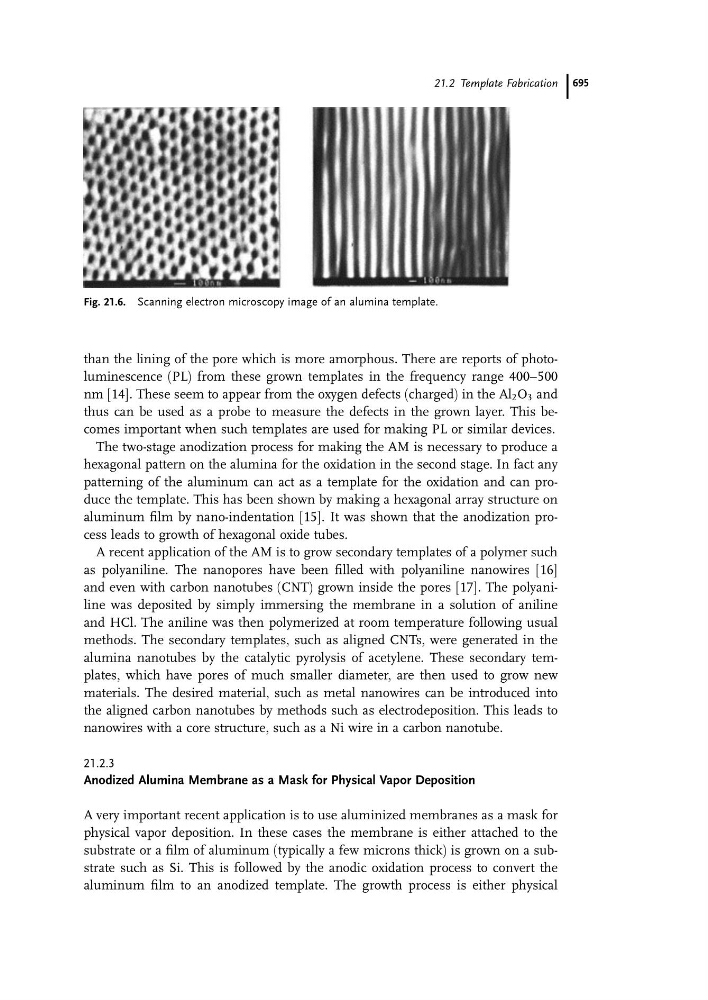
Fig. 21.6. Scanning electron microscopy image of an alumina template.
21.2 Template Fabrication 695