

alkylthiol are prepared using the Brust synthesis and the ligand place-exchange
procedure [193]. In the solution phase, these mixed MPCs act as exo-receptors and
can specifically sense oxo-anions such as H 2 PO 4
À and HSO 4
À due to hydrogen
bonding between the amide functionality and the anion. In the case of H 2 PO 4
À ,
this manifests as a new wave in the cyclic voltammogram. The intensity of the
wave increases at the expense of the initial Fc/Fc
þ wave and completely replaces it
once one equivalent of H 2 PO 4
À is added, indicating the formation of a 1:1 complex
between the amidoferrocenyl group and the oxo-anion. A progressive cathodic shift
is observed with increasing concentration of HSO 4
À , rather than the appearance of
a second wave. Here too, a 1:1 complex is formed though the association constant
is smaller than for H 2 PO 4
À . Other ions like Cl
À , Br
À
, NO 3
À are not recognized by
the MPC thus showing good selectivity. Israel and co workers [194a] reported on
the affinity of metal ions towards gold nanoparticles modified with self-assembled
monolayers containing acid end functionalities. The ion binding affinity is found
to vary in the order Fe
3þ > Cu
2þ > Zn
2þ . The ion gating or permselective properties of gold nanoparticles with self-assembled monolayers containing carboxylic
acid functional groups have been reported for [Ru(NH 3 ) 6 ]
3þ=2þ and Fe(CN 6 )
3À=4À
based on the solution pH and the analyte size [194b].
Nanoparticles have also been used successfully as amperometric gas sensors.
Chiou and co-workers developed a dispersed catalyst gas-diffusion electrode for
SO 2 sensing [195]. Chloroauric acid is adsorbed on carbon black and subsequently
reduced in a stream of hydrogen to obtain nanometer-sized particles. These are
then shaped in the form of an electrode and used as a sensor. The electrochemical
oxidation of SO 2 gas is catalyzed by the nanoparticles with a fast response time. A
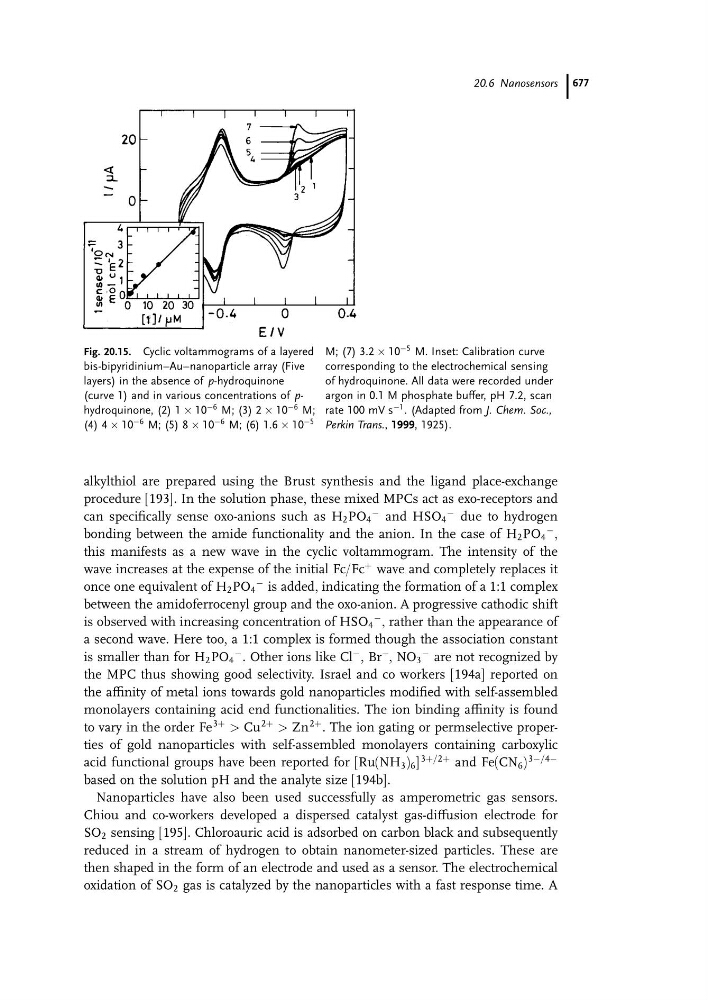
Fig. 20.15. Cyclic voltammograms of a layered
bis-bipyridinium–Au–nanoparticle array (Five
layers) in the absence of p-hydroquinone
(curve 1) and in various concentrations of phydroquinone, (2) 1 Â 10
À6 M; (3) 2 Â 10
À6 M;
(4) 4 Â 10
À6 M; (5) 8 Â 10
À6 M; (6) 1.6 Â 10
À5
M; (7) 3.2 Â 10
À5 M. Inset: Calibration curve
corresponding to the electrochemical sensing
of hydroquinone. All data were recorded under
argon in 0.1 M phosphate buffer, pH 7.2, scan
rate 100 mV s
À1 . (Adapted from J. Chem. Soc.,
Perkin Trans., 1999, 1925).
20.6 Nanosensors 677