

protonation of the exocyclic nitrogens that extend away from the nanoparticle surface towards the solvent (Figure 3.13).
Gittins and Caruso have developed their approach and recently demonstrated the
phase transfer of silver, gold, platinum and palladium nanoparticles using a number of exchanging ligands such as mercaptoundecanoic acid (MUA), mecaptosuccinic acid etc. [77]. A highlight of the work was the non-specific bioconjugation
of the protein, bovine serum albumin (BSA) with MUA-functionalized gold nanoparticles, possibly through electrostatic and hydrogen bonding interactions between the protein and the ionized carboxylate ions on the nanoparticle surface [77].
In a completely different approach, interdigitated bilayers have been used to
transfer gold nanoparticles present in non-polar organic solvents to water [78].
Dodecylamine-capped gold nanoparticles dispersed in chloroform were vigorously
stirred with an aqueous solution containing the water-soluble surfactant cetyltrimethylammonium bromide (CTAB). During the stirring process, a secondary
interdigitated monolayer of CTAB forms on the existing dodecylamine monolayer
in contact with the gold nanoparticle surface. This results in significant hydrophilicity of the gold nanoparticles and a consequent phase transfer to the aqueous
phase [78].
In conclusion, I have tried to outline the advantages of carrying out the phase
transfer of inorganic nanoparticles (gold nanoparticles in particular) from aqueous
to non-polar organic environments and vice versa. Various methods in the literature, including work from my group, in this fascinating area have been covered
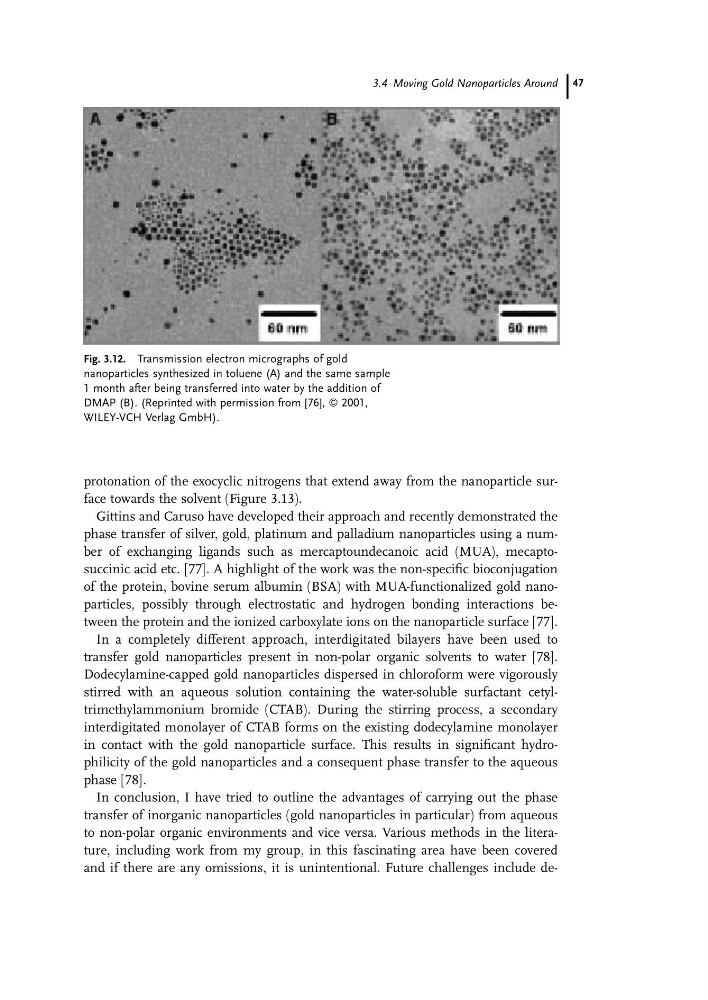
and if there are any omissions, it is unintentional. Future challenges include deFig. 3.12. Transmission electron micrographs of gold
nanoparticles synthesized in toluene (A) and the same sample
1 month after being transferred into water by the addition of
DMAP (B). (Reprinted with permission from [76], 8 2001,
WILEY-VCH Verlag GmbH).
3.4 Moving Gold Nanoparticles Around 47
Gittins and Caruso have developed their approach and recently demonstrated the
phase transfer of silver, gold, platinum and palladium nanoparticles using a number of exchanging ligands such as mercaptoundecanoic acid (MUA), mecaptosuccinic acid etc. [77]. A highlight of the work was the non-specific bioconjugation
of the protein, bovine serum albumin (BSA) with MUA-functionalized gold nanoparticles, possibly through electrostatic and hydrogen bonding interactions between the protein and the ionized carboxylate ions on the nanoparticle surface [77].
In a completely different approach, interdigitated bilayers have been used to
transfer gold nanoparticles present in non-polar organic solvents to water [78].
Dodecylamine-capped gold nanoparticles dispersed in chloroform were vigorously
stirred with an aqueous solution containing the water-soluble surfactant cetyltrimethylammonium bromide (CTAB). During the stirring process, a secondary
interdigitated monolayer of CTAB forms on the existing dodecylamine monolayer
in contact with the gold nanoparticle surface. This results in significant hydrophilicity of the gold nanoparticles and a consequent phase transfer to the aqueous
phase [78].
In conclusion, I have tried to outline the advantages of carrying out the phase
transfer of inorganic nanoparticles (gold nanoparticles in particular) from aqueous
to non-polar organic environments and vice versa. Various methods in the literature, including work from my group, in this fascinating area have been covered
and if there are any omissions, it is unintentional. Future challenges include deFig. 3.12. Transmission electron micrographs of gold
nanoparticles synthesized in toluene (A) and the same sample
1 month after being transferred into water by the addition of
DMAP (B). (Reprinted with permission from [76], 8 2001,
WILEY-VCH Verlag GmbH).
3.4 Moving Gold Nanoparticles Around 47