

Absorbance and electroreflectance studies involving viologen radicals that are
placed in close proximity to electrochemically controlled gold nanoparticles reveal
an anomalous electroreflectance spectrum around the formal potential of the
viologen redox couple [152]. The spectra show characteristics of electrochemical
charging and discharging of the gold particles at positive potentials. The authors
suggest a strong interaction between viologen cation radical moieties and gold
particles under plasmon excitation. The possibility of charge injection into gold
nanoparticle ensembles and the consequent changes in the reflectance and transmittance of the nanostructured films has been explored by Schiffrin and coworkers [153]. The optical response to the electrochemical charge injection is explained in terms of electron density oscillations in individual particles [153]. The
charge injection, according to the authors, occurs mostly on the outer layer and the
rest of the film acts like a support for electron transfer. The behavior may be compared to that of individual quantum dots that can respond to electron injection.
Potential-dependent surface enhanced Raman spectra (SERS) of pyridine using Ag
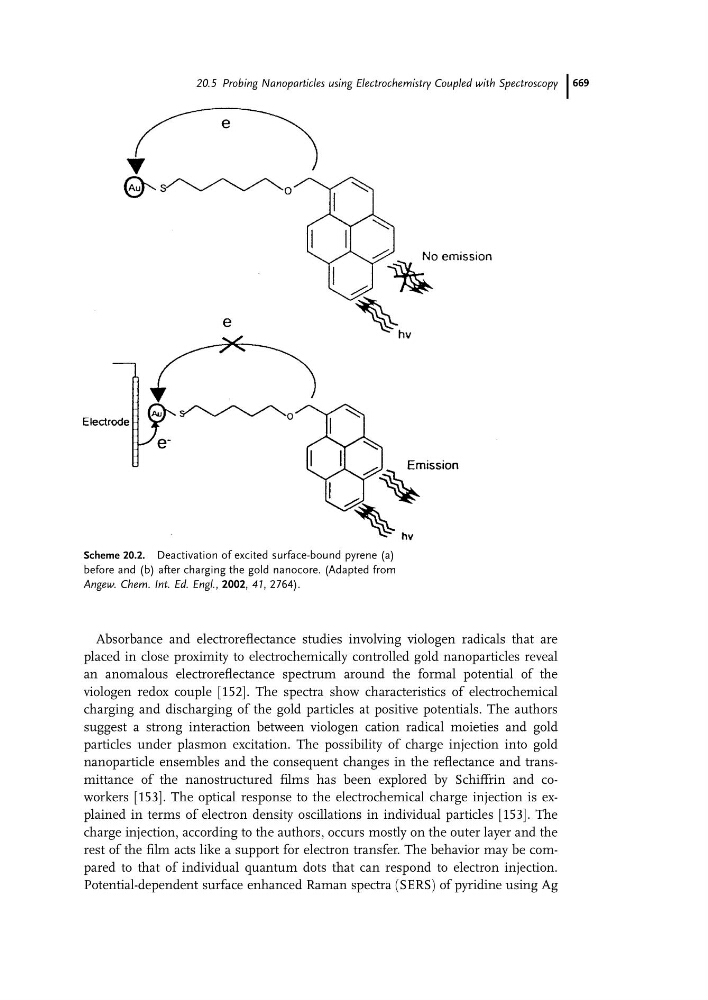
Scheme 20.2. Deactivation of excited surface-bound pyrene (a)
before and (b) after charging the gold nanocore. (Adapted from
Angew. Chem. Int. Ed. Engl., 2002, 41, 2764).
20.5 Probing Nanoparticles using Electrochemistry Coupled with Spectroscopy 669