

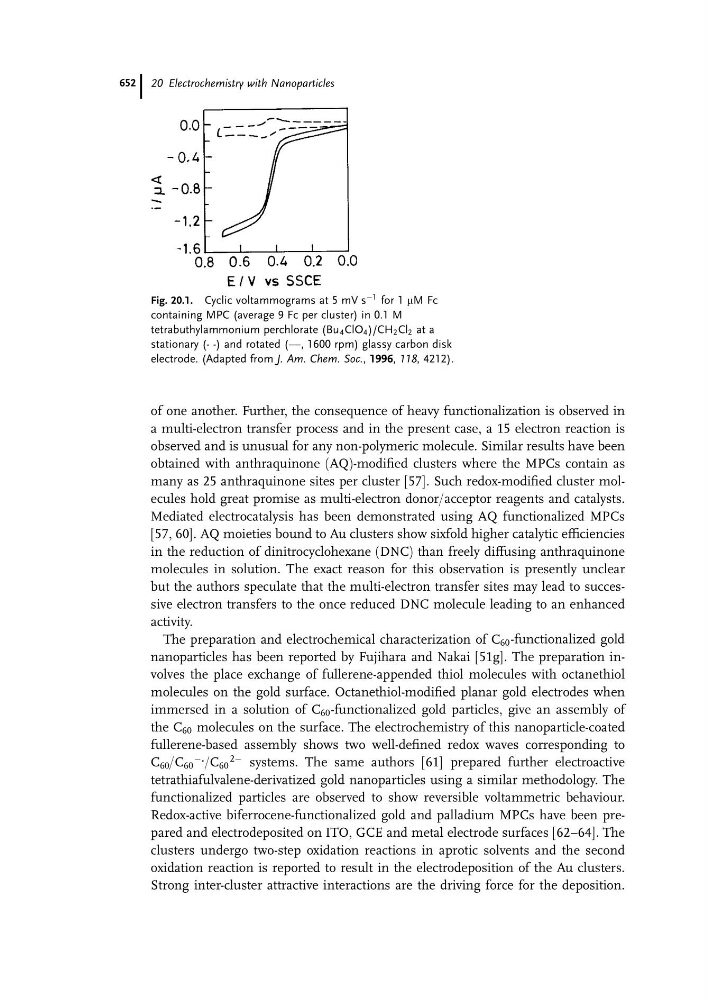
of one another. Further, the consequence of heavy functionalization is observed in
a multi-electron transfer process and in the present case, a 15 electron reaction is
observed and is unusual for any non-polymeric molecule. Similar results have been
obtained with anthraquinone (AQ)-modified clusters where the MPCs contain as
many as 25 anthraquinone sites per cluster [57]. Such redox-modified cluster molecules hold great promise as multi-electron donor/acceptor reagents and catalysts.
Mediated electrocatalysis has been demonstrated using AQ functionalized MPCs
[57, 60]. AQ moieties bound to Au clusters show sixfold higher catalytic efficiencies
in the reduction of dinitrocyclohexane (DNC) than freely diffusing anthraquinone
molecules in solution. The exact reason for this observation is presently unclear
but the authors speculate that the multi-electron transfer sites may lead to successive electron transfers to the once reduced DNC molecule leading to an enhanced
activity.
The preparation and electrochemical characterization of C 60 -functionalized gold
nanoparticles has been reported by Fujihara and Nakai [51g]. The preparation involves the place exchange of fullerene-appended thiol molecules with octanethiol
molecules on the gold surface. Octanethiol-modified planar gold electrodes when
immersed in a solution of C 60 -functionalized gold particles, give an assembly of
the C 60 molecules on the surface. The electrochemistry of this nanoparticle-coated
fullerene-based assembly shows two well-defined redox waves corresponding to
C 60 /C 60
À.
/C 60
2À systems. The same authors [61] prepared further electroactive
tetrathiafulvalene-derivatized gold nanoparticles using a similar methodology. The
functionalized particles are observed to show reversible voltammetric behaviour.
Redox-active biferrocene-functionalized gold and palladium MPCs have been prepared and electrodeposited on ITO, GCE and metal electrode surfaces [62–64]. The
clusters undergo two-step oxidation reactions in aprotic solvents and the second
oxidation reaction is reported to result in the electrodeposition of the Au clusters.
Strong inter-cluster attractive interactions are the driving force for the deposition.
Fig. 20.1. Cyclic voltammograms at 5 mV s
À1 for 1 mM Fc
containing MPC (average 9 Fc per cluster) in 0.1 M
tetrabuthylammonium perchlorate (Bu 4 ClO 4 )/CH 2 Cl 2 at a
stationary (- -) and rotated (—, 1600 rpm) glassy carbon disk
electrode. (Adapted from J. Am. Chem. Soc., 1996, 118, 4212).
20 Electrochemistry with Nanoparticles
652