

assembly, electrostatic or covalent ordering, use of polymers, and patterning based
on biomolecules such as DNA etc. [39]. Carbon is an important substrate for many
applications related to the use of nanoparticles, especially in electrocatalysis [40a].
Electrodeposition of metal particles on carbon surfaces is one of the ways of producing uniformly dispersed catalytic particles [40b–e]. Another method involves
the adsorption of metal salts on the substrate and then reducing them chemically
[41a]. Nanoparticles containing more than one metal component have been synthesized using stabilizers such as functionalized silanes, citrate, polyvinyl alcohol
and thiols [41b–g]. Metal nanowires and their arrays have been prepared by an
electrodeposition technique [41h]. The metallic nanowires composed of molybdenum, copper, nickel, gold and palladium are electrodeposited selectively on basal
plane oriented pyrolytic graphite (HOPG) electrodes. The electrochemically decorated nanowires are found to be 500 mm long, hemicylindrical and polycrystalline
in nature. The nanowires can also be lifted off the HOPG surface and this property
makes them amenable for sensing applications.
20.3
Electrochemistry with Metallic Nanoparticles
Studies of the interaction of colloidal metal particles with macroelectrodes are
essential for an understanding of properties such as the redox potential of the
nanometallic particles in the presence of a particular environment. This information will be useful in extending the conventional electrochemical treatment to colloidal systems.
O
O
Au
O Au
O
Au O Au
O
Au
O
Au
O
Au
O Au O
Au
O
Au
O
Au
-1.5 V
Au substrate
Acetone
Water
a
b
1
1
Citrate stabilised gold nanoparticles
NH 2
ZnCl 2
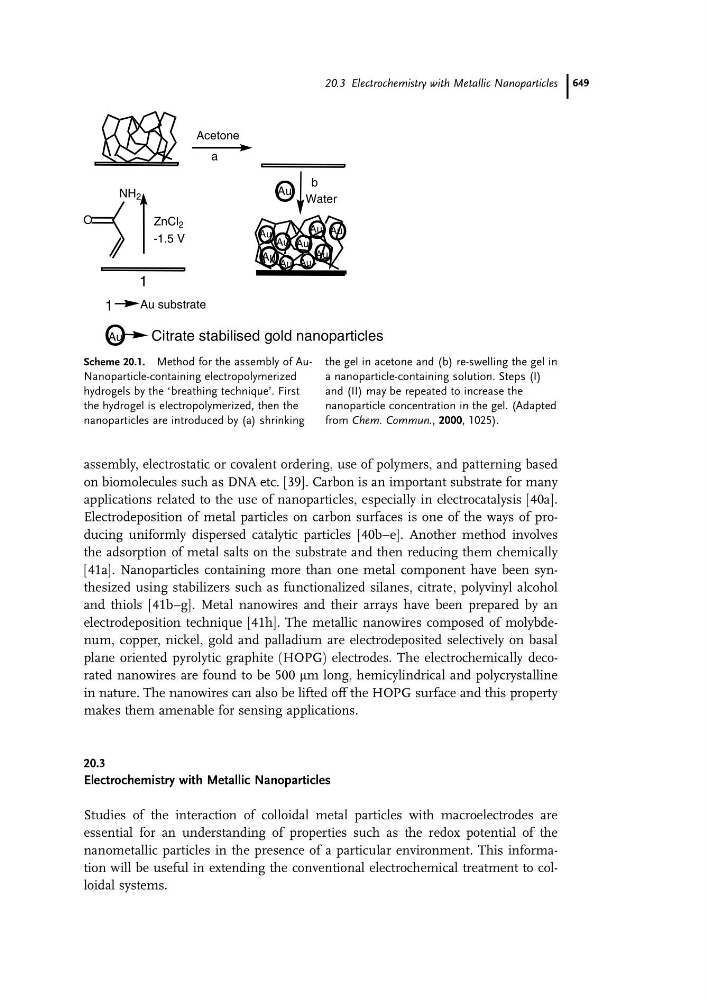
Scheme 20.1. Method for the assembly of AuNanoparticle-containing electropolymerized
hydrogels by the ‘breathing technique’. First
the hydrogel is electropolymerized, then the
nanoparticles are introduced by (a) shrinking
the gel in acetone and (b) re-swelling the gel in
a nanoparticle-containing solution. Steps (I)
and (II) may be repeated to increase the
nanoparticle concentration in the gel. (Adapted
from Chem. Commun., 2000, 1025).
20.3 Electrochemistry with Metallic Nanoparticles 649