

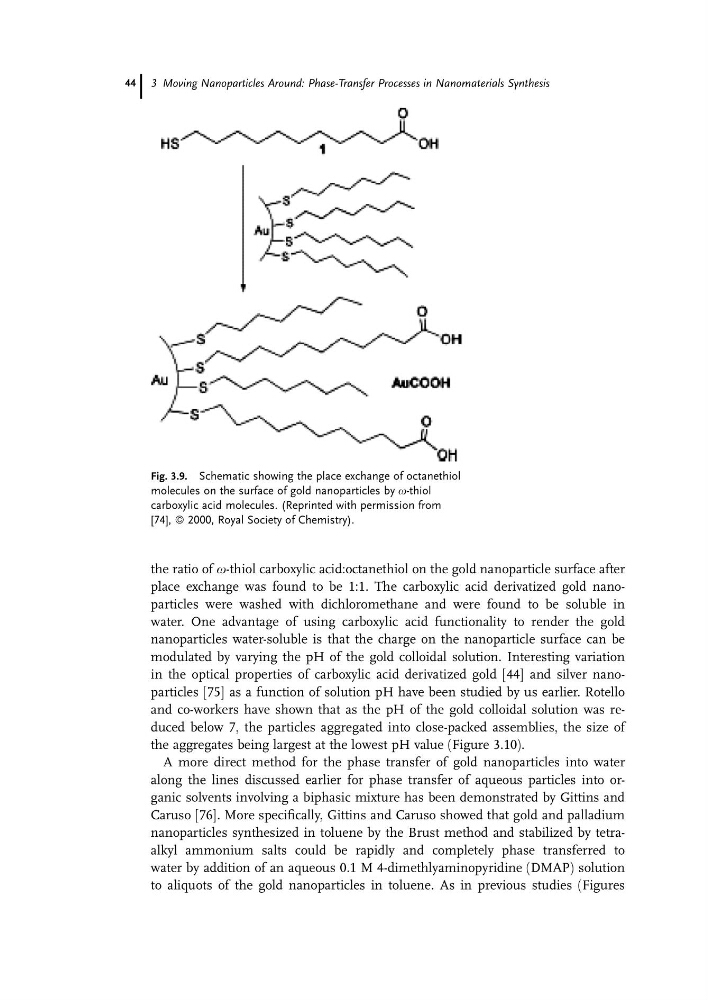
the ratio of o-thiol carboxylic acid:octanethiol on the gold nanoparticle surface after
place exchange was found to be 1:1. The carboxylic acid derivatized gold nanoparticles were washed with dichloromethane and were found to be soluble in
water. One advantage of using carboxylic acid functionality to render the gold
nanoparticles water-soluble is that the charge on the nanoparticle surface can be
modulated by varying the pH of the gold colloidal solution. Interesting variation
in the optical properties of carboxylic acid derivatized gold [44] and silver nanoparticles [75] as a function of solution pH have been studied by us earlier. Rotello
and co-workers have shown that as the pH of the gold colloidal solution was reduced below 7, the particles aggregated into close-packed assemblies, the size of
the aggregates being largest at the lowest pH value (Figure 3.10).
A more direct method for the phase transfer of gold nanoparticles into water
along the lines discussed earlier for phase transfer of aqueous particles into organic solvents involving a biphasic mixture has been demonstrated by Gittins and
Caruso [76]. More specifically, Gittins and Caruso showed that gold and palladium
nanoparticles synthesized in toluene by the Brust method and stabilized by tetraalkyl ammonium salts could be rapidly and completely phase transferred to
water by addition of an aqueous 0.1 M 4-dimethlyaminopyridine (DMAP) solution
to aliquots of the gold nanoparticles in toluene. As in previous studies (Figures
Fig. 3.9. Schematic showing the place exchange of octanethiol
molecules on the surface of gold nanoparticles by o-thiol
carboxylic acid molecules. (Reprinted with permission from
[74], 8 2000, Royal Society of Chemistry).
3 Moving Nanoparticles Around: Phase-Transfer Processes in Nanomaterials Synthesis
44
place exchange was found to be 1:1. The carboxylic acid derivatized gold nanoparticles were washed with dichloromethane and were found to be soluble in
water. One advantage of using carboxylic acid functionality to render the gold
nanoparticles water-soluble is that the charge on the nanoparticle surface can be
modulated by varying the pH of the gold colloidal solution. Interesting variation
in the optical properties of carboxylic acid derivatized gold [44] and silver nanoparticles [75] as a function of solution pH have been studied by us earlier. Rotello
and co-workers have shown that as the pH of the gold colloidal solution was reduced below 7, the particles aggregated into close-packed assemblies, the size of
the aggregates being largest at the lowest pH value (Figure 3.10).
A more direct method for the phase transfer of gold nanoparticles into water
along the lines discussed earlier for phase transfer of aqueous particles into organic solvents involving a biphasic mixture has been demonstrated by Gittins and
Caruso [76]. More specifically, Gittins and Caruso showed that gold and palladium
nanoparticles synthesized in toluene by the Brust method and stabilized by tetraalkyl ammonium salts could be rapidly and completely phase transferred to
water by addition of an aqueous 0.1 M 4-dimethlyaminopyridine (DMAP) solution
to aliquots of the gold nanoparticles in toluene. As in previous studies (Figures
Fig. 3.9. Schematic showing the place exchange of octanethiol
molecules on the surface of gold nanoparticles by o-thiol
carboxylic acid molecules. (Reprinted with permission from
[74], 8 2000, Royal Society of Chemistry).
3 Moving Nanoparticles Around: Phase-Transfer Processes in Nanomaterials Synthesis
44