

decays. As confirmed from the pulse radiolysis experiments [183], the 390 nm
absorption band represents complexation between (SCN) 2
À. radicals and the gold
surface which results in the oxidation of the gold layer.
19.6.2
Fermi Level Equilibration
Metal islands or nanoparticles deposited on a semiconductor surface undergo
Fermi level equilibration following charging with photogenerated electrons. The
effect of Fermi level equilibration is predominantly seen when the metal deposits
consist of small islands or small particles. Unlike the ohmic contact observed in
bulk metals, the nanoparticles retain the charge before transferring them to the
redox species. During extended UV-photolysis, electron-capture by metal islands of
Ag, Au and Cu becomes inhibited as their Fermi level shifts close to the conduction band of the semiconductor. Pt on the other hand acts as an electron sink and
fails to achieve Fermi level equilibration.
Semiconductor nanoparticles such as TiO 2 and ZnO store electrons following
bandgap excitation. Since the Fermi level of gold (E F ¼ þ0:5 V vs. NHE) is more
positive than the conduction band energy of TiO 2 and ZnO (E CB ¼ À0:5 V vs. NHE
at pH 7), we expect a quick distribution of electrons between excited semiconductor and metal nanoparticles. The electrons transferred to a gold nanoparticle increase the electron density within the nanoparticle, thus shifting the Fermi-level
towards more negative potentials. The transfer of electrons to metal continues
until the Fermi level equilibrates with the conduction band edge of the semiconductor (Figure 19.14).
By employing C 60 /C 60
À as a probe-redox couple it is possible to estimate the apparent Fermi levels of TiO 2 and TiO 2 /Au nanoparticles [184]. The particle size of
0.00
0.01
0.02
0.00
0.04
0.08
0.12
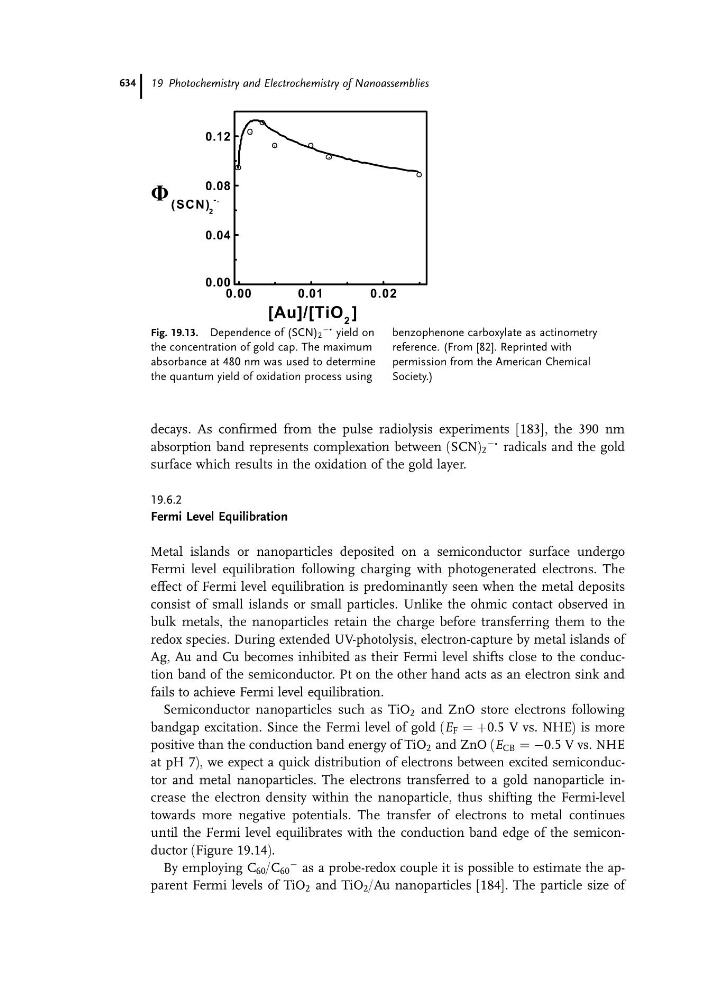
F (SCN)
2
-.
[Au]/[TiO 2 ]
Fig. 19.13. Dependence of (SCN) 2
À . yield on
the concentration of gold cap. The maximum
absorbance at 480 nm was used to determine
the quantum yield of oxidation process using
benzophenone carboxylate as actinometry
reference. (From [82]. Reprinted with
permission from the American Chemical
Society.)
19 Photochemistry and Electrochemistry of Nanoassemblies
634