

ible diphosphonates in combination with transition metals. Two of the most spectacular examples from this field are [M(O 3 PCH 2 NH(C 2 H 4 ) 2 NHCH 2 PO 3 )]ÁH 2 O
(M ¼ Mn, Co) and [NH 4 ] 4 [(V
IV O) 3 (O 3 PCH 2 PO 3 ) 4 (H 2 O) 4 ]Á4H 2 O. The first [135] is
made from tetrameric Co 2 P 2 entities linked by CH 2 NH(C 2 H 4 ) 2 NHCH 2 groups in
three directions. The long connections between the tetramers lead to very large,
ellipsoidal 44-membered rings (0:47 Â 1:8 nm
2 ) containing water molecules. The
second [136], using vanadium, leads to clover-like windows in which ammonium
ions and water molecules lie. Such an approach, successful with 3d transition
metals, is also valuable for lanthanides [137]. For example, a whole series of lanthanide phosphonates has recently been characterized. Some of these materials
involve vertex-sharing chains of LnO n polyhedra, in which case they formally belong to the hybrid metal oxides category described in the next section.
Several drawbacks to the coordination polymer approach exist. First, their thermal stability is relatively low (typically losing crystallinity below 300
C). Secondly,
organic molecules do not normally communicate magnetic interactions efficiently
enough to prepare magnetic materials with ordering temperatures sufficiently high
to be useful. Recently, Veciana and coworkers demonstrated that organic radicals
could be used to improve the strength of coupling between Cu
2þ centers in an
open-framework coordination polymer [138]. While the ordering temperature is
relatively low because their material is two-dimensional, it remains to be seen if
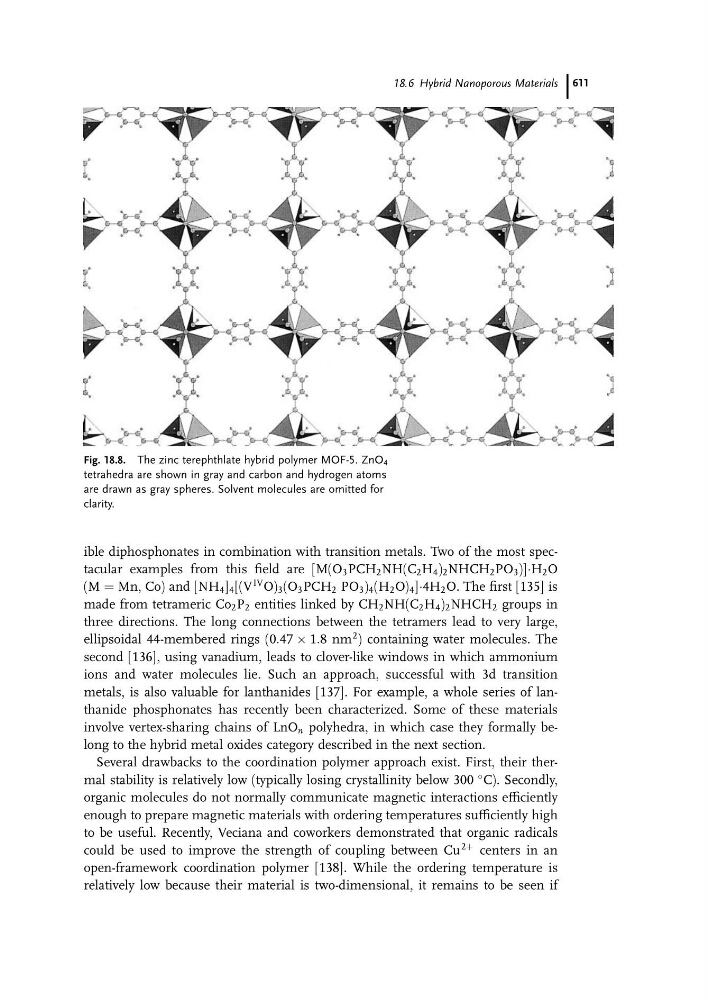
Fig. 18.8. The zinc terephthlate hybrid polymer MOF-5. ZnO 4
tetrahedra are shown in gray and carbon and hydrogen atoms
are drawn as gray spheres. Solvent molecules are omitted for
clarity.
18.6 Hybrid Nanoporous Materials 611