

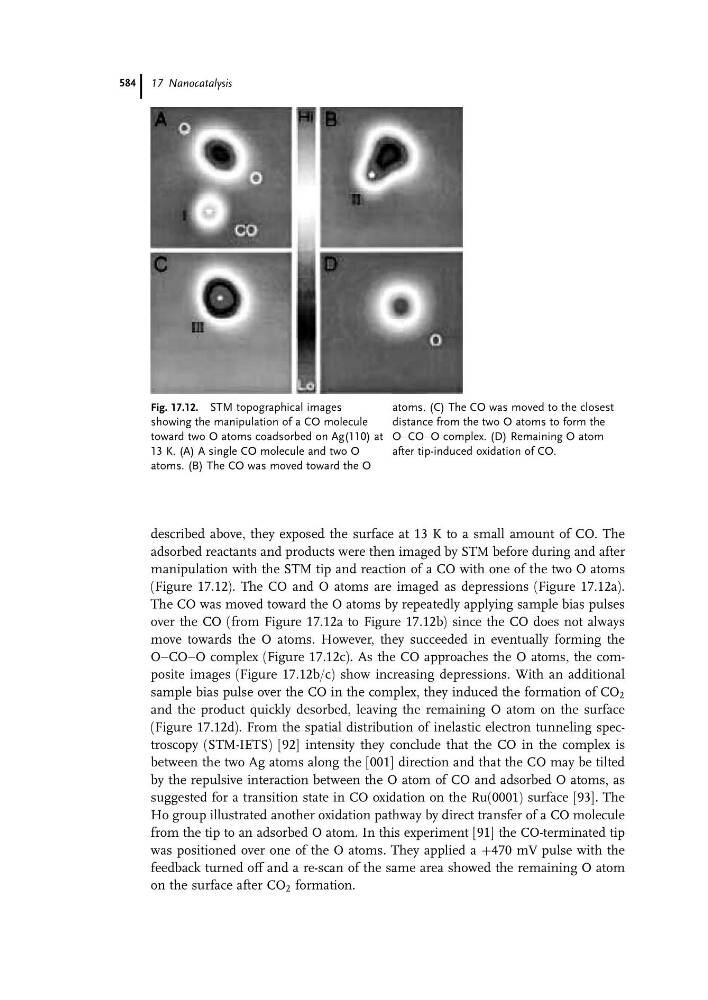
described above, they exposed the surface at 13 K to a small amount of CO. The
adsorbed reactants and products were then imaged by STM before during and after
manipulation with the STM tip and reaction of a CO with one of the two O atoms
(Figure 17.12). The CO and O atoms are imaged as depressions (Figure 17.12a).
The CO was moved toward the O atoms by repeatedly applying sample bias pulses
over the CO (from Figure 17.12a to Figure 17.12b) since the CO does not always
move towards the O atoms. However, they succeeded in eventually forming the
OaCOaO complex (Figure 17.12c). As the CO approaches the O atoms, the composite images (Figure 17.12b/c) show increasing depressions. With an additional
sample bias pulse over the CO in the complex, they induced the formation of CO 2
and the product quickly desorbed, leaving the remaining O atom on the surface
(Figure 17.12d). From the spatial distribution of inelastic electron tunneling spectroscopy (STM-IETS) [92] intensity they conclude that the CO in the complex is
between the two Ag atoms along the [001] direction and that the CO may be tilted
by the repulsive interaction between the O atom of CO and adsorbed O atoms, as
suggested for a transition state in CO oxidation on the Ru(0001) surface [93]. The
Ho group illustrated another oxidation pathway by direct transfer of a CO molecule
from the tip to an adsorbed O atom. In this experiment [91] the CO-terminated tip
was positioned over one of the O atoms. They applied a þ470 mV pulse with the
feedback turned off and a re-scan of the same area showed the remaining O atom
on the surface after CO 2 formation.
Fig. 17.12. STM topographical images
showing the manipulation of a CO molecule
toward two O atoms coadsorbed on Ag(110) at
13 K. (A) A single CO molecule and two O
atoms. (B) The CO was moved toward the O
atoms. (C) The CO was moved to the closest
distance from the two O atoms to form the
OaCOaO complex. (D) Remaining O atom
after tip-induced oxidation of CO.
17 Nanocatalysis
584