

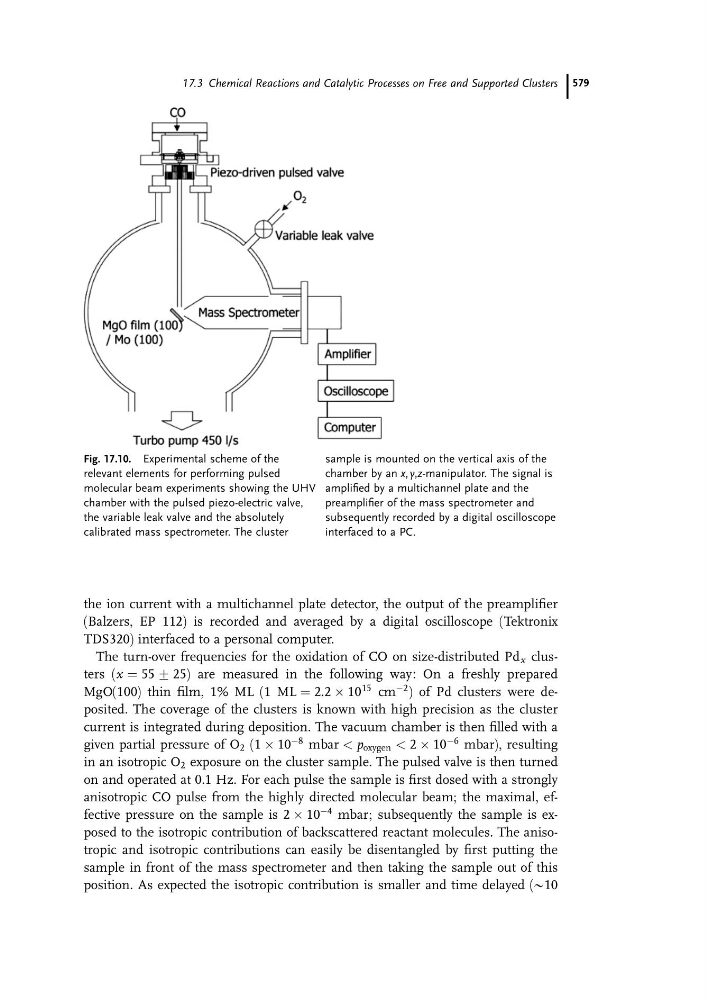
the ion current with a multichannel plate detector, the output of the preamplifier
(Balzers, EP 112) is recorded and averaged by a digital oscilloscope (Tektronix
TDS320) interfaced to a personal computer.
The turn-over frequencies for the oxidation of CO on size-distributed Pd x clusters (x ¼ 55 G 25) are measured in the following way: On a freshly prepared
MgO(100) thin film, 1% ML (1 ML ¼ 2.2 Â 10
15 cm
À2 ) of Pd clusters were deposited. The coverage of the clusters is known with high precision as the cluster
current is integrated during deposition. The vacuum chamber is then filled with a
given partial pressure of O 2 (1 Â 10
À8 mbar < p oxygen < 2 Â 10
À6 mbar), resulting
in an isotropic O 2 exposure on the cluster sample. The pulsed valve is then turned
on and operated at 0.1 Hz. For each pulse the sample is first dosed with a strongly
anisotropic CO pulse from the highly directed molecular beam; the maximal, effective pressure on the sample is 2 Â 10
À4 mbar; subsequently the sample is exposed to the isotropic contribution of backscattered reactant molecules. The anisotropic and isotropic contributions can easily be disentangled by first putting the
sample in front of the mass spectrometer and then taking the sample out of this
position. As expected the isotropic contribution is smaller and time delayed (@10
Fig. 17.10. Experimental scheme of the
relevant elements for performing pulsed
molecular beam experiments showing the UHV
chamber with the pulsed piezo-electric valve,
the variable leak valve and the absolutely
calibrated mass spectrometer. The cluster
sample is mounted on the vertical axis of the
chamber by an x, y,z-manipulator. The signal is
amplified by a multichannel plate and the
preamplifier of the mass spectrometer and
subsequently recorded by a digital oscilloscope
interfaced to a PC.
17.3 Chemical Reactions and Catalytic Processes on Free and Supported Clusters 579