

structural, dynamical, electronic and compositional factors that govern these processes is the key to elucidation of the observed size-dependent activity of the Au n /
MgO(F 5c ) model catalysts. Indeed, these first-principles simulations show that the
binding energy of O 2 to the supported Au n clusters and the degree of OaO bond
activation are strongly dependent on the cluster size (see below). In contrast, the
adsorption energy of CO to the supported clusters is relatively insensitive to the
cluster size, and it is higher than that of oxygen (0.7–1.0 eV per CO molecule, depending on coverage). Consequently, in the following the adsorption and activation
of O 2 by the supported gold nanoclusters is studied in more detail, to illustrate the
aforementioned nanocatalytic factors that govern this key reaction step.
1. Structural Dynamical Fluxionality: The capability of small clusters to exhibit
several structural forms (isomers) of comparable energies, and to interconvert between such isomers at finite temperature, is one of the hallmarks of cluster
science. This unique structural variability may influence the chemical reactivity of
nanocatalytic systems in two main ways. First, at finite temperature, the model
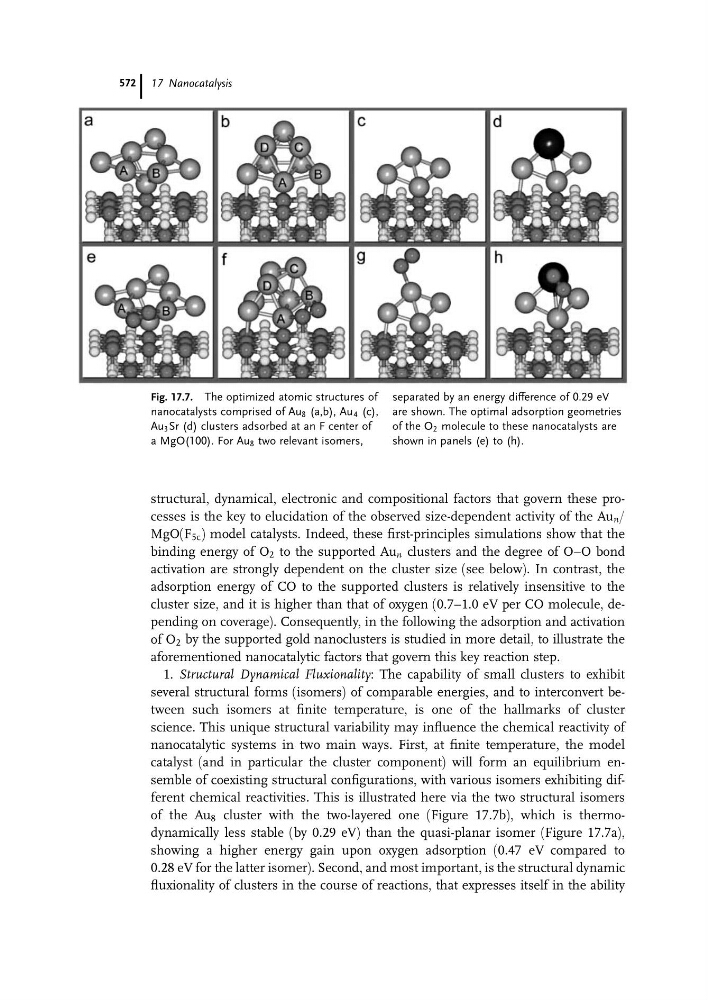
catalyst (and in particular the cluster component) will form an equilibrium ensemble of coexisting structural configurations, with various isomers exhibiting different chemical reactivities. This is illustrated here via the two structural isomers
of the Au 8 cluster with the two-layered one (Figure 17.7b), which is thermodynamically less stable (by 0.29 eV) than the quasi-planar isomer (Figure 17.7a),
showing a higher energy gain upon oxygen adsorption (0.47 eV compared to
0.28 eV for the latter isomer). Second, and most important, is the structural dynamic
fluxionality of clusters in the course of reactions, that expresses itself in the ability
Fig. 17.7. The optimized atomic structures of
nanocatalysts comprised of Au 8 (a,b), Au 4 (c),
Au 3 Sr (d) clusters adsorbed at an F center of
a MgO(100). For Au 8 two relevant isomers,
separated by an energy difference of 0.29 eV
are shown. The optimal adsorption geometries
of the O 2 molecule to these nanocatalysts are
shown in panels (e) to (h).
17 Nanocatalysis
572