

sorbed molecule is found to be activated to a peroxo O 2
à molecular state with a
weakened highly stretched intramolecular bond length (1.41 A ˚ –1.46 A ˚ ) compared
to that in the free molecule (1.24 A ˚ ). The activation of the adsorbed oxygen molecule involves occupation of the antibonding p k
à molecular orbital (i.e., the molecular oxygen p g
à orbital oriented parallel to the adsorbing surface), which hybridizes
with the orbitals of neighboring gold atoms of the partially negatively charged adsorbed gold cluster (Figure 17.6a).
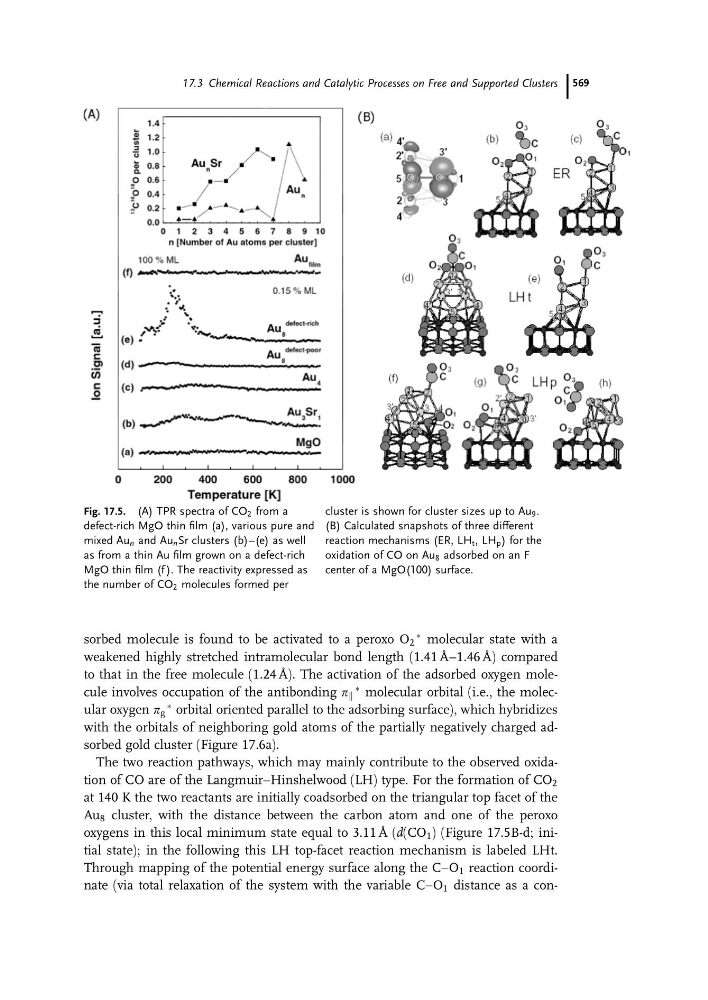
The two reaction pathways, which may mainly contribute to the observed oxidation of CO are of the Langmuir–Hinshelwood (LH) type. For the formation of CO 2
at 140 K the two reactants are initially coadsorbed on the triangular top facet of the
Au 8 cluster, with the distance between the carbon atom and one of the peroxo
oxygens in this local minimum state equal to 3.11 A ˚ (d(CO 1 ) (Figure 17.5B-d; initial state); in the following this LH top-facet reaction mechanism is labeled LHt.
Through mapping of the potential energy surface along the CaO 1 reaction coordinate (via total relaxation of the system with the variable CaO 1 distance as a conFig. 17.5. (A) TPR spectra of CO 2 from a
defect-rich MgO thin film (a), various pure and
mixed Au n and Au n Sr clusters (b)–(e) as well
as from a thin Au film grown on a defect-rich
MgO thin film (f ). The reactivity expressed as
the number of CO 2 molecules formed per
cluster is shown for cluster sizes up to Au 9 .
(B) Calculated snapshots of three different
reaction mechanisms (ER, LH t , LH p ) for the
oxidation of CO on Au 8 adsorbed on an F
center of a MgO(100) surface.
17.3 Chemical Reactions and Catalytic Processes on Free and Supported Clusters 569