

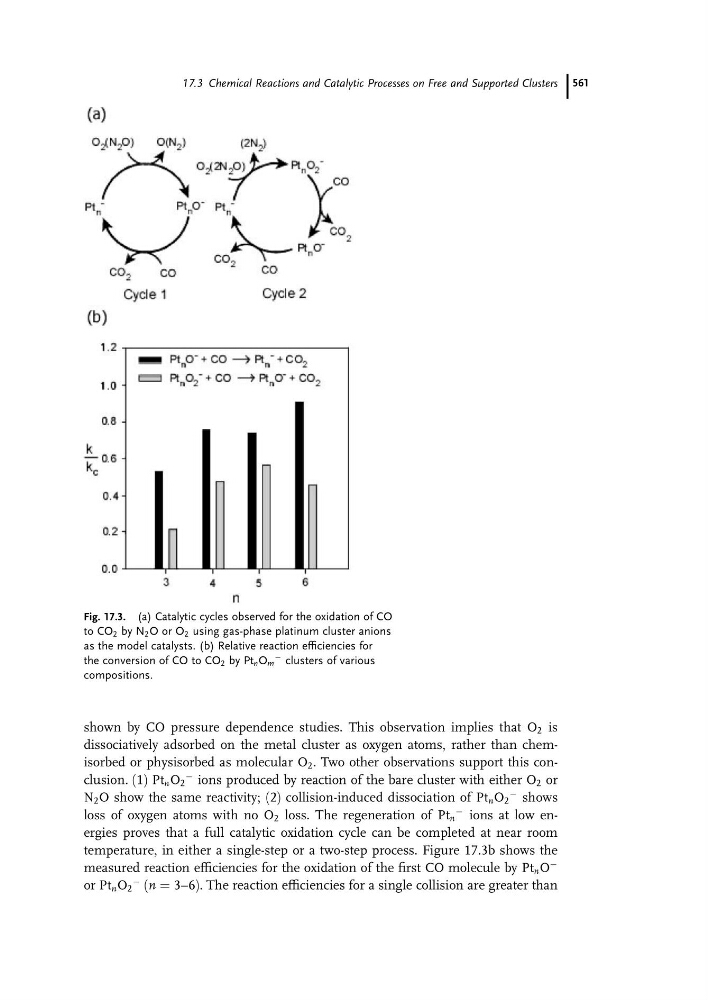
shown by CO pressure dependence studies. This observation implies that O 2 is
dissociatively adsorbed on the metal cluster as oxygen atoms, rather than chemisorbed or physisorbed as molecular O 2 . Two other observations support this conclusion. (1) Pt n O 2
À ions produced by reaction of the bare cluster with either O 2 or
N 2 O show the same reactivity; (2) collision-induced dissociation of Pt n O 2
À shows
loss of oxygen atoms with no O 2 loss. The regeneration of Pt n
À ions at low energies proves that a full catalytic oxidation cycle can be completed at near room
temperature, in either a single-step or a two-step process. Figure 17.3b shows the
measured reaction efficiencies for the oxidation of the first CO molecule by Pt n O
À
or Pt n O 2
À (n ¼ 3–6). The reaction efficiencies for a single collision are greater than
Fig. 17.3. (a) Catalytic cycles observed for the oxidation of CO
to CO 2 by N 2 O or O 2 using gas-phase platinum cluster anions
as the model catalysts. (b) Relative reaction efficiencies for
the conversion of CO to CO 2 by Pt n O m
À clusters of various
compositions.
17.3 Chemical Reactions and Catalytic Processes on Free and Supported Clusters 561