

accomplish phase transfer into organic solvents essentially differ in the nature of
the capping molecule employed to hydrophobize the nanoparticles. Possibly the
first report on the phase transfer of gold nanoparticles from water to an organic
solvent such as butyl acetate was that of Underwood and Mulvaney [64]. In this
study, the authors showed that aqueous gold nanoparticles synthesized by the Turkevich method [33] could be quantitatively transferred into butyl acetate by complexation of the particles with a ‘comb stabilizer’ present in the organic phase [64].
The comb stabilizer used was a co-polymer consisting of a backbone of methyl
methacrylate and glycidyl methacrylate with poly(12-hydroxystearic acid) as pendant side chains. Gentle shaking of a biphasic mixture of the gold hydrosol and
comb stabilizer in butyl acetate resulted in the emulsification of the gold hydrosol–
butyl acetate mixture, this process accelerating the complexation of the polymer
with the gold nanoparticle surface. The gold nanoparticles were thereby hydrophobized and were phase transferred to the organic phase. Gold sols possess a
lovely pink to ruby red color [64] and therefore, the phase transfer of the gold particles from one phase to another is seen as a dramatic transfer of color between
phases.
The focus of the work of Underwood and Mulvaney was to study changes in the
optical properties of gold colloids as the refractive index of the organic solution was
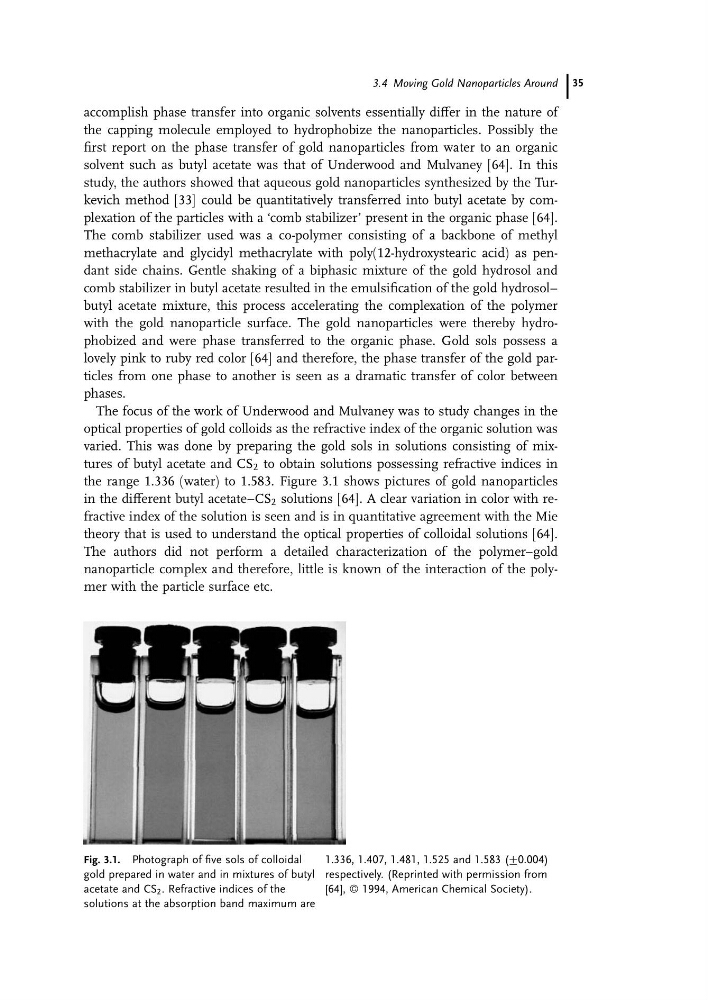
varied. This was done by preparing the gold sols in solutions consisting of mixtures of butyl acetate and CS 2 to obtain solutions possessing refractive indices in
the range 1.336 (water) to 1.583. Figure 3.1 shows pictures of gold nanoparticles
in the different butyl acetate–CS 2 solutions [64]. A clear variation in color with refractive index of the solution is seen and is in quantitative agreement with the Mie
theory that is used to understand the optical properties of colloidal solutions [64].
The authors did not perform a detailed characterization of the polymer–gold
nanoparticle complex and therefore, little is known of the interaction of the polymer with the particle surface etc.
Fig. 3.1. Photograph of five sols of colloidal
gold prepared in water and in mixtures of butyl
acetate and CS 2 . Refractive indices of the
solutions at the absorption band maximum are
1.336, 1.407, 1.481, 1.525 and 1.583 (G0.004)
respectively. (Reprinted with permission from
[64], 8 1994, American Chemical Society).
3.4 Moving Gold Nanoparticles Around 35
the capping molecule employed to hydrophobize the nanoparticles. Possibly the
first report on the phase transfer of gold nanoparticles from water to an organic
solvent such as butyl acetate was that of Underwood and Mulvaney [64]. In this
study, the authors showed that aqueous gold nanoparticles synthesized by the Turkevich method [33] could be quantitatively transferred into butyl acetate by complexation of the particles with a ‘comb stabilizer’ present in the organic phase [64].
The comb stabilizer used was a co-polymer consisting of a backbone of methyl
methacrylate and glycidyl methacrylate with poly(12-hydroxystearic acid) as pendant side chains. Gentle shaking of a biphasic mixture of the gold hydrosol and
comb stabilizer in butyl acetate resulted in the emulsification of the gold hydrosol–
butyl acetate mixture, this process accelerating the complexation of the polymer
with the gold nanoparticle surface. The gold nanoparticles were thereby hydrophobized and were phase transferred to the organic phase. Gold sols possess a
lovely pink to ruby red color [64] and therefore, the phase transfer of the gold particles from one phase to another is seen as a dramatic transfer of color between
phases.
The focus of the work of Underwood and Mulvaney was to study changes in the
optical properties of gold colloids as the refractive index of the organic solution was
varied. This was done by preparing the gold sols in solutions consisting of mixtures of butyl acetate and CS 2 to obtain solutions possessing refractive indices in
the range 1.336 (water) to 1.583. Figure 3.1 shows pictures of gold nanoparticles
in the different butyl acetate–CS 2 solutions [64]. A clear variation in color with refractive index of the solution is seen and is in quantitative agreement with the Mie
theory that is used to understand the optical properties of colloidal solutions [64].
The authors did not perform a detailed characterization of the polymer–gold
nanoparticle complex and therefore, little is known of the interaction of the polymer with the particle surface etc.
Fig. 3.1. Photograph of five sols of colloidal
gold prepared in water and in mixtures of butyl
acetate and CS 2 . Refractive indices of the
solutions at the absorption band maximum are
1.336, 1.407, 1.481, 1.525 and 1.583 (G0.004)
respectively. (Reprinted with permission from
[64], 8 1994, American Chemical Society).
3.4 Moving Gold Nanoparticles Around 35