

Desorption/ionization on silicon mass spectrometry (DIOS-MS), introduced by
Buriak and Siuzdak in 1999 [127], employs porous silicon prepared by anodization
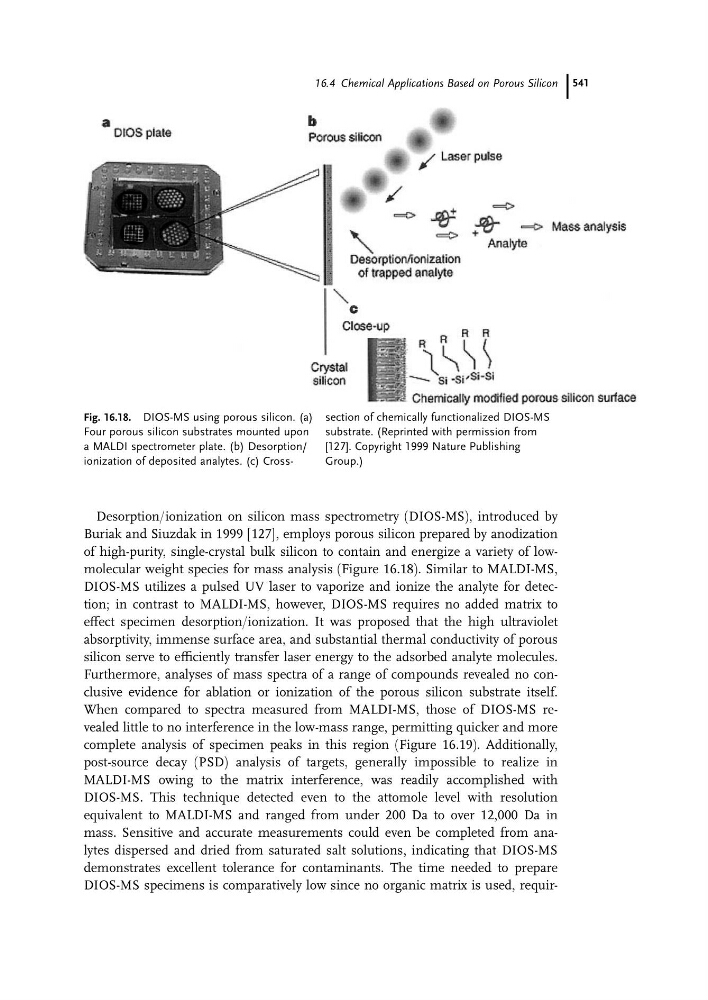
of high-purity, single-crystal bulk silicon to contain and energize a variety of lowmolecular weight species for mass analysis (Figure 16.18). Similar to MALDI-MS,
DIOS-MS utilizes a pulsed UV laser to vaporize and ionize the analyte for detection; in contrast to MALDI-MS, however, DIOS-MS requires no added matrix to
effect specimen desorption/ionization. It was proposed that the high ultraviolet
absorptivity, immense surface area, and substantial thermal conductivity of porous
silicon serve to efficiently transfer laser energy to the adsorbed analyte molecules.
Furthermore, analyses of mass spectra of a range of compounds revealed no conclusive evidence for ablation or ionization of the porous silicon substrate itself.
When compared to spectra measured from MALDI-MS, those of DIOS-MS revealed little to no interference in the low-mass range, permitting quicker and more
complete analysis of specimen peaks in this region (Figure 16.19). Additionally,
post-source decay (PSD) analysis of targets, generally impossible to realize in
MALDI-MS owing to the matrix interference, was readily accomplished with
DIOS-MS. This technique detected even to the attomole level with resolution
equivalent to MALDI-MS and ranged from under 200 Da to over 12,000 Da in
mass. Sensitive and accurate measurements could even be completed from analytes dispersed and dried from saturated salt solutions, indicating that DIOS-MS
demonstrates excellent tolerance for contaminants. The time needed to prepare
DIOS-MS specimens is comparatively low since no organic matrix is used, requirFig. 16.18. DIOS-MS using porous silicon. (a)
Four porous silicon substrates mounted upon
a MALDI spectrometer plate. (b) Desorption/
ionization of deposited analytes. (c) Crosssection of chemically functionalized DIOS-MS
substrate. (Reprinted with permission from
[127]. Copyright 1999 Nature Publishing
Group.)
16.4 Chemical Applications Based on Porous Silicon 541