

rated into porous silicon substrates (Figure 16.6), demonstrating the ability to tailor
surfaces for particular reactivity or interaction. Numerous studies of the stability of
functionalized surfaces have shown repeatedly that the steric, hydrophobic organic
monolayers protect the underlying material from the oxidation and degradation
inflicted by long-term storage in air, exposure to boiling organic solvents and basic
aqueous solutions, and even full immersion and incubation in simulated biological
media. In contrast, hydride-terminated porous silicon corrodes quickly or dissolves
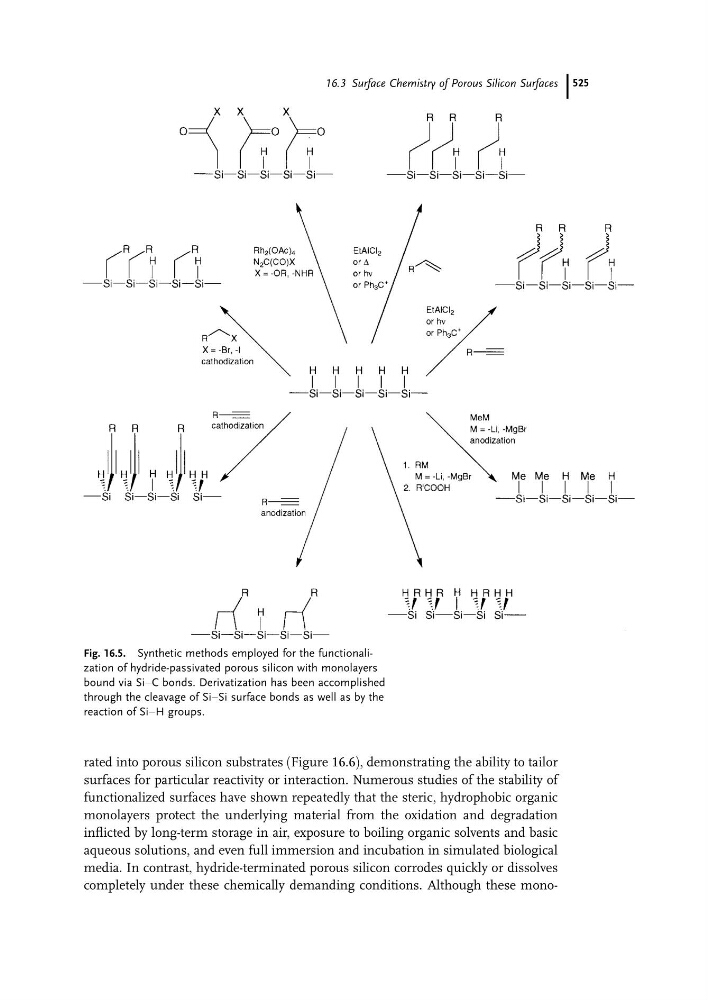
completely under these chemically demanding conditions. Although these monoFig. 16.5. Synthetic methods employed for the functionalization of hydride-passivated porous silicon with monolayers
bound via SiaC bonds. Derivatization has been accomplished
through the cleavage of SiaSi surface bonds as well as by the
reaction of SiaH groups.
16.3 Surface Chemistry of Porous Silicon Surfaces 525