

By judicious choice of the structure and relative sizes of the block segments, a
wider range of nanostructures have become accessible in a relatively short timespan.
15.7
Rod–Coil Diblock Copolymers
Block copolymers, wherein both blocks consist of polymer chains that adopt a
random coil conformation, are by far the most thoroughly investigated systems
and, as seen in the earlier section, they have been extensively utilized to prepare a
variety of nanostructures. However, in most of these systems there is little if any
molecular order within the nanosize objects they help to generate. Replacing one
of the blocks by a relatively stiff rod-like segment generates systems that are
termed rod–coil diblock copolymers [64]. Strongly interacting and often crystallizable rod-segments could provide an additional driving force for the microphase separation in terms of the enthalpic contribution. Another important factor
that is distinct in rod–coil systems is the stiffness asymmetry (or stiffness contrast)
between the two blocks, which leads to an increase in the Flory–Huggins wparameter. This in turn can induce phase separation at relatively smaller block
lengths (degree of polymerization) when compared to simple coil–coil diblock copolymers, thereby permitting the formation of much smaller domain sizes. Furthermore, because the rods form orientationally ordered domains, it has been possible to generate polar ordering in bulk systems utilizing this approach. Thus, the
final morphology that results from rod–coil block copolymers is often governed by
the competition between the microphase separation of the rod and coil segments,
and the tendency for the rods to form anisotropic orientationally ordered domains.
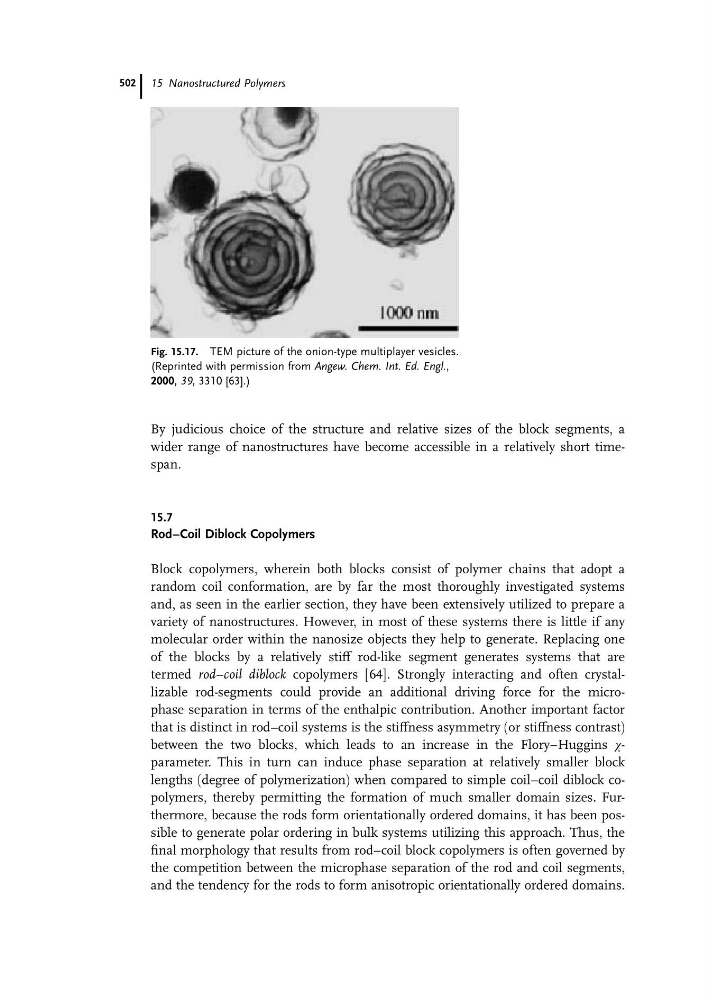
Fig. 15.17. TEM picture of the onion-type multiplayer vesicles.
(Reprinted with permission from Angew. Chem. Int. Ed. Engl.,
2000, 39, 3310 [63].)
15 Nanostructured Polymers
502
wider range of nanostructures have become accessible in a relatively short timespan.
15.7
Rod–Coil Diblock Copolymers
Block copolymers, wherein both blocks consist of polymer chains that adopt a
random coil conformation, are by far the most thoroughly investigated systems
and, as seen in the earlier section, they have been extensively utilized to prepare a
variety of nanostructures. However, in most of these systems there is little if any
molecular order within the nanosize objects they help to generate. Replacing one
of the blocks by a relatively stiff rod-like segment generates systems that are
termed rod–coil diblock copolymers [64]. Strongly interacting and often crystallizable rod-segments could provide an additional driving force for the microphase separation in terms of the enthalpic contribution. Another important factor
that is distinct in rod–coil systems is the stiffness asymmetry (or stiffness contrast)
between the two blocks, which leads to an increase in the Flory–Huggins wparameter. This in turn can induce phase separation at relatively smaller block
lengths (degree of polymerization) when compared to simple coil–coil diblock copolymers, thereby permitting the formation of much smaller domain sizes. Furthermore, because the rods form orientationally ordered domains, it has been possible to generate polar ordering in bulk systems utilizing this approach. Thus, the
final morphology that results from rod–coil block copolymers is often governed by
the competition between the microphase separation of the rod and coil segments,
and the tendency for the rods to form anisotropic orientationally ordered domains.
Fig. 15.17. TEM picture of the onion-type multiplayer vesicles.
(Reprinted with permission from Angew. Chem. Int. Ed. Engl.,
2000, 39, 3310 [63].)
15 Nanostructured Polymers
502