

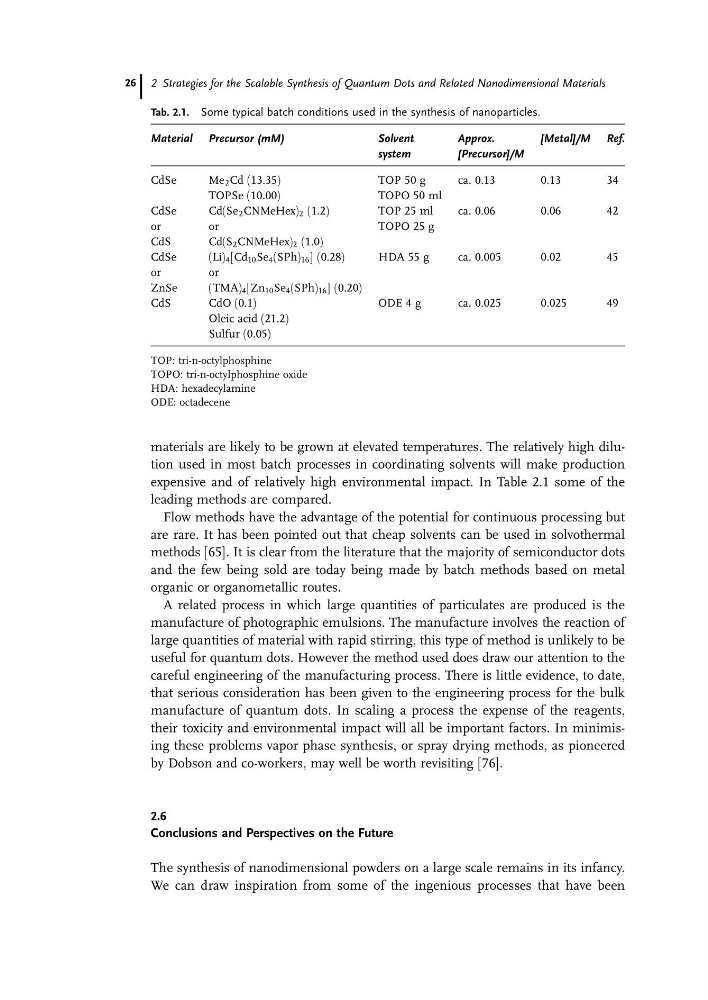
materials are likely to be grown at elevated temperatures. The relatively high dilution used in most batch processes in coordinating solvents will make production
expensive and of relatively high environmental impact. In Table 2.1 some of the
leading methods are compared.
Flow methods have the advantage of the potential for continuous processing but
are rare. It has been pointed out that cheap solvents can be used in solvothermal
methods [65]. It is clear from the literature that the majority of semiconductor dots
and the few being sold are today being made by batch methods based on metal
organic or organometallic routes.
A related process in which large quantities of particulates are produced is the
manufacture of photographic emulsions. The manufacture involves the reaction of
large quantities of material with rapid stirring, this type of method is unlikely to be
useful for quantum dots. However the method used does draw our attention to the
careful engineering of the manufacturing process. There is little evidence, to date,
that serious consideration has been given to the engineering process for the bulk
manufacture of quantum dots. In scaling a process the expense of the reagents,
their toxicity and environmental impact will all be important factors. In minimising these problems vapor phase synthesis, or spray drying methods, as pioneered
by Dobson and co-workers, may well be worth revisiting [76].
2.6
Conclusions and Perspectives on the Future
The synthesis of nanodimensional powders on a large scale remains in its infancy.
We can draw inspiration from some of the ingenious processes that have been
Tab. 2.1. Some typical batch conditions used in the synthesis of nanoparticles.
Material Precursor (mM)
Solvent
system
Approx.
[Precursor]/M
[Metal]/M Ref.
CdSe
Me 2 Cd (13.35)
TOPSe (10.00)
TOP 50 g
TOPO 50 ml
ca. 0.13
0.13
34
CdSe
or
CdS
Cd(Se 2 CNMeHex) 2 (1.2)
or
Cd(S 2 CNMeHex) 2 (1.0)
TOP 25 ml
TOPO 25 g
ca. 0.06
0.06
42
CdSe
or
ZnSe
(Li) 4 [Cd 10 Se 4 (SPh) 16 ] (0.28)
or
(TMA) 4 [Zn 10 Se 4 (SPh) 16 ] (0.20)
HDA 55 g
ca. 0.005
0.02
45
CdS
CdO (0.1)
Oleic acid (21.2)
Sulfur (0.05)
ODE 4 g
ca. 0.025
0.025
49
TOP: tri-n-octylphosphine
TOPO: tri-n-octylphosphine oxide
HDA: hexadecylamine
ODE: octadecene
2 Strategies for the Scalable Synthesis of Quantum Dots and Related Nanodimensional Materials
26
expensive and of relatively high environmental impact. In Table 2.1 some of the
leading methods are compared.
Flow methods have the advantage of the potential for continuous processing but
are rare. It has been pointed out that cheap solvents can be used in solvothermal
methods [65]. It is clear from the literature that the majority of semiconductor dots
and the few being sold are today being made by batch methods based on metal
organic or organometallic routes.
A related process in which large quantities of particulates are produced is the
manufacture of photographic emulsions. The manufacture involves the reaction of
large quantities of material with rapid stirring, this type of method is unlikely to be
useful for quantum dots. However the method used does draw our attention to the
careful engineering of the manufacturing process. There is little evidence, to date,
that serious consideration has been given to the engineering process for the bulk
manufacture of quantum dots. In scaling a process the expense of the reagents,
their toxicity and environmental impact will all be important factors. In minimising these problems vapor phase synthesis, or spray drying methods, as pioneered
by Dobson and co-workers, may well be worth revisiting [76].
2.6
Conclusions and Perspectives on the Future
The synthesis of nanodimensional powders on a large scale remains in its infancy.
We can draw inspiration from some of the ingenious processes that have been
Tab. 2.1. Some typical batch conditions used in the synthesis of nanoparticles.
Material Precursor (mM)
Solvent
system
Approx.
[Precursor]/M
[Metal]/M Ref.
CdSe
Me 2 Cd (13.35)
TOPSe (10.00)
TOP 50 g
TOPO 50 ml
ca. 0.13
0.13
34
CdSe
or
CdS
Cd(Se 2 CNMeHex) 2 (1.2)
or
Cd(S 2 CNMeHex) 2 (1.0)
TOP 25 ml
TOPO 25 g
ca. 0.06
0.06
42
CdSe
or
ZnSe
(Li) 4 [Cd 10 Se 4 (SPh) 16 ] (0.28)
or
(TMA) 4 [Zn 10 Se 4 (SPh) 16 ] (0.20)
HDA 55 g
ca. 0.005
0.02
45
CdS
CdO (0.1)
Oleic acid (21.2)
Sulfur (0.05)
ODE 4 g
ca. 0.025
0.025
49
TOP: tri-n-octylphosphine
TOPO: tri-n-octylphosphine oxide
HDA: hexadecylamine
ODE: octadecene
2 Strategies for the Scalable Synthesis of Quantum Dots and Related Nanodimensional Materials
26