

tion environments of the copper centers in these Cu 2 S clusters approximate either
trigonal planar or linear geometry, while sulfur atoms almost always act as m 4
bridges, although additional bridging modes of the sulfur ligands are observed in
the larger derivatives 11 (m 3 , m 5 ) and 12 (m 5 , m 6 ). The higher coordination numbers
in 12 are characteristic of Cu 2 S phases [50], but its structure is not strongly related
to that of the Cu 2 S lattice. The structure of the highest nuclearity Cu 2 S cluster 12
(Figure 13.9) can be viewed as a condensation of two spherical units, which themselves are clearly structurally related to cluster 11 (Figure 13.9). This description is
further supported by contrasting the cylindrical 0.7 Â 0.7 Â 1.7 nm
3 core in 12,
with the more symmetrical 0.8 Â 1.2 Â 1.2 nm
3 core observed in the selenide
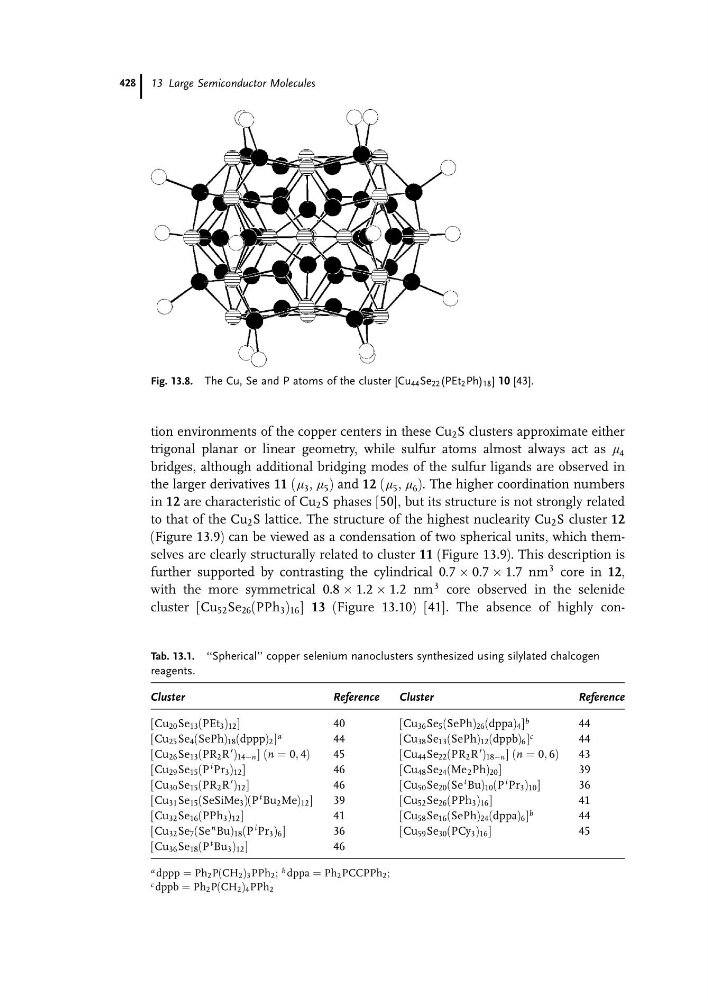
cluster [Cu 52 Se 26 (PPh 3 ) 16 ] 13 (Figure 13.10) [41]. The absence of highly conFig. 13.8. The Cu, Se and P atoms of the cluster [Cu 44 Se 22 (PEt 2 Ph) 18 ] 10 [43].
Tab. 13.1. ‘‘Spherical’’ copper selenium nanoclusters synthesized using silylated chalcogen
reagents.
Cluster
Reference
Cluster
Reference
[Cu 20 Se 13 (PEt 3 ) 12 ]
40
[Cu 36 Se 5 (SePh) 26 (dppa) 4 ] b
44
[Cu 25 Se 4 (SePh) 18 (dppp) 2 ] a
44
[Cu 38 Se 13 (SePh) 12 (dppb) 6 ] c
44
[Cu 26 Se 13 (PR 2 R
0 ) 14Àn ] (n ¼ 0; 4)
45
[Cu 44 Se 22 (PR 2 R
0 ) 18Àn ] (n ¼ 0; 6)
43
[Cu 29 Se 15 (P
i Pr 3 ) 12 ]
46
[Cu 48 Se 24 (Me 2 Ph) 20 ]
3 9
[Cu 30 Se 15 (PR 2 R
0 ) 12 ]
46
[Cu 50 Se 20 (Se
t Bu) 10 (P
i Pr 3 ) 10 ]
3 6
[Cu 31 Se 15 (SeSiMe 3 )(P
t Bu 2 Me) 12 ]
39
[Cu 52 Se 26 (PPh 3 ) 16 ]
4 1
[Cu 32 Se 16 (PPh 3 ) 12 ]
41
[Cu 58 Se 16 (SePh) 24 (dppa) 6 ] b
44
[Cu 32 Se 7 (Se
n Bu) 18 (P
i Pr 3 ) 6 ]
36
[Cu 59 Se 30 (PCy 3 ) 16 ]
4 5
[Cu 36 Se 18 (P
t Bu 3 ) 12 ]
4 6
a dppp ¼ Ph 2 P(CH 2 ) 3 PPh 2 ; b dppa ¼ Ph 2 PCCPPh 2 ;
c dppb ¼ Ph 2 P(CH 2 ) 4 PPh 2
13 Large Semiconductor Molecules
428
trigonal planar or linear geometry, while sulfur atoms almost always act as m 4
bridges, although additional bridging modes of the sulfur ligands are observed in
the larger derivatives 11 (m 3 , m 5 ) and 12 (m 5 , m 6 ). The higher coordination numbers
in 12 are characteristic of Cu 2 S phases [50], but its structure is not strongly related
to that of the Cu 2 S lattice. The structure of the highest nuclearity Cu 2 S cluster 12
(Figure 13.9) can be viewed as a condensation of two spherical units, which themselves are clearly structurally related to cluster 11 (Figure 13.9). This description is
further supported by contrasting the cylindrical 0.7 Â 0.7 Â 1.7 nm
3 core in 12,
with the more symmetrical 0.8 Â 1.2 Â 1.2 nm
3 core observed in the selenide
cluster [Cu 52 Se 26 (PPh 3 ) 16 ] 13 (Figure 13.10) [41]. The absence of highly conFig. 13.8. The Cu, Se and P atoms of the cluster [Cu 44 Se 22 (PEt 2 Ph) 18 ] 10 [43].
Tab. 13.1. ‘‘Spherical’’ copper selenium nanoclusters synthesized using silylated chalcogen
reagents.
Cluster
Reference
Cluster
Reference
[Cu 20 Se 13 (PEt 3 ) 12 ]
40
[Cu 36 Se 5 (SePh) 26 (dppa) 4 ] b
44
[Cu 25 Se 4 (SePh) 18 (dppp) 2 ] a
44
[Cu 38 Se 13 (SePh) 12 (dppb) 6 ] c
44
[Cu 26 Se 13 (PR 2 R
0 ) 14Àn ] (n ¼ 0; 4)
45
[Cu 44 Se 22 (PR 2 R
0 ) 18Àn ] (n ¼ 0; 6)
43
[Cu 29 Se 15 (P
i Pr 3 ) 12 ]
46
[Cu 48 Se 24 (Me 2 Ph) 20 ]
3 9
[Cu 30 Se 15 (PR 2 R
0 ) 12 ]
46
[Cu 50 Se 20 (Se
t Bu) 10 (P
i Pr 3 ) 10 ]
3 6
[Cu 31 Se 15 (SeSiMe 3 )(P
t Bu 2 Me) 12 ]
39
[Cu 52 Se 26 (PPh 3 ) 16 ]
4 1
[Cu 32 Se 16 (PPh 3 ) 12 ]
41
[Cu 58 Se 16 (SePh) 24 (dppa) 6 ] b
44
[Cu 32 Se 7 (Se
n Bu) 18 (P
i Pr 3 ) 6 ]
36
[Cu 59 Se 30 (PCy 3 ) 16 ]
4 5
[Cu 36 Se 18 (P
t Bu 3 ) 12 ]
4 6
a dppp ¼ Ph 2 P(CH 2 ) 3 PPh 2 ; b dppa ¼ Ph 2 PCCPPh 2 ;
c dppb ¼ Ph 2 P(CH 2 ) 4 PPh 2
13 Large Semiconductor Molecules
428