

ergy. Such behaviour is usually associated with extremely pure single crystals in
bulk semiconductors such as the gallium arsenide or indium phosphide or related
alloys used in solid-state lasers. The small shift in the emission is termed a ‘Stokes
shift’.
The characteristic wavelength of light at which these interactions occur is governed by the size of the particle. This effect could be exploited in:
. Inks and dyes (optical probes in general) with a unique color signature often
only visible to the eye when exposed to UV light.
. Functional materials e.g. ones triggered by light to release payloads of proteins
or DNA at an exact location in the human body.
. Solar cells probably hybrid organic/inorganic structures.
Leading to market applications in:
. Security: Authentication and anti-forgery, specifically the elimination of counterfeit currency, documents, brand name clothing, car parts, etc.
Overt and covert anti-counterfeiting features – bank notes, paper documents,
casino chips and brand protection, i.e. as replacement for specialty conventional
(luminescent and fluorescent) dyes in security applications.
. Life Sciences: examples include: diagnostics; biological sensors; drug delivery;
replacements for luminescent and fluorescent dyes in biological probes for high
throughput screening applications.
. Electronics: data storage; LEDs; photovoltaics; flat panel displays. The materials
are likely to be crucial in the evolution of an electronics industry based on soft
materials such as plastics.
These possibilities are summarised schematically in Figure 2.3. Clearly there are a
variety of markets in which quantum dots could be used if problems associated
with their manufacture could be overcome. The striking sharp photoluminescence
spectra of some quantum dots are shown in Figure 2.4 together with pictures of
samples taken under UV irradiation.
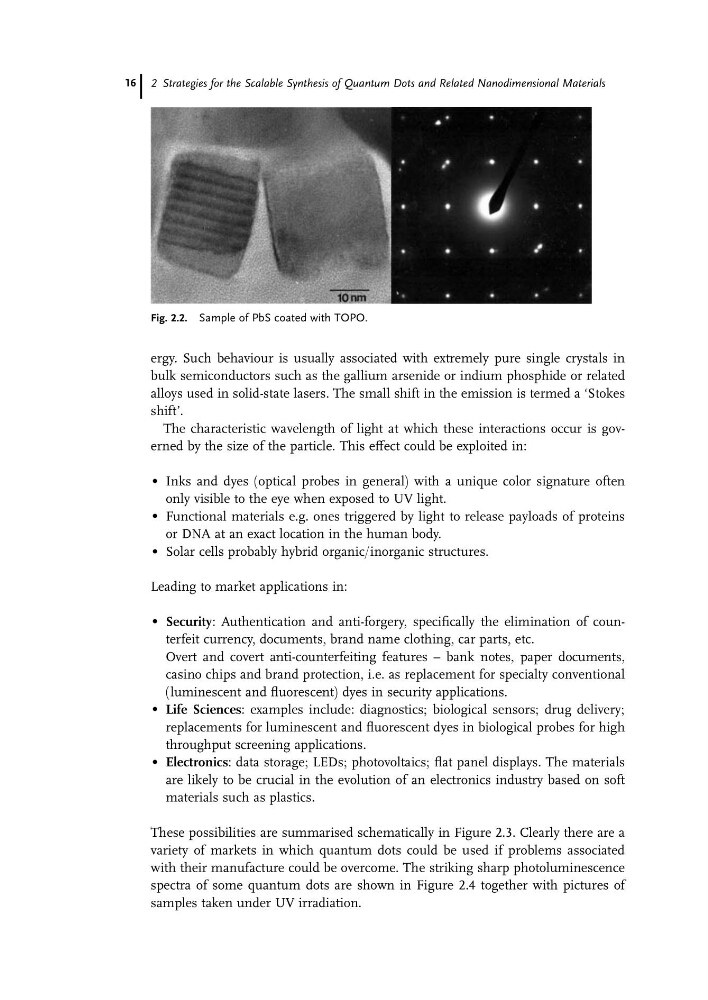
Fig. 2.2. Sample of PbS coated with TOPO.
2 Strategies for the Scalable Synthesis of Quantum Dots and Related Nanodimensional Materials
16
bulk semiconductors such as the gallium arsenide or indium phosphide or related
alloys used in solid-state lasers. The small shift in the emission is termed a ‘Stokes
shift’.
The characteristic wavelength of light at which these interactions occur is governed by the size of the particle. This effect could be exploited in:
. Inks and dyes (optical probes in general) with a unique color signature often
only visible to the eye when exposed to UV light.
. Functional materials e.g. ones triggered by light to release payloads of proteins
or DNA at an exact location in the human body.
. Solar cells probably hybrid organic/inorganic structures.
Leading to market applications in:
. Security: Authentication and anti-forgery, specifically the elimination of counterfeit currency, documents, brand name clothing, car parts, etc.
Overt and covert anti-counterfeiting features – bank notes, paper documents,
casino chips and brand protection, i.e. as replacement for specialty conventional
(luminescent and fluorescent) dyes in security applications.
. Life Sciences: examples include: diagnostics; biological sensors; drug delivery;
replacements for luminescent and fluorescent dyes in biological probes for high
throughput screening applications.
. Electronics: data storage; LEDs; photovoltaics; flat panel displays. The materials
are likely to be crucial in the evolution of an electronics industry based on soft
materials such as plastics.
These possibilities are summarised schematically in Figure 2.3. Clearly there are a
variety of markets in which quantum dots could be used if problems associated
with their manufacture could be overcome. The striking sharp photoluminescence
spectra of some quantum dots are shown in Figure 2.4 together with pictures of
samples taken under UV irradiation.
Fig. 2.2. Sample of PbS coated with TOPO.
2 Strategies for the Scalable Synthesis of Quantum Dots and Related Nanodimensional Materials
16