

tice defects. The nanowires consisted of only Si and oxygen with no ambient gas
atoms, as determined by EDS and XPS.
The mechanism by which the carrier gas affects the growth and diameter of the
SiNWs is not clear. We propose that the ambient atoms affect the formation and
transport of nanoclusters and the phase separation process at the growth front of
SiNWs. We suggest that the dominant effect of the ambient is on the phase separation. First, the thermal conductivity of the ambient affects the cooling rate of the
nanoclusters and thus the rate of phase separation. Second, the inert gas atoms are
very likely incorporated in the deposited matrix at the growing tips of SiNWs, and
their presence would influence the phase separation process, despite their eventual
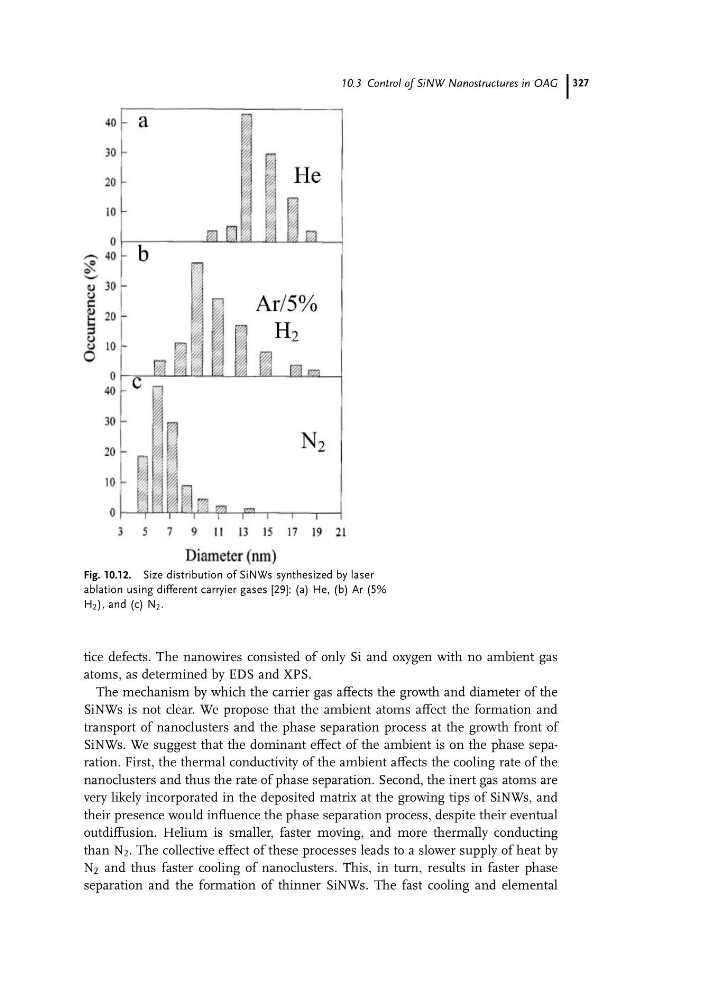
outdiffusion. Helium is smaller, faster moving, and more thermally conducting
than N 2 . The collective effect of these processes leads to a slower supply of heat by
N 2 and thus faster cooling of nanoclusters. This, in turn, results in faster phase
separation and the formation of thinner SiNWs. The fast cooling and elemental
Fig. 10.12. Size distribution of SiNWs synthesized by laser
ablation using different carryier gases [29]: (a) He, (b) Ar (5%
H 2 ), and (c) N 2 .
10.3 Control of SiNW Nanostructures in OAG 327
atoms, as determined by EDS and XPS.
The mechanism by which the carrier gas affects the growth and diameter of the
SiNWs is not clear. We propose that the ambient atoms affect the formation and
transport of nanoclusters and the phase separation process at the growth front of
SiNWs. We suggest that the dominant effect of the ambient is on the phase separation. First, the thermal conductivity of the ambient affects the cooling rate of the
nanoclusters and thus the rate of phase separation. Second, the inert gas atoms are
very likely incorporated in the deposited matrix at the growing tips of SiNWs, and
their presence would influence the phase separation process, despite their eventual
outdiffusion. Helium is smaller, faster moving, and more thermally conducting
than N 2 . The collective effect of these processes leads to a slower supply of heat by
N 2 and thus faster cooling of nanoclusters. This, in turn, results in faster phase
separation and the formation of thinner SiNWs. The fast cooling and elemental
Fig. 10.12. Size distribution of SiNWs synthesized by laser
ablation using different carryier gases [29]: (a) He, (b) Ar (5%
H 2 ), and (c) N 2 .
10.3 Control of SiNW Nanostructures in OAG 327