

of a weak reducing agent, usually ascorbic acid, that cannot reduce the metal salt
on its own (at room temperature). Varying the seed to metal salt ratio controls the
aspect ratio of the resulting nanorods. Additionally, one can use short nanorods as
‘‘seeds’’ on which to grow longer nanorods.
Our seed-mediated growth approach has been successful for the synthesis of
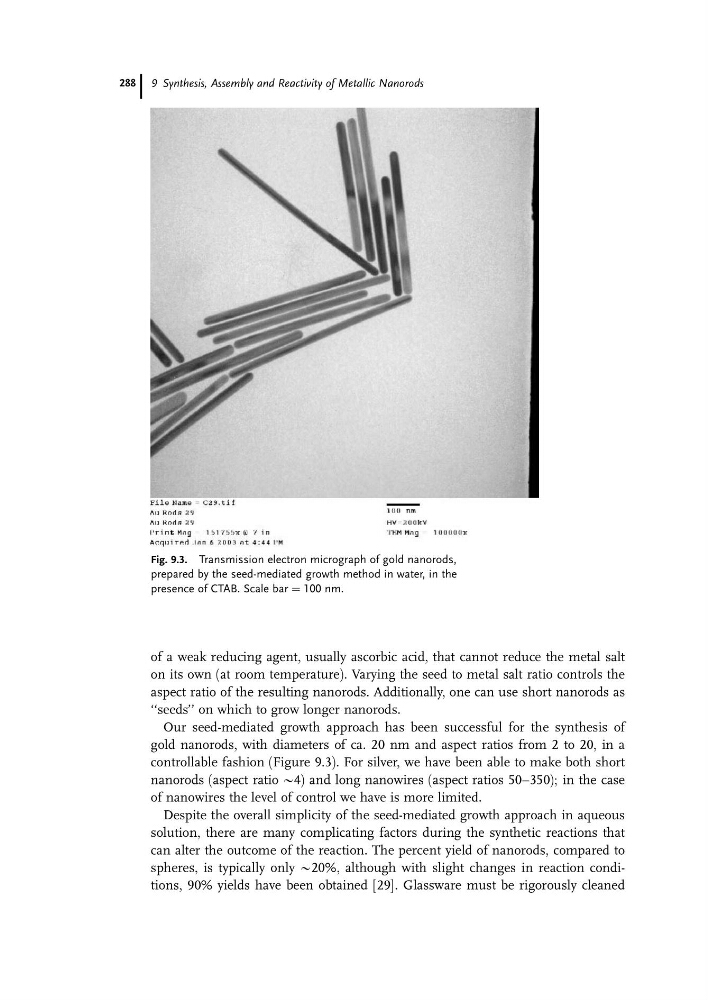
gold nanorods, with diameters of ca. 20 nm and aspect ratios from 2 to 20, in a
controllable fashion (Figure 9.3). For silver, we have been able to make both short
nanorods (aspect ratio @4) and long nanowires (aspect ratios 50–350); in the case
of nanowires the level of control we have is more limited.
Despite the overall simplicity of the seed-mediated growth approach in aqueous
solution, there are many complicating factors during the synthetic reactions that
can alter the outcome of the reaction. The percent yield of nanorods, compared to
spheres, is typically only @20%, although with slight changes in reaction conditions, 90% yields have been obtained [29]. Glassware must be rigorously cleaned
Fig. 9.3. Transmission electron micrograph of gold nanorods,
prepared by the seed-mediated growth method in water, in the
presence of CTAB. Scale bar ¼ 100 nm.
9 Synthesis, Assembly and Reactivity of Metallic Nanorods
288
on its own (at room temperature). Varying the seed to metal salt ratio controls the
aspect ratio of the resulting nanorods. Additionally, one can use short nanorods as
‘‘seeds’’ on which to grow longer nanorods.
Our seed-mediated growth approach has been successful for the synthesis of
gold nanorods, with diameters of ca. 20 nm and aspect ratios from 2 to 20, in a
controllable fashion (Figure 9.3). For silver, we have been able to make both short
nanorods (aspect ratio @4) and long nanowires (aspect ratios 50–350); in the case
of nanowires the level of control we have is more limited.
Despite the overall simplicity of the seed-mediated growth approach in aqueous
solution, there are many complicating factors during the synthetic reactions that
can alter the outcome of the reaction. The percent yield of nanorods, compared to
spheres, is typically only @20%, although with slight changes in reaction conditions, 90% yields have been obtained [29]. Glassware must be rigorously cleaned
Fig. 9.3. Transmission electron micrograph of gold nanorods,
prepared by the seed-mediated growth method in water, in the
presence of CTAB. Scale bar ¼ 100 nm.
9 Synthesis, Assembly and Reactivity of Metallic Nanorods
288