

1.4
Applications and Technology Development
Some of the important applications and technologies based on nanomaterials are
the following: (i) Production of nanopowders of ceramics and other materials, (ii)
nanocomposites, (iii) development of nanolectrochemical systems (NEMS), (iv)
Applications of nanotubes for hydrogen storage and other purposes, (v) DNA chips
and chips for chemical/biochemical assays, (vi) gene targeting/drug targeting and
(vii) nanoelectronics and nanodevices. The last one, which is probably the most
challenging area, includes new lasers, nanosensors, nanocomputers (based on
nanotubes and other materials), defect-free electronics for future molecular computers, resonant tunneling devices, spintronics and the linking of biological motors with inorganic nanodevices.
1.5
Nanoelectronics
The multidisciplinary area of nanoelectronics has two objectives: (i) utilization of a
single nanostructure (e.g. nanocrystal, quantum dot, nanotube) for processing
electrical, optical or chemical signals, and (ii) utilization of nanostructured materials involving assemblies of nanostructures for electronic, optoelectronic, chemical
and other applications. While it is often difficult to make distinctions between the
two, the first category is specifically intended to obtain single-electron devices and
the second category is for the purpose of miniaturization in information storage
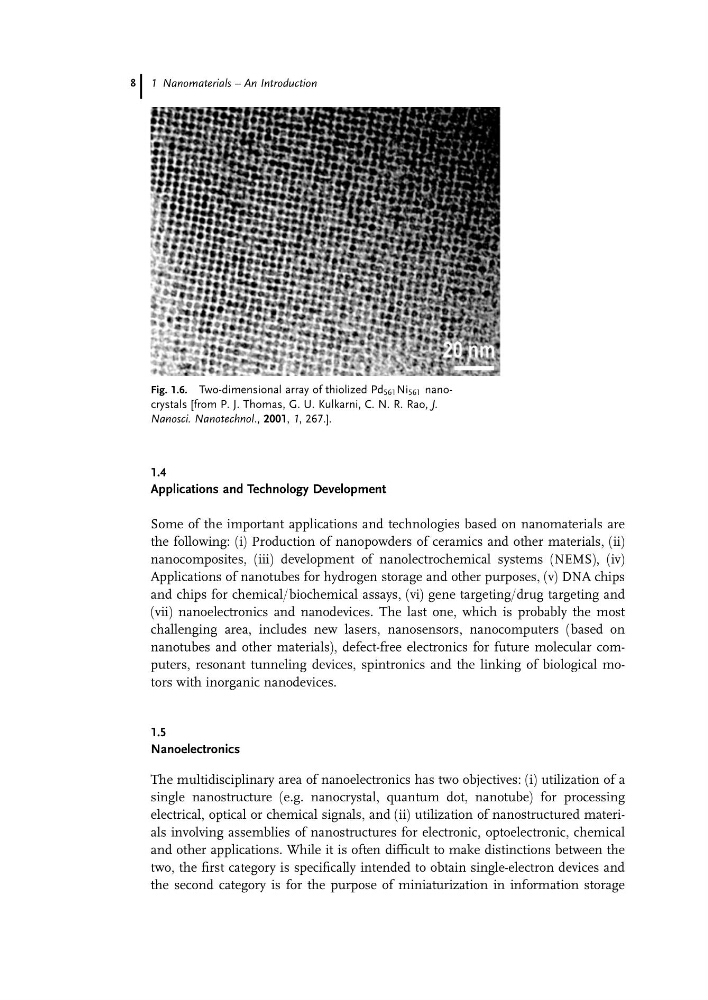
Fig. 1.6. Two-dimensional array of thiolized Pd 561 Ni 561 nanocrystals [from P. J. Thomas, G. U. Kulkarni, C. N. R. Rao, J.
Nanosci. Nanotechnol., 2001, 1, 267.].
1 Nanomaterials – An Introduction
8
Applications and Technology Development
Some of the important applications and technologies based on nanomaterials are
the following: (i) Production of nanopowders of ceramics and other materials, (ii)
nanocomposites, (iii) development of nanolectrochemical systems (NEMS), (iv)
Applications of nanotubes for hydrogen storage and other purposes, (v) DNA chips
and chips for chemical/biochemical assays, (vi) gene targeting/drug targeting and
(vii) nanoelectronics and nanodevices. The last one, which is probably the most
challenging area, includes new lasers, nanosensors, nanocomputers (based on
nanotubes and other materials), defect-free electronics for future molecular computers, resonant tunneling devices, spintronics and the linking of biological motors with inorganic nanodevices.
1.5
Nanoelectronics
The multidisciplinary area of nanoelectronics has two objectives: (i) utilization of a
single nanostructure (e.g. nanocrystal, quantum dot, nanotube) for processing
electrical, optical or chemical signals, and (ii) utilization of nanostructured materials involving assemblies of nanostructures for electronic, optoelectronic, chemical
and other applications. While it is often difficult to make distinctions between the
two, the first category is specifically intended to obtain single-electron devices and
the second category is for the purpose of miniaturization in information storage
Fig. 1.6. Two-dimensional array of thiolized Pd 561 Ni 561 nanocrystals [from P. J. Thomas, G. U. Kulkarni, C. N. R. Rao, J.
Nanosci. Nanotechnol., 2001, 1, 267.].
1 Nanomaterials – An Introduction
8