

longitudinal plasmon band, corresponding to light absorption and scattering along
the long axis of the particle, and the transverse plasmon band, corresponding to
light absorption and scattering along the short axis of the particle [2, 5–7, 10].
Other nanoparticle shapes are predicted to have other, more complicated extinction
spectra [10, 21]. Thus, metallic nanorods and nanowires have tunable optical
properties throughout the visible and into the infrared portions of the electromagnetic spectrum, and they are predicted to have enhanced SERS activity compared to
spheres [9].
Information technology and storage is another arena for which metallic nanoparticles are of interest. As the size of integrated circuit elements shrinks to the
@100 nm scale and below, metallic and semiconducting nanowires of controllable
size and ability to be positioned need to be developed [22]. The magnetic domain
size in magnetic nanoparticles is of the order of 10 nm, and control of crystal
structure and size of the relevant metals and metal alloys (e.g., Fe, Co) on this scale
are key to advances in magnetic data storage [23, 24]. Hybrid data storage schemes
that rely on melting metallic nanorods to nanospheres in polymer matrices, with
subsequent detection of the altered optical properties for ‘‘reading’’ and ‘‘writing’’,
are also being developed [25].
All of the promise of the future technology based on nanometer-scale inorganic
solids relies on the production of nanoparticles of controlled size, shape and crystal
structure, and further ultimately requires that these nanoparticles be rationally
linked to make a working device. Enormous progress has been made in the synthesis of inorganic nanospheres; routinely, at present, control over the diameter of
nanoparticles leads to particle size distributions that are within 10% of the mean
diameter, and frequently within 5%. Only since the mid-1990s and later have there
been good synthetic methods to make nanoparticles of controllable size and shape
(other than spheres) [3, 20, 22].
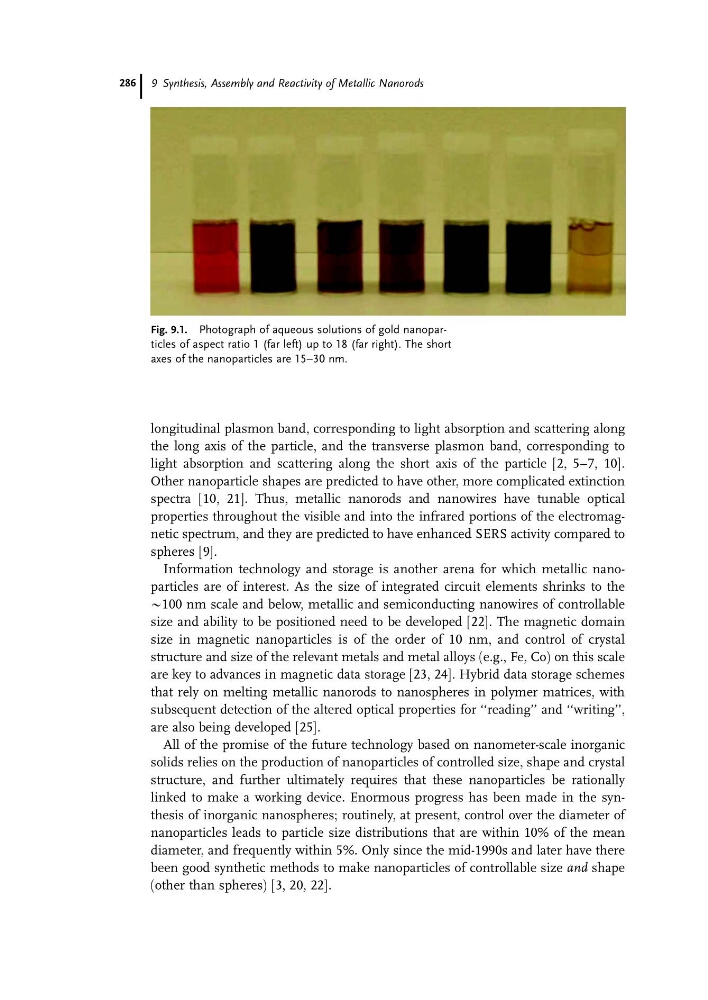
Fig. 9.1. Photograph of aqueous solutions of gold nanoparticles of aspect ratio 1 (far left) up to 18 (far right). The short
axes of the nanoparticles are 15–30 nm.
9 Synthesis, Assembly and Reactivity of Metallic Nanorods
286
the long axis of the particle, and the transverse plasmon band, corresponding to
light absorption and scattering along the short axis of the particle [2, 5–7, 10].
Other nanoparticle shapes are predicted to have other, more complicated extinction
spectra [10, 21]. Thus, metallic nanorods and nanowires have tunable optical
properties throughout the visible and into the infrared portions of the electromagnetic spectrum, and they are predicted to have enhanced SERS activity compared to
spheres [9].
Information technology and storage is another arena for which metallic nanoparticles are of interest. As the size of integrated circuit elements shrinks to the
@100 nm scale and below, metallic and semiconducting nanowires of controllable
size and ability to be positioned need to be developed [22]. The magnetic domain
size in magnetic nanoparticles is of the order of 10 nm, and control of crystal
structure and size of the relevant metals and metal alloys (e.g., Fe, Co) on this scale
are key to advances in magnetic data storage [23, 24]. Hybrid data storage schemes
that rely on melting metallic nanorods to nanospheres in polymer matrices, with
subsequent detection of the altered optical properties for ‘‘reading’’ and ‘‘writing’’,
are also being developed [25].
All of the promise of the future technology based on nanometer-scale inorganic
solids relies on the production of nanoparticles of controlled size, shape and crystal
structure, and further ultimately requires that these nanoparticles be rationally
linked to make a working device. Enormous progress has been made in the synthesis of inorganic nanospheres; routinely, at present, control over the diameter of
nanoparticles leads to particle size distributions that are within 10% of the mean
diameter, and frequently within 5%. Only since the mid-1990s and later have there
been good synthetic methods to make nanoparticles of controllable size and shape
(other than spheres) [3, 20, 22].
Fig. 9.1. Photograph of aqueous solutions of gold nanoparticles of aspect ratio 1 (far left) up to 18 (far right). The short
axes of the nanoparticles are 15–30 nm.
9 Synthesis, Assembly and Reactivity of Metallic Nanorods
286