

HNO 3 in the presence of metal salts such as Ni(NO 3 ) 2 . The nanotubes are opened
by HNO 3 and filled by the metal salt. On drying and calcination, the metal salt
transforms to the metal oxide and reduction of the encapsulated oxide in hydrogen
at around 400
C gives rise to the metal inside the nanotubes. MWNTs have been
opened by using a variety of oxidants [125–127] and the opened nanotubes have
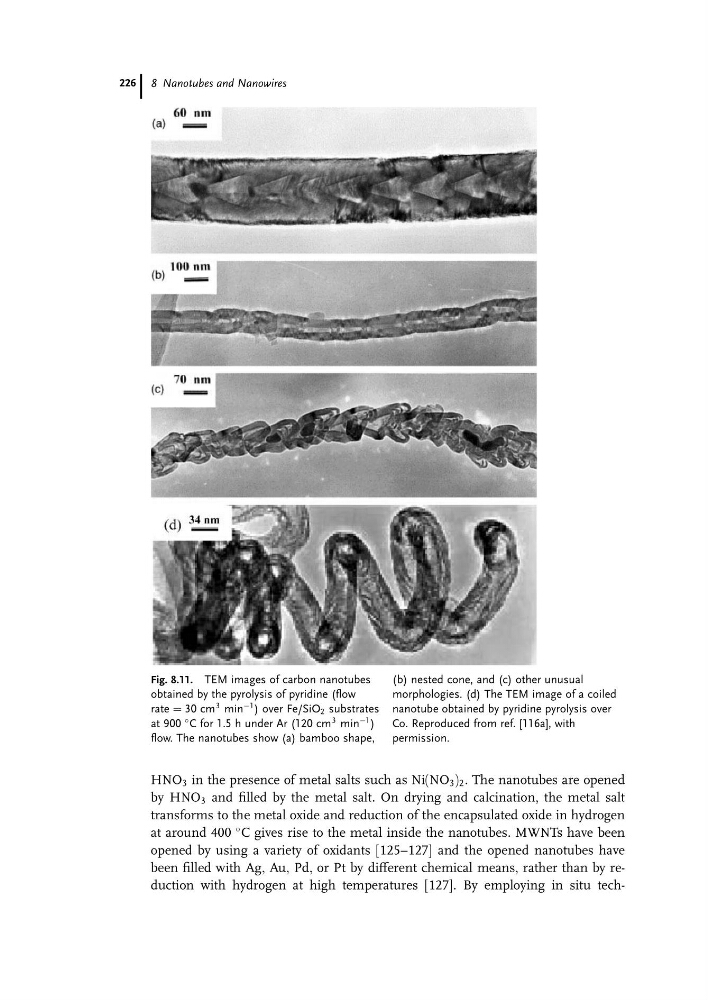
been filled with Ag, Au, Pd, or Pt by different chemical means, rather than by reduction with hydrogen at high temperatures [127]. By employing in situ techFig. 8.11. TEM images of carbon nanotubes
obtained by the pyrolysis of pyridine (flow
rate ¼ 30 cm
3 min
À1 ) over Fe/SiO 2 substrates
at 900
C for 1.5 h under Ar (120 cm
3 min
À1 )
flow. The nanotubes show (a) bamboo shape,
(b) nested cone, and (c) other unusual
morphologies. (d) The TEM image of a coiled
nanotube obtained by pyridine pyrolysis over
Co. Reproduced from ref. [116a], with
permission.
8 Nanotubes and Nanowires
226
by HNO 3 and filled by the metal salt. On drying and calcination, the metal salt
transforms to the metal oxide and reduction of the encapsulated oxide in hydrogen
at around 400
C gives rise to the metal inside the nanotubes. MWNTs have been
opened by using a variety of oxidants [125–127] and the opened nanotubes have
been filled with Ag, Au, Pd, or Pt by different chemical means, rather than by reduction with hydrogen at high temperatures [127]. By employing in situ techFig. 8.11. TEM images of carbon nanotubes
obtained by the pyrolysis of pyridine (flow
rate ¼ 30 cm
3 min
À1 ) over Fe/SiO 2 substrates
at 900
C for 1.5 h under Ar (120 cm
3 min
À1 )
flow. The nanotubes show (a) bamboo shape,
(b) nested cone, and (c) other unusual
morphologies. (d) The TEM image of a coiled
nanotube obtained by pyridine pyrolysis over
Co. Reproduced from ref. [116a], with
permission.
8 Nanotubes and Nanowires
226