

et al. [87] surprisingly found that the linewidth of phonon peaks in the Raman
spectrum was narrow, of the order of 20 cm
À1 . The Raman phonon frequency of
nanotubes is softer than that of HOPG, probably due to the curvature of the
nanotubes. Softening of phonon modes can be related to the larger c-axis lattice
parameter in the nanotube as compared to graphite. Holden et al. [88] have examined the spectra of single-walled carbon nanotubes produced by using Co catalysts
and have compared them with the predictions of Jishi et al. [86]. Studies on
SWNTs by Rao et al. [89] reveal many of the characteristic normal modes of an
armchair (n,n) carbon nanotubes and also show a diameter-selective resonance behavior. The resonance results from the one-dimensional quantum confinement
of electrons in the nanotubes. Kasuya et al. [90] have provided the first evidence
for a diameter-dependent dispersion arising from the cylindrical symmetry of the
nanotubes. They carried out Raman scattering studies on SWNTs with mean diameters of 1.1, 1.3 and 2 nm and found size-dependent multiple splitting of the
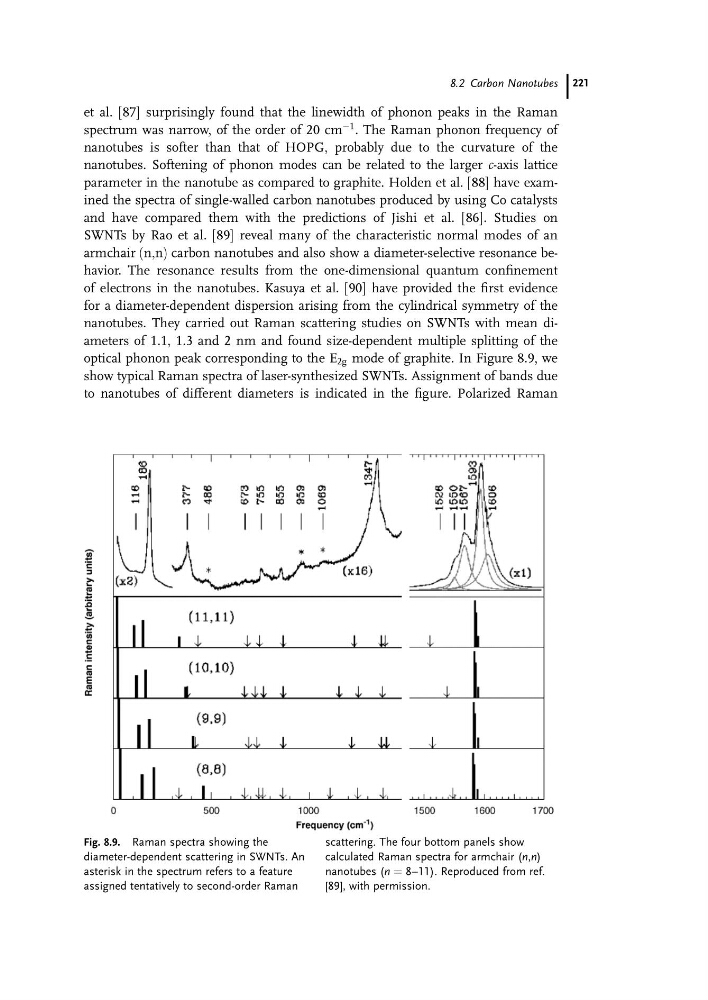
optical phonon peak corresponding to the E 2g mode of graphite. In Figure 8.9, we
show typical Raman spectra of laser-synthesized SWNTs. Assignment of bands due
to nanotubes of different diameters is indicated in the figure. Polarized Raman
Fig. 8.9. Raman spectra showing the
diameter-dependent scattering in SWNTs. An
asterisk in the spectrum refers to a feature
assigned tentatively to second-order Raman
scattering. The four bottom panels show
calculated Raman spectra for armchair (n,n)
nanotubes (n ¼ 8–11). Reproduced from ref.
[89], with permission.
8.2 Carbon Nanotubes 221
spectrum was narrow, of the order of 20 cm
À1 . The Raman phonon frequency of
nanotubes is softer than that of HOPG, probably due to the curvature of the
nanotubes. Softening of phonon modes can be related to the larger c-axis lattice
parameter in the nanotube as compared to graphite. Holden et al. [88] have examined the spectra of single-walled carbon nanotubes produced by using Co catalysts
and have compared them with the predictions of Jishi et al. [86]. Studies on
SWNTs by Rao et al. [89] reveal many of the characteristic normal modes of an
armchair (n,n) carbon nanotubes and also show a diameter-selective resonance behavior. The resonance results from the one-dimensional quantum confinement
of electrons in the nanotubes. Kasuya et al. [90] have provided the first evidence
for a diameter-dependent dispersion arising from the cylindrical symmetry of the
nanotubes. They carried out Raman scattering studies on SWNTs with mean diameters of 1.1, 1.3 and 2 nm and found size-dependent multiple splitting of the
optical phonon peak corresponding to the E 2g mode of graphite. In Figure 8.9, we
show typical Raman spectra of laser-synthesized SWNTs. Assignment of bands due
to nanotubes of different diameters is indicated in the figure. Polarized Raman
Fig. 8.9. Raman spectra showing the
diameter-dependent scattering in SWNTs. An
asterisk in the spectrum refers to a feature
assigned tentatively to second-order Raman
scattering. The four bottom panels show
calculated Raman spectra for armchair (n,n)
nanotubes (n ¼ 8–11). Reproduced from ref.
[89], with permission.
8.2 Carbon Nanotubes 221