

sation of a laser-vaporized carbon–nickel–cobalt mixture at 1200
C [53]. These
SWNTs were nearly uniform in diameter and self-assemble into ropes which consist of 100 to 500 tubes in a 2D triangular lattice.
Under controlled conditions of pyrolysis, dilute hydrocarbon–organometallic
mixtures yield SWNTs [45, 54]. Pyrolysis of metallocene–acetylene mixtures at
1100
C yields SWNTs [54, 55], shown in the TEM image in Figure 8.3(c). The diameter of the SWNT in Figure 8.3(c) is 1.4 nm. Figure 8.3(d) shows the SWNTs
obtained similarly by the pyrolysis of a ferroceneaCH 4 mixture at 1100
C. It may
be recalled that the pyrolysis of nickelocene in admixture with benzene under
similar conditions primarily yields MWNTs. The bottom portion of the SWNT in
Figure 8.3(c) shows an amorphous carbon coating around the tube, common with
such preparations. This can be avoided by reducing the proportion of the hydrocarbon C 2 H 2 and mixing hydrogen in the Ar stream. Pyrolysis of acetylene
in mixture with Fe(CO) 5 at 1100
C gives good yields of SWNTs. Pyrolysis of
ferrocene–thiophene mixtures also yield SWNTs, but the yield appears to be
somewhat low. Pyrolysis of benzene and thiophene along with ferrocene gives a
high yield of SWNTs [56].
Laplaze et al. [57] have demonstrated that concentrated solar energy can be employed to vaporize graphite to synthesize SWNTs. Nikolaev et al. [58] have obtained
SWNTs using a gas-phase catalytic method involving the pyrolysis of Fe(CO) 5 and
CO. The decomposition of CO on a silica-supported CoaMo catalyst also yields
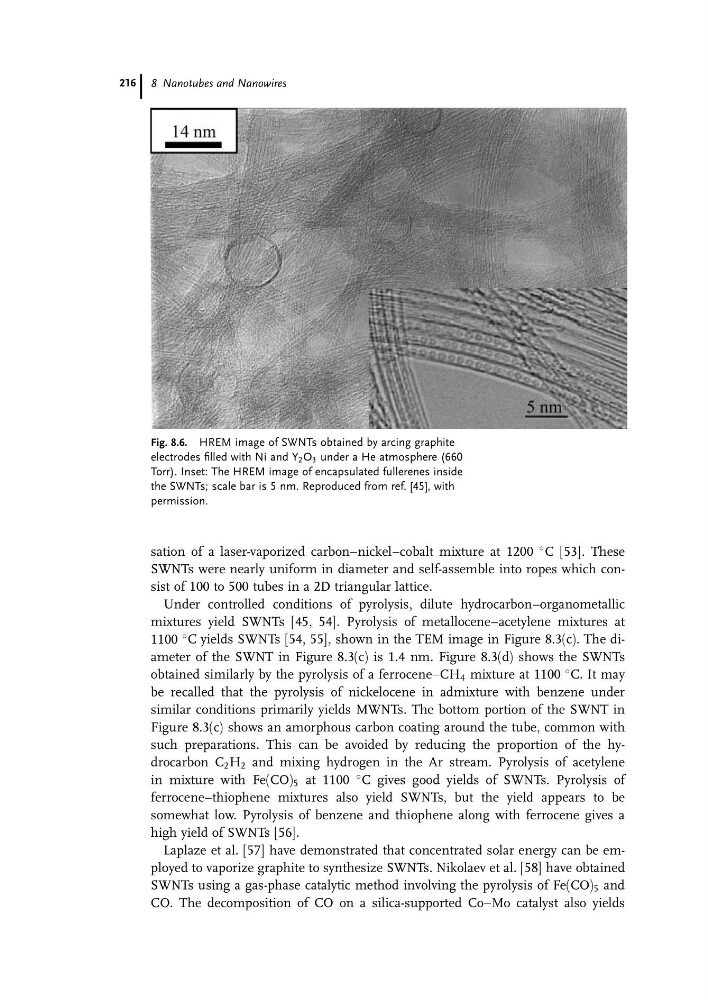
Fig. 8.6. HREM image of SWNTs obtained by arcing graphite
electrodes filled with Ni and Y 2 O 3 under a He atmosphere (660
Torr). Inset: The HREM image of encapsulated fullerenes inside
the SWNTs; scale bar is 5 nm. Reproduced from ref. [45], with
permission.
8 Nanotubes and Nanowires
216
C [53]. These
SWNTs were nearly uniform in diameter and self-assemble into ropes which consist of 100 to 500 tubes in a 2D triangular lattice.
Under controlled conditions of pyrolysis, dilute hydrocarbon–organometallic
mixtures yield SWNTs [45, 54]. Pyrolysis of metallocene–acetylene mixtures at
1100
C yields SWNTs [54, 55], shown in the TEM image in Figure 8.3(c). The diameter of the SWNT in Figure 8.3(c) is 1.4 nm. Figure 8.3(d) shows the SWNTs
obtained similarly by the pyrolysis of a ferroceneaCH 4 mixture at 1100
C. It may
be recalled that the pyrolysis of nickelocene in admixture with benzene under
similar conditions primarily yields MWNTs. The bottom portion of the SWNT in
Figure 8.3(c) shows an amorphous carbon coating around the tube, common with
such preparations. This can be avoided by reducing the proportion of the hydrocarbon C 2 H 2 and mixing hydrogen in the Ar stream. Pyrolysis of acetylene
in mixture with Fe(CO) 5 at 1100
C gives good yields of SWNTs. Pyrolysis of
ferrocene–thiophene mixtures also yield SWNTs, but the yield appears to be
somewhat low. Pyrolysis of benzene and thiophene along with ferrocene gives a
high yield of SWNTs [56].
Laplaze et al. [57] have demonstrated that concentrated solar energy can be employed to vaporize graphite to synthesize SWNTs. Nikolaev et al. [58] have obtained
SWNTs using a gas-phase catalytic method involving the pyrolysis of Fe(CO) 5 and
CO. The decomposition of CO on a silica-supported CoaMo catalyst also yields
Fig. 8.6. HREM image of SWNTs obtained by arcing graphite
electrodes filled with Ni and Y 2 O 3 under a He atmosphere (660
Torr). Inset: The HREM image of encapsulated fullerenes inside
the SWNTs; scale bar is 5 nm. Reproduced from ref. [45], with
permission.
8 Nanotubes and Nanowires
216