

of graphite for the preparation of fullerenes. These nanotubes are concentric
graphitic cylinders closed at either end due to the presence of five-membered rings.
Nanotubes can be multi-walled with a central tubule of nanometric diameter surrounded by graphitic layers separated by @3.4 A ˚ . Unlike the multi-walled nanotubes (MWNTs), in single-walled nanotubes (SWNTs), there is only the tubule and
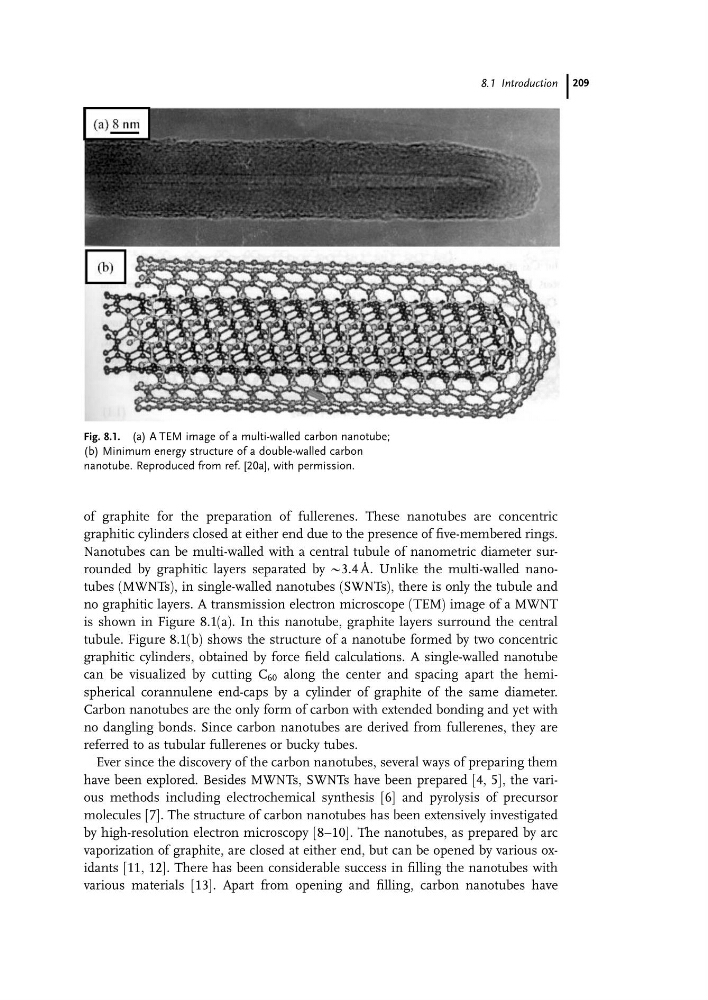
no graphitic layers. A transmission electron microscope (TEM) image of a MWNT
is shown in Figure 8.1(a). In this nanotube, graphite layers surround the central
tubule. Figure 8.1(b) shows the structure of a nanotube formed by two concentric
graphitic cylinders, obtained by force field calculations. A single-walled nanotube
can be visualized by cutting C 60 along the center and spacing apart the hemispherical corannulene end-caps by a cylinder of graphite of the same diameter.
Carbon nanotubes are the only form of carbon with extended bonding and yet with
no dangling bonds. Since carbon nanotubes are derived from fullerenes, they are
referred to as tubular fullerenes or bucky tubes.
Ever since the discovery of the carbon nanotubes, several ways of preparing them
have been explored. Besides MWNTs, SWNTs have been prepared [4, 5], the various methods including electrochemical synthesis [6] and pyrolysis of precursor
molecules [7]. The structure of carbon nanotubes has been extensively investigated
by high-resolution electron microscopy [8–10]. The nanotubes, as prepared by arc
vaporization of graphite, are closed at either end, but can be opened by various oxidants [11, 12]. There has been considerable success in filling the nanotubes with
various materials [13]. Apart from opening and filling, carbon nanotubes have
Fig. 8.1. (a) A TEM image of a multi-walled carbon nanotube;
(b) Minimum energy structure of a double-walled carbon
nanotube. Reproduced from ref. [20a], with permission.
8.1 Introduction 209
graphitic cylinders closed at either end due to the presence of five-membered rings.
Nanotubes can be multi-walled with a central tubule of nanometric diameter surrounded by graphitic layers separated by @3.4 A ˚ . Unlike the multi-walled nanotubes (MWNTs), in single-walled nanotubes (SWNTs), there is only the tubule and
no graphitic layers. A transmission electron microscope (TEM) image of a MWNT
is shown in Figure 8.1(a). In this nanotube, graphite layers surround the central
tubule. Figure 8.1(b) shows the structure of a nanotube formed by two concentric
graphitic cylinders, obtained by force field calculations. A single-walled nanotube
can be visualized by cutting C 60 along the center and spacing apart the hemispherical corannulene end-caps by a cylinder of graphite of the same diameter.
Carbon nanotubes are the only form of carbon with extended bonding and yet with
no dangling bonds. Since carbon nanotubes are derived from fullerenes, they are
referred to as tubular fullerenes or bucky tubes.
Ever since the discovery of the carbon nanotubes, several ways of preparing them
have been explored. Besides MWNTs, SWNTs have been prepared [4, 5], the various methods including electrochemical synthesis [6] and pyrolysis of precursor
molecules [7]. The structure of carbon nanotubes has been extensively investigated
by high-resolution electron microscopy [8–10]. The nanotubes, as prepared by arc
vaporization of graphite, are closed at either end, but can be opened by various oxidants [11, 12]. There has been considerable success in filling the nanotubes with
various materials [13]. Apart from opening and filling, carbon nanotubes have
Fig. 8.1. (a) A TEM image of a multi-walled carbon nanotube;
(b) Minimum energy structure of a double-walled carbon
nanotube. Reproduced from ref. [20a], with permission.
8.1 Introduction 209