

ratio of the TBA ion to exchangeable protons in HaTi; a minimum ratio of TBA/H
greater than or equal to 0.5 is required for rapid exfoliation.
Shafi et al. found that sonochemistry is a fast and efficient technique for coating octadecyltrihydrosilane (CH 3 (CH 2 ) 17 SiH 3 ) onto titania surfaces [131]. Infrared
spectroscopy and thermal analysis confirm that complete coating is achieved after
30 min. Solid-state C-13 NMR spectroscopy establishes the bonding of trihydrosilane to the titania particles. Raman microscopy gives the expected rutile
structure and further confirms the presence of an octadecyl monolayer. X-ray diffraction confirms that the rutile structure of the titania particles does not change
during sonication. Anatase titania undergoes the same reaction when sonicated in
the presence of octadecyltrihydrosilane.
6.1.2.10 The Sonochemical Preparation of Other Oxides
Brij-35 [polyoxyethylene (23) lauryl ether] stabilized palladium nanoparticles, obtained on attempted sonochemical reduction of PdCl 2 , by sodium sulfite in water
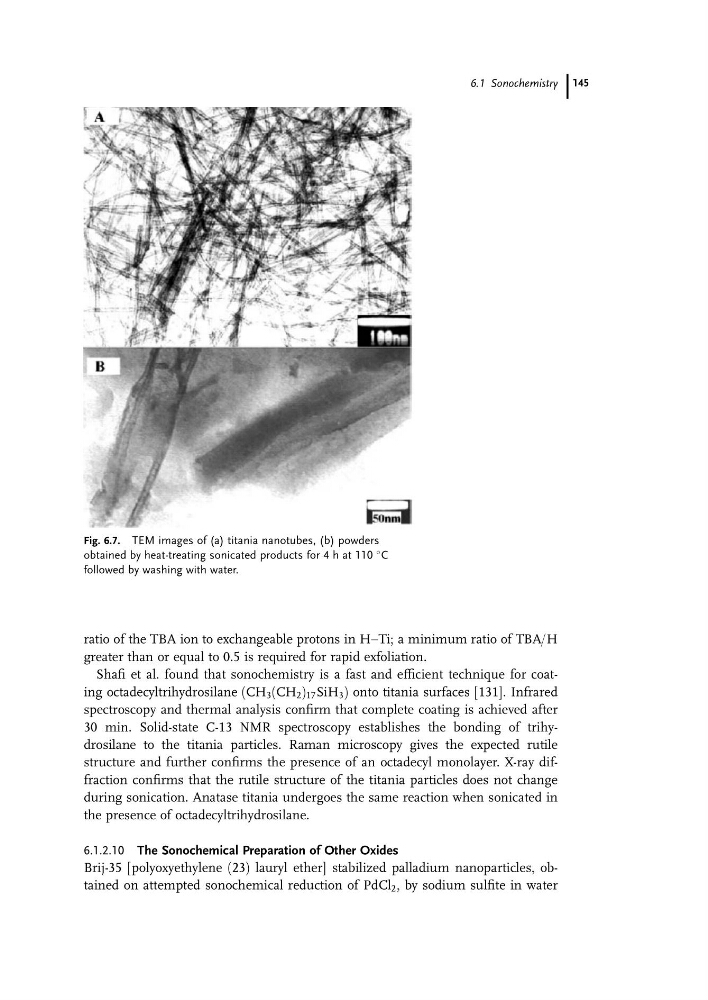
Fig. 6.7. TEM images of (a) titania nanotubes, (b) powders
obtained by heat-treating sonicated products for 4 h at 110
C
followed by washing with water.
6.1 Sonochemistry 145
greater than or equal to 0.5 is required for rapid exfoliation.
Shafi et al. found that sonochemistry is a fast and efficient technique for coating octadecyltrihydrosilane (CH 3 (CH 2 ) 17 SiH 3 ) onto titania surfaces [131]. Infrared
spectroscopy and thermal analysis confirm that complete coating is achieved after
30 min. Solid-state C-13 NMR spectroscopy establishes the bonding of trihydrosilane to the titania particles. Raman microscopy gives the expected rutile
structure and further confirms the presence of an octadecyl monolayer. X-ray diffraction confirms that the rutile structure of the titania particles does not change
during sonication. Anatase titania undergoes the same reaction when sonicated in
the presence of octadecyltrihydrosilane.
6.1.2.10 The Sonochemical Preparation of Other Oxides
Brij-35 [polyoxyethylene (23) lauryl ether] stabilized palladium nanoparticles, obtained on attempted sonochemical reduction of PdCl 2 , by sodium sulfite in water
Fig. 6.7. TEM images of (a) titania nanotubes, (b) powders
obtained by heat-treating sonicated products for 4 h at 110
C
followed by washing with water.
6.1 Sonochemistry 145