

cated that the as-prepared NiFe 2 O 4 ferrite particles were super-paramagnetic. The
Mo ¨ssbauer spectrum of the crystallized sample showed a clear sextet pattern, with
hyperfine field values of 500 and 508 kOe for A (tetrahedral) and B (octahedral)
sublattices, respectively, of the inverse spinel NiFe 2 O 4 . Saturation magnetization of
the annealed sample (25 emu g
À1 ) was significantly lower than that for the reported multidomain bulk particles (55 emu g
À1 ), reflecting the ultrafine nature of
the sample. Thermogravimetric measurements with a permanent magnet gave
Curie temperatures of 44
C for amorphous and 560
C for the crystallized forms.
Another ferrite exhibiting two unique properties was also synthesized sonochemically, BaFe 12 O 19 [80]. A solution of Fe(CO) 5 and barium ethylhexanoate
(Baa[OOCCH(C 2 H 5 )C 4 H 9 ] 2 ) in decane, in stoichiometric ratio, was decomposed
by high-intensity ultrasonication. The as-prepared material was an amorphous
BaFe 12 O 19 precursor in colloidal suspension, where the particles are in the nanometer size regime and are homogeneously distributed. The precursor is extracted
from the solution as powder by precipitation or by evaporation and then calcined at
low temperature (600
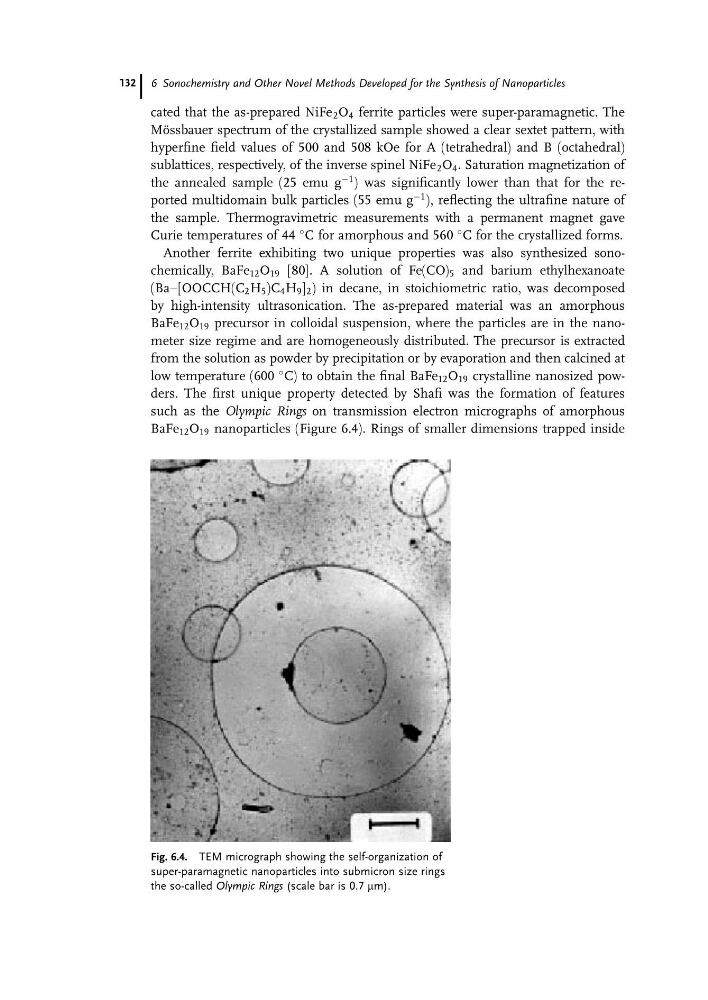
C) to obtain the final BaFe 12 O 19 crystalline nanosized powders. The first unique property detected by Shafi was the formation of features
such as the Olympic Rings on transmission electron micrographs of amorphous
BaFe 12 O 19 nanoparticles (Figure 6.4). Rings of smaller dimensions trapped inside
Fig. 6.4. TEM micrograph showing the self-organization of
super-paramagnetic nanoparticles into submicron size rings
the so-called Olympic Rings (scale bar is 0.7 mm).
6 Sonochemistry and Other Novel Methods Developed for the Synthesis of Nanoparticles
132
Mo ¨ssbauer spectrum of the crystallized sample showed a clear sextet pattern, with
hyperfine field values of 500 and 508 kOe for A (tetrahedral) and B (octahedral)
sublattices, respectively, of the inverse spinel NiFe 2 O 4 . Saturation magnetization of
the annealed sample (25 emu g
À1 ) was significantly lower than that for the reported multidomain bulk particles (55 emu g
À1 ), reflecting the ultrafine nature of
the sample. Thermogravimetric measurements with a permanent magnet gave
Curie temperatures of 44
C for amorphous and 560
C for the crystallized forms.
Another ferrite exhibiting two unique properties was also synthesized sonochemically, BaFe 12 O 19 [80]. A solution of Fe(CO) 5 and barium ethylhexanoate
(Baa[OOCCH(C 2 H 5 )C 4 H 9 ] 2 ) in decane, in stoichiometric ratio, was decomposed
by high-intensity ultrasonication. The as-prepared material was an amorphous
BaFe 12 O 19 precursor in colloidal suspension, where the particles are in the nanometer size regime and are homogeneously distributed. The precursor is extracted
from the solution as powder by precipitation or by evaporation and then calcined at
low temperature (600
C) to obtain the final BaFe 12 O 19 crystalline nanosized powders. The first unique property detected by Shafi was the formation of features
such as the Olympic Rings on transmission electron micrographs of amorphous
BaFe 12 O 19 nanoparticles (Figure 6.4). Rings of smaller dimensions trapped inside
Fig. 6.4. TEM micrograph showing the self-organization of
super-paramagnetic nanoparticles into submicron size rings
the so-called Olympic Rings (scale bar is 0.7 mm).
6 Sonochemistry and Other Novel Methods Developed for the Synthesis of Nanoparticles
132