

work in the absence of long chain amines (n-octylamine and n-dodecylamine)
which are added as capping agents. A complete characterization of the magnetic
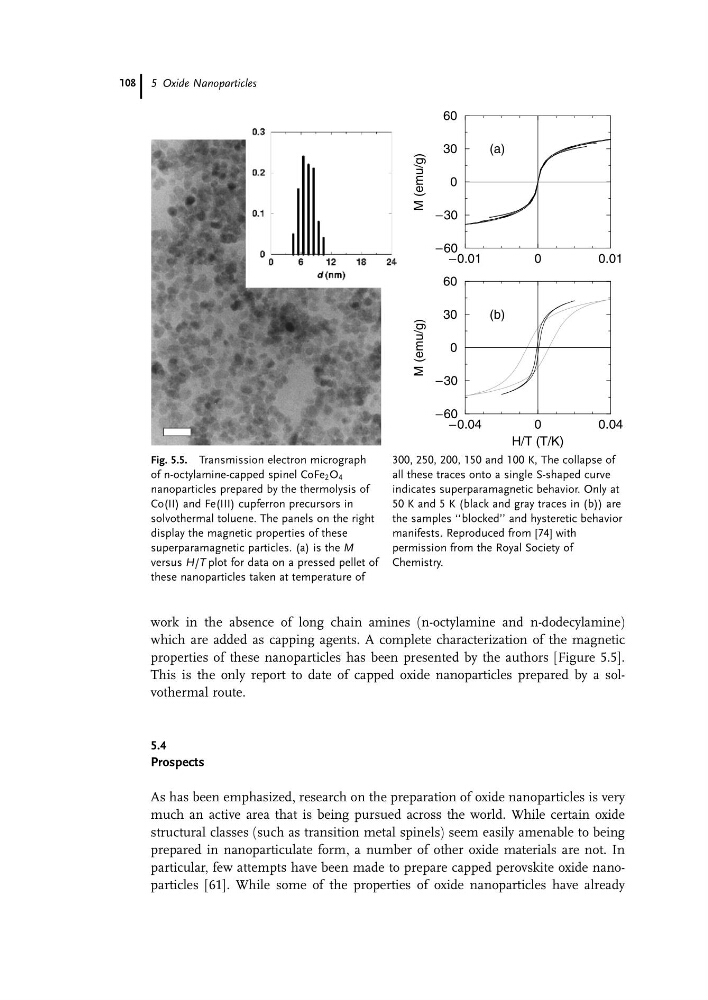
properties of these nanoparticles has been presented by the authors [Figure 5.5].
This is the only report to date of capped oxide nanoparticles prepared by a solvothermal route.
5.4
Prospects
As has been emphasized, research on the preparation of oxide nanoparticles is very
much an active area that is being pursued across the world. While certain oxide
structural classes (such as transition metal spinels) seem easily amenable to being
prepared in nanoparticulate form, a number of other oxide materials are not. In
particular, few attempts have been made to prepare capped perovskite oxide nanoparticles [61]. While some of the properties of oxide nanoparticles have already
_ 0.01
0
0.01
_ 60
_ 30
0
30
60
M (emu/g)
_ 0.04
0
0.04
H/T (T/K)
_ 60
_ 30
0
30
60
M (emu/g)
(a)
(b)
Fig. 5.5. Transmission electron micrograph
of n-octylamine-capped spinel CoFe 2 O 4
nanoparticles prepared by the thermolysis of
Co(II) and Fe(III) cupferron precursors in
solvothermal toluene. The panels on the right
display the magnetic properties of these
superparamagnetic particles. (a) is the M
versus H/T plot for data on a pressed pellet of
these nanoparticles taken at temperature of
300, 250, 200, 150 and 100 K, The collapse of
all these traces onto a single S-shaped curve
indicates superparamagnetic behavior. Only at
50 K and 5 K (black and gray traces in (b)) are
the samples ‘‘blocked’’ and hysteretic behavior
manifests. Reproduced from [74] with
permission from the Royal Society of
Chemistry.
5 Oxide Nanoparticles
108
which are added as capping agents. A complete characterization of the magnetic
properties of these nanoparticles has been presented by the authors [Figure 5.5].
This is the only report to date of capped oxide nanoparticles prepared by a solvothermal route.
5.4
Prospects
As has been emphasized, research on the preparation of oxide nanoparticles is very
much an active area that is being pursued across the world. While certain oxide
structural classes (such as transition metal spinels) seem easily amenable to being
prepared in nanoparticulate form, a number of other oxide materials are not. In
particular, few attempts have been made to prepare capped perovskite oxide nanoparticles [61]. While some of the properties of oxide nanoparticles have already
_ 0.01
0
0.01
_ 60
_ 30
0
30
60
M (emu/g)
_ 0.04
0
0.04
H/T (T/K)
_ 60
_ 30
0
30
60
M (emu/g)
(a)
(b)
Fig. 5.5. Transmission electron micrograph
of n-octylamine-capped spinel CoFe 2 O 4
nanoparticles prepared by the thermolysis of
Co(II) and Fe(III) cupferron precursors in
solvothermal toluene. The panels on the right
display the magnetic properties of these
superparamagnetic particles. (a) is the M
versus H/T plot for data on a pressed pellet of
these nanoparticles taken at temperature of
300, 250, 200, 150 and 100 K, The collapse of
all these traces onto a single S-shaped curve
indicates superparamagnetic behavior. Only at
50 K and 5 K (black and gray traces in (b)) are
the samples ‘‘blocked’’ and hysteretic behavior
manifests. Reproduced from [74] with
permission from the Royal Society of
Chemistry.
5 Oxide Nanoparticles
108